
How to Get More Monthly Listeners on Spotify and Keep Them
Getting more monthly listeners on Spotify is the easy part. Keeping them past day 28 is where most growth disappears.
You’ve probably lived this. A playlist add or an ad push takes you from 4,000 to 15,000. A month later you’re at 6,000, and you can’t tell what you paid for.
The short answer
To get more monthly listeners on Spotify, grow the listeners who play you on purpose. Bring new people in from sources you can aim. Give them a reason to play you again inside 28 days. Then let Radio, Autoplay, and Discover Weekly add reach on top.
Why your number keeps slipping
Spotify counts two kinds of people in your monthly listeners. Some chose you. Others heard you because a playlist or Spotify’s recommendations picked you for them.
The second group drops out 28 days after the playlist or algorithm stops playing you. That’s the drop you keep seeing.
This guide is about growing the first group. For how the count itself works, start with our guide to Spotify monthly listeners.
What You’ll Learn
- What your monthly listeners are made of, and which part you keep
- A 15-minute Spotify for Artists check that shows where your growth comes from
- How to pick the song that wins new listeners
- Which Spotify tools unlock at 1K, 3K, 5K, and 25K
- How to bring listeners back before they age out
- A 90-day plan with clear rules for when to spend more
What are your Spotify monthly listeners made of?
Your monthly listeners are two groups added together: active listeners and programmed listeners. Spotify counts everyone who played you in the last 28 days, “including both active and programmed listeners” (Spotify for Artists).
| Group | Where their plays come from | What happens next |
|---|---|---|
| Active listeners: they chose you | Your artist profile, your release pages, your “This Is” playlist, their own library and playlists | They often come back on their own, so they stay in the count |
| Programmed listeners: someone else picked you for them | Editorial playlists, other listeners’ playlists, Discover Weekly, Release Radar, Radio, Autoplay, AI DJ | They come back only if a playlist or Spotify plays you to them again. Otherwise they drop out 28 days after their last play |
Spotify lists each of these on its source of streams page.
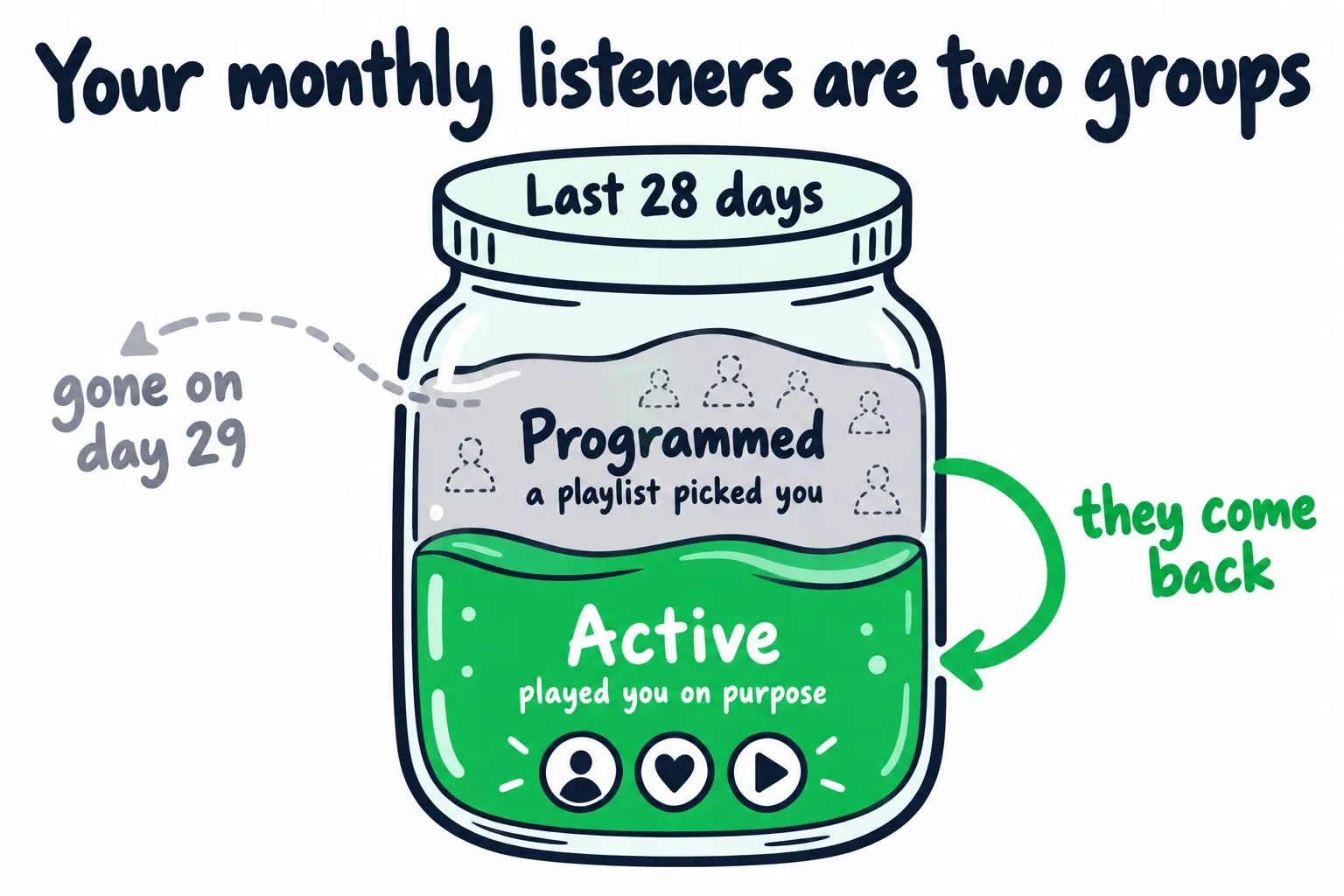
Programmed listeners fill the jar fast. Active listeners are the ones still there next month.
The active group is smaller, but it does most of the work. Spotify says monthly active listeners are about a third of an artist’s audience on average. That third drives 60% of streams and 80% of merch sales through Spotify (Spotify for Artists).
Your deepest fans sit inside that group. Super listeners play you on purpose 15 or more times in 28 days. They’re about 2% of your monthly listeners, but they drive over 18% of streams and half of your ticket sales from Spotify (Spotify for Artists).
Key takeaway
Where are your monthly listeners coming from right now?
Spotify for Artists shows you: compare your monthly active listeners with the total, then check where each song’s streams come from. Do it before you spend another dollar. It takes about 15 minutes and shows how much of your number is rented.
Pull these five numbers for the last 28 days:
- Monthly listeners and monthly active listeners. Divide active by total. That’s your active share.
- Your super, moderate, and light listener split. Our audience segments guide shows where to find it.
- Source of streams for your top three songs. Note how much comes from active sources versus playlists and Radio.
- Streams per listener for each song. Divide the song’s streams by its listeners.
- Saves per listener for each song. Divide its saves by its listeners.
Now match what you see:
| What you see | What it means | What to do next |
|---|---|---|
| Big total, active share under 10% | Most of your number is rented from playlists or algorithms | Send new traffic to your profile or “This Is” playlist, and plan a release inside 28 days |
| Radio and Autoplay lead, follows stay flat | The algorithm pushes the song, but listeners don’t know who made it | Put a second song in front of those listeners and give them a reason to follow |
| Small total, high active share | Real fans, not enough reach | Buy targeted reach: ads, Showcase or Marquee, collabs |
| One song brings 70% or more of your streams | One song carries the profile | Feed that song and build a path from it into the rest of your catalog |
| A song gets under 1.5 streams per listener | People hear it once and move on | Change the audience or the song before you spend more |
| Listeners pile up in countries you never targeted | Some source is sending traffic you didn’t choose | Check the source, and read our artificial streaming guide if it looks wrong |
The cutoffs in that table are starting points, not Spotify rules. Compare against your own last three months before you act on any of them.
For streams per listener, artists who post their Spotify for Artists data in music marketing forums share a common rule of thumb: under 1.5 over 28 days is a warning sign, and around 2 or higher is healthy. Use it to rank your own songs. A 7-minute ambient track and a 2-minute rap song will never score the same.
Picture an artist with 60,000 monthly listeners and 6,000 active ones. That’s a 10% active share. The headline number looks like a mid-size act. The active number looks like a strong local one. Plan around the second number.
If you want a second set of eyes on these numbers, get a free Spotify audit.
Which song should you use to win new listeners?
Use the song strangers save and replay, even if another song has bigger numbers. A song that new people save and replay grows your active listeners. A song that gets one passive play doesn’t.
Compare your songs over the same 28 days:
| Song | Listeners | Streams per listener | Saves per listener | Use it as the entry song? |
|---|---|---|---|---|
| Song A (your biggest) | 9,800 | 1.3 | 3% | No |
| Song B | 2,100 | 2.6 | 11% | Yes, new people come back to it |
| Song C | 3,400 | 1.9 | 6% | Test it with a second audience |
Example numbers to show the method.
Song A looks like the obvious pick. But most of its listeners heard it once and moved on. Song B has fewer listeners and a stronger pull, so every new person you send there is more likely to stay.
Once you’ve picked the entry song, send people where their plays count as active: your profile or your “This Is” playlist. Both lead straight into more of your catalog. A playlist you build yourself isn’t on Spotify’s list of active sources, so plays there count as programmed.
Point your Artist Pick at the same song or playlist during the push. Someone who taps through from an ad should land on the music the ad promised.
How do you bring in new listeners without renting them?
Pick each source by how many listeners it leaves behind. Every source adds monthly listeners. Only some of them turn into people who come back.
| Source | Counts as | Cost | How long they stay | Use it for |
|---|---|---|---|---|
| Editorial playlists | Programmed | Free pitch, low odds | While you’re on the playlist | A big reach test |
| Other listeners’ playlists | Programmed | Time or money | While you’re on the playlist | Testing fit with a niche crowd |
| Radio, Autoplay, Mixes, Discover Weekly | Programmed | Earned. Discovery Mode (30% cut) covers Radio, Autoplay, and Mixes only | While listeners keep saving and replaying | Scaling a song that already proved itself |
| Release Radar | Programmed, sent to followers | Free | Up to 4 weeks per song | Waking up people who already follow |
| Ads that land on your profile, “This Is” playlist, or release page | Active, when they play from there | Per click | As long as they save, follow, and return | New, targeted listeners |
| Collabs | Depends on where fans play it | Your time and a split | As long as the other artist’s fans stay curious | Borrowed trust from a close match |
| Live shows | Active, once they look you up | Your time | Longest | Super listeners in one city |
Targeted ads: aim them at a source you keep
Ads are the one source you can aim at a specific crowd and switch on any day. The trap is paying for clicks that never turn into plays.
One house producer shared a full year of Meta ad results. The producer went from about 200 monthly listeners to a 16,000 peak. Most of the $7,000 budget went to two ads at around $0.11 per click, all sent to the producer’s “This Is” playlist. Two songs reached Discover Weekly.
Then the ads went off. Daily streams fell by only 300 to 400, and monthly listeners settled at 12,000 instead of crashing. That floor, the count you hold when nothing is pushing, came from people who saved the playlist and from the algorithm still pushing two songs.
The same post shows the limits. Spotify paid about $600 in royalties. Ads for later songs never worked as well, and more budget didn’t buy more streams.
The ads bought listeners, data, and a start with the algorithm, but they never paid for themselves in royalties. Plan ad money as an investment in audience, and check the math first with our Meta ads for Spotify calculator.
Four things decide whether an ad grows the group you keep:
- Where the click lands. A profile, release page, or “This Is” playlist makes the play an active one.
- What the ad optimizes for. Meta can’t track anything inside Spotify. Send ads to a landing page that records the click through to Spotify, and optimize for that event. When the producer above skipped the landing page and linked straight to Spotify, playlist follows fell from 30 to 40 a day to 1 or 2.
- What the ad tool counts. A Meta “result” is usually a click on a landing page, not a Spotify stream. Artists often report dozens of results and a handful of plays. Trust Spotify for Artists, not the ad dashboard.
- Where the budget drifts. Ad tools chase the cheapest clicks, which can mean countries you never meant to reach. Split audiences by country so you can see who stayed.
For a side-by-side of the two big paid options, read Meta ads vs playlist pitching.
Playlists: judge the add by what’s left after it ends
A playlist add is programmed reach. It pays off when some of those listeners follow, save, or open your profile. If they don’t, your number drops 28 days after the playlist moves on.
Our guide on how to get on Spotify playlists covers finding curators who play your sound and reading an add like a campaign.
Collabs and shows: borrow trust you can keep
A feature with a close match puts you in front of fans who already trust that artist’s taste. Plan who posts what, and when, in your collab release plan.
Shows are slower, but they stick. Put a QR code on the merch table that opens your artist profile, not a single song. A week later, check your top cities in Spotify for Artists to see whether the room turned into listeners.
How do you get Spotify’s algorithm to send you more listeners?
Spotify recommends songs that people play, save, and don’t skip. Its own recommendations page names searching, listening, skipping, and saving as the actions that shape what each listener hears next.
So treat the algorithm as the last step of a loop:
- Send the right people to one strong entry song.
- They save and replay it, ideally from sources that count as active.
- Radio, Autoplay, Mixes, and Discover Weekly test it with similar listeners.
- You release again before the 28 days run out, and Release Radar puts the new song in front of your followers.
Cheap clicks break step two. If paid traffic skips after a few seconds, you’re teaching Spotify the song isn’t for that crowd.
Algorithmic support can also shift without warning. Artists regularly report Radio or Discover Weekly streams falling hard within a few days. A bigger active share is your insurance, because those listeners don’t depend on a playlist.
If that already happened to you, our guide to algorithmic streams dropping walks through what to check. For release week, use the Spotify algorithm launch playbook and our guide to Spotify algorithmic playlists.
Which Spotify tools unlock as your listeners grow?
Showcase opens at 1,000 streams in a market, Countdown Pages at 3,000 active listeners, Marquee at 5,000 active listeners in a market, and Discovery Mode at 25,000 monthly listeners. Knowing the levels tells you which tool you can use today, and which number to grow next.
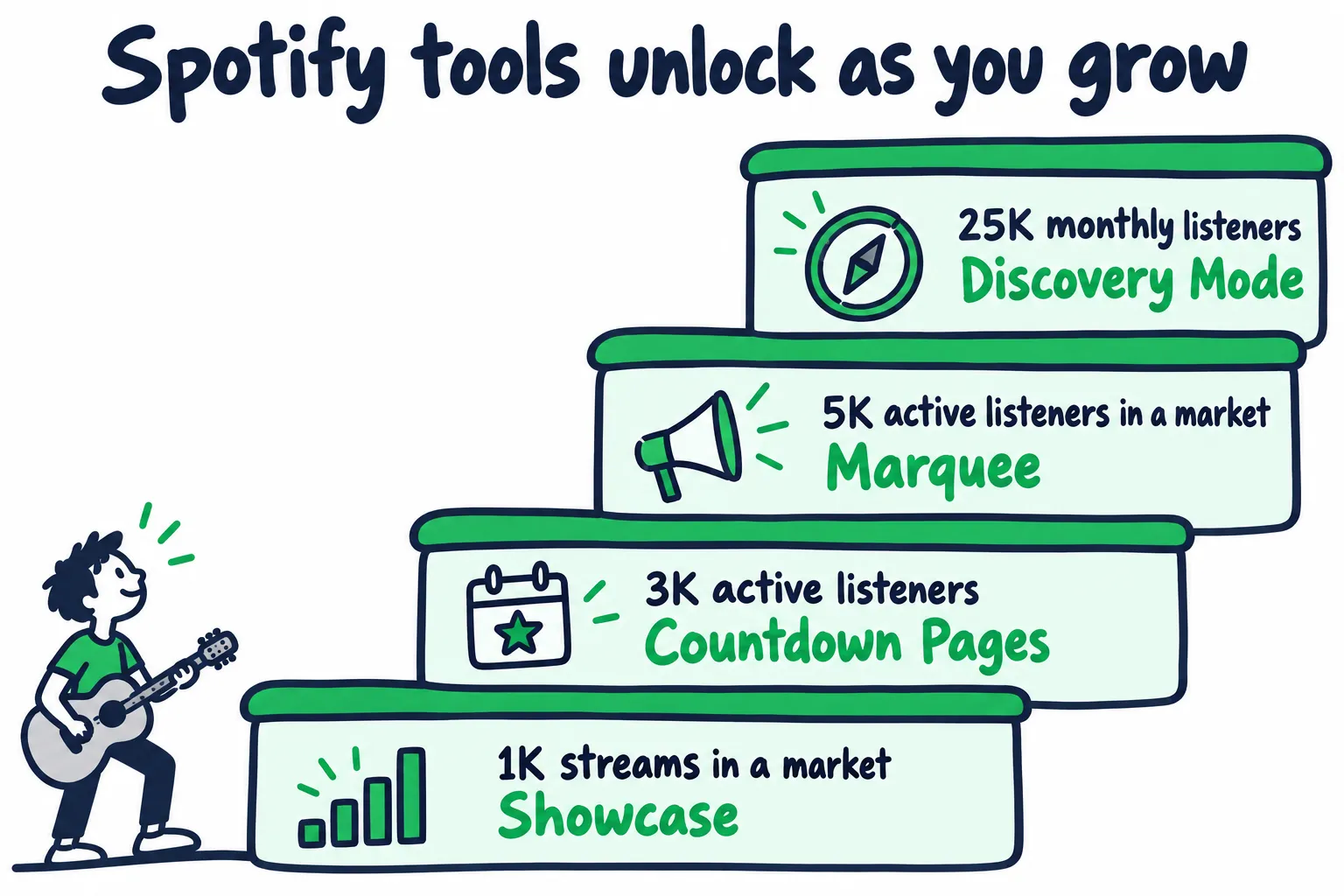
Two of these steps count active listeners, not your public number.
| What you need | What it unlocks | What to know |
|---|---|---|
| Any artist profile | Pitching to editors | Pitch at least 7 days before release. Followers get the pitched song in Release Radar |
| 1,000 streams in the last 28 days in a target market | Showcase | Paid per click, and saves count as clicks. Budgets run $100 to $10,000. Spotify says Showcase on a catalog release drives 4.8x more active streams on average |
| 3,000 monthly active listeners | Countdown Pages | Albums and EPs only. Nearly 60% of pre-savers stream the album in week one |
| 5,000 monthly active listeners in the target market, plus the 1,000 streams | Marquee | A full-screen pop-up on Home for a new release, shown to listeners most likely to stream it |
| 25,000 monthly listeners and 3 eligible songs | Discovery Mode | A 30% commission on streams in Radio, Autoplay, and Mixes. Each song must be out 30+ days, have 20+ streams in those contexts in the last 28 days, meet Spotify’s monetization rules, and come through a supported distributor (Spotify) |
Countdown Pages and Marquee count active listeners. An artist with 30,000 monthly listeners and 2,000 active ones can’t use either. Growing the active group is how you climb.
Showcase and Marquee also look at one market at a time. Both need 1,000 streams in at least one market you target, and Marquee needs 5,000 active listeners in that market (Spotify). Spreading a small ad budget across ten countries can leave you short in all of them. Focusing tests on one or two countries gets you there faster.
Discovery Mode is the one step gated on your total. Spotify notes that some distributors may offer it outside Spotify for Artists, so ask yours if you’re under 25,000. It can lift reach fast. One shoegaze artist shared a month of results: monthly listeners went from 55,800 to 90,000, with Discovery Mode behind about 40% of streams.
Daily follows didn’t change, and super listeners didn’t rise. If you use Discovery Mode, pair it with a plan to bring those new listeners back.
How do you keep listeners from dropping off after 28 days?
Give every new listener a reason to play you again before their 28 days run out. A listener who comes back stays in the count. One who doesn’t is gone on day 29.
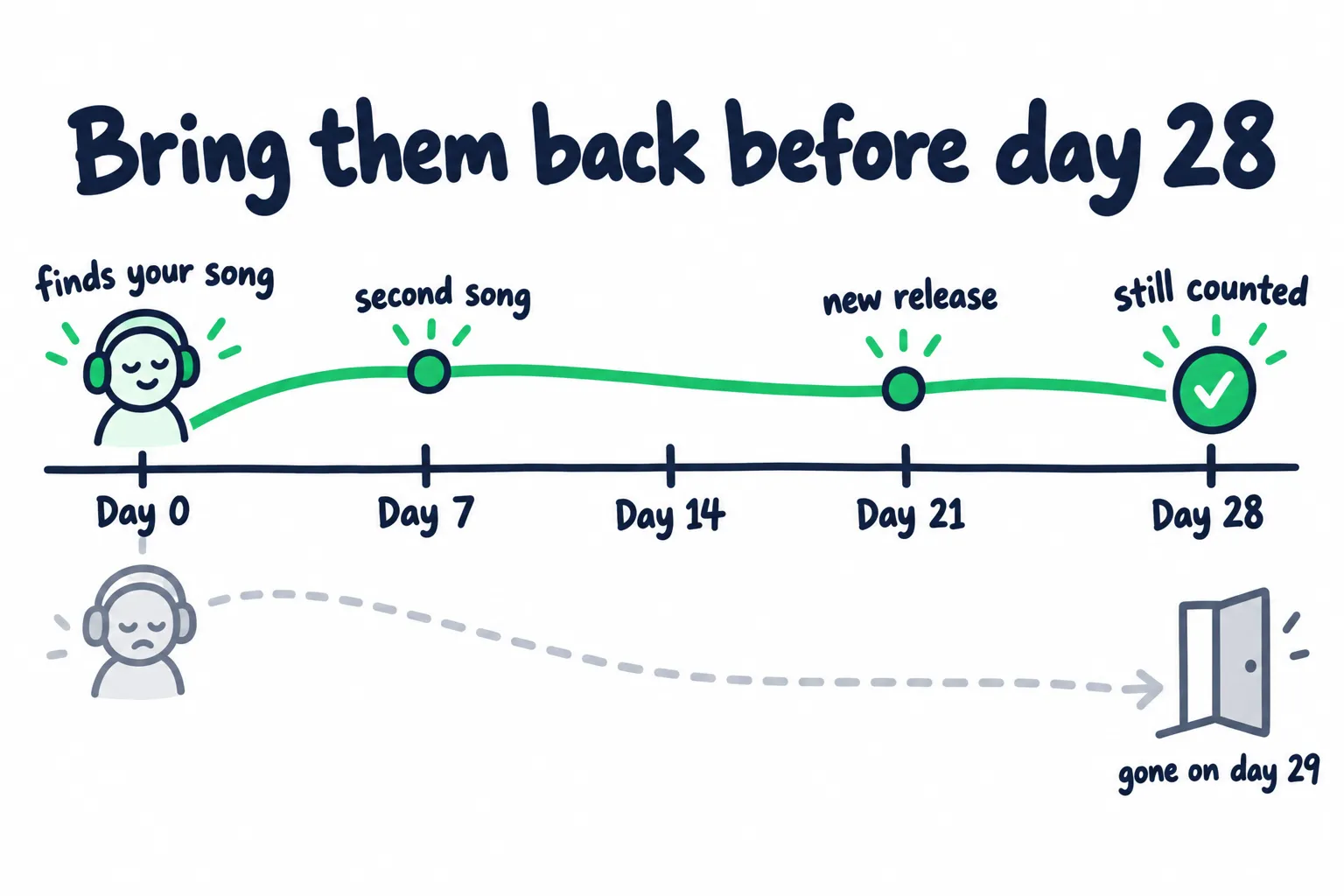
Plan at least one return moment inside every 28 days.
Build at least one return moment into every 28 days:
- Release on a pace your fans can feel. Release Radar refreshes every Friday. It gives each listener one song per artist per week, and keeps a song for up to 4 weeks if they haven’t heard it (Spotify). Releasing every 4 weeks keeps something new inside each window. If you release every 6, fill the gap with a live take, an acoustic version, or a collab.
- Turn listeners into followers. Followers get your new songs in Release Radar. Our guide on how to get followers on Spotify shows how to ask in a way that works.
- Earn saves. A saved song lives in the listener’s library, and plays from their library count as active.
- Bring people back from outside Spotify. Email, shows, and posts that open your profile all lead to active plays.
- Use a Countdown Page for your next EP or album once you pass 3,000 active listeners.
Spotify says artists see an 18% increase in super listeners after a release (Spotify for Artists). Artists who share their numbers tell the same story from both sides: steady releases built their floor, and long breaks let it slide for months.
What does a 90-day plan to grow monthly listeners look like?
Spend the first month learning, the second proving, and the third scaling what kept listeners. Here’s the plan, with a rule for each stage.
- Run the 15-minute check. Write down monthly listeners, active listeners, active share, and streams and saves per listener for your top songs.
- Pick your entry song by streams and saves per listener. Point your Artist Pick at it.
- Send paid traffic to your profile or "This Is" playlist through a landing page that tracks the click. Give each test its own country so you can read it in Spotify for Artists.
- Keep a test only if active listeners in that country rise with the total. Cut the rest and move the money.
- Release your next song inside this window, pitched at least 7 days ahead so it lands in Release Radar.
- Push your best country toward 1,000 streams in 28 days, so Showcase unlocks there.
- Run Showcase on a catalog song in the country that qualified, and put most of your ad budget behind the song and country that grew active listeners.
- Compare active listeners and your floor to day 1. If both rose, keep going. If only the total rose, start again with a different entry song.
Set the rule for spending more before you start: only add budget when active listeners grow along with the total. If the total climbs while active share falls, you’re paying for rented reach.
How to judge anyone running this for you
Running this well means watching several audiences, rotating songs, reading Spotify for Artists by country every few days, and moving money before a weak test eats the budget. If you hand that work to someone else, hold them to these checks:
- Separate audience tests by country
- More than one song in rotation
- Budget that moves toward listeners who save and follow
- Every result visible in your own Spotify for Artists
If you’d rather have it run for you, see how our Spotify promotion works.
What hurts your monthly listeners?
Anything that adds listeners who never come back, or that puts your music at risk.
Builds your floor
- Ads that land on your profile, release page, or This Is playlist
- Small tests split by audience and country
- Something new for fans inside every 28 days
- Judging results by active listeners, saves, and follows
- Adding budget only to pairs that keep listeners
Rents the number
- Services that guarantee a number of streams
- Boosted posts that count clicks as results
- Letting the ad tool chase the cheapest countries
- Huge playlists that don't fit your sound
- Paying to hold the public number up between releases
The first red flag is the expensive one. Spotify says paid services that guarantee streams aren’t legitimate, and using them can get your music removed (Spotify). Spotify can also withhold royalties and correct your public numbers.
FAQ: Getting More Monthly Listeners on Spotify
How do you get to 10,000 monthly listeners on Spotify?
Find one entry song that new listeners replay, then send targeted traffic to it in one or two countries at a time. Release something new about every 4 weeks so those listeners have a reason to come back.
Track active listeners alongside the total. If the total climbs past 10,000 while active share keeps falling, the number won’t hold once the push ends.
How many monthly listeners is good on Spotify?
There’s no single good number. Your active share tells you more than the total.
5,000 monthly listeners with 1,500 active ones is a healthier profile than 30,000 with 2,000 active. The levels that unlock Spotify’s tools make useful targets: 3,000 active listeners, 5,000 active in a market, and 25,000 total.
Should you put all your promo money behind your most popular song?
Not by default. Your most popular song is often the one people hear once on a playlist and move on from.
Put the money behind the song with the best streams and saves per listener, then make sure it leads into the rest of your catalog. If your biggest song also wins on those numbers, back it.
How long does it take to grow monthly listeners on Spotify?
You’ll see new listeners within days of an ad test or a playlist add. You won’t know whether they stayed until about 28 days later, when that first wave either comes back or drops out.
Give a plan like the one above three months: one to learn, one to prove, and one to scale what held.
Is it safe to pay for Spotify monthly listeners?
Paying for reach is fine. Paying for a guaranteed number of streams is not. Spotify can remove the streams, hold back royalties, or take your music down.
Safe options let you check who showed up: ads aimed at real audiences, Spotify’s own Showcase and Marquee campaigns, and Discovery Mode. Judge every one of them in your own Spotify for Artists.