
Meta Ads vs Playlist Pitching: Which Brings More Listeners?
A playlist add and a Meta campaign can both lift the same song. The hard part is finding out which one leaves people listening after the push ends.
The short answer
If you’re weighing Meta ads vs playlist pitching, start with what the song needs next. Meta lets you choose the clip, market, spend, and link. A playlist puts the track inside a listening session built around a sound or mood.
The better buy leaves more people choosing your music after the push ends, at a cost you can repeat. Check new saves, chosen plays, and active listeners. Cost per stream alone cannot tell you that.
Pitch an eligible new song to Spotify’s editors for free either way. Then use the paid route that fits the gap you see in your own numbers.
Who this is for
You already read Spotify for Artists. One track earns saves, one pulls listeners into older songs, and one gets a quick play and little else. You may have a manager or a small team, but the next test still comes from a real budget.
The music release checklist covers the full launch. The Spotify promotion value guide helps you decide whether paid reach makes sense at all.
What You’ll Learn
- How to find the save rate an ad must hit to beat a playlist buy
- What Spotify for Artists can show about each route, and what it cannot
- When a song is better suited to a Meta test or a playlist test
- How to run both without claiming the same saves twice
- When to scale, fix, or stop after the first push
Meta Ads vs Playlist Pitching: The Decision in One Table
| Question | Meta ads | Playlist pitching or placement |
|---|---|---|
| What do you pay for? | Ad delivery to people on Facebook or Instagram | Curator review, or a place on a named playlist, depending on the offer |
| What can you choose? | Clip, message, link, market, budget, and start date | Song, curator or list fit, and sometimes the exact playlist |
| What happens first? | A person hears a clip and chooses whether to tap | A person plays a list and your song comes on |
| What can you see fast? | Spend, ad clicks, and taps through a smart link | The live add, its date, and later playlist listening in Spotify |
| What is easy to miss? | Clicks that never turn into a play | Plays that never turn into a save or a return visit |
| What happens when you stop? | Ad delivery stops; saved songs may keep playing | The track may stay or leave the list; saved songs may keep playing |
| Best use | Scale a song and clip that already get a strong response | Put a song in a clear listening setting with a good playlist fit |
Keep free Spotify editorial pitching out of the paid comparison. Spotify’s pitch tool is free. Its release guide says to send the pitch at least two weeks before release. Our editorial playlist guide covers song choice and pitch copy.
Paid playlist offers also differ. A curator review buys a listen and a decision. A named placement tells you where the song will go. Check the offer you are buying before you compare it with an ad budget.
The $0.30 Click vs $0.02 Stream Question
A 30-cent ad click looks expensive next to a 2-cent playlist stream. At those prices, one ad click costs as much as 15 playlist streams.
But an ad click is a step toward a play. A playlist stream is already a play. Compare what each dollar buys after that first step.
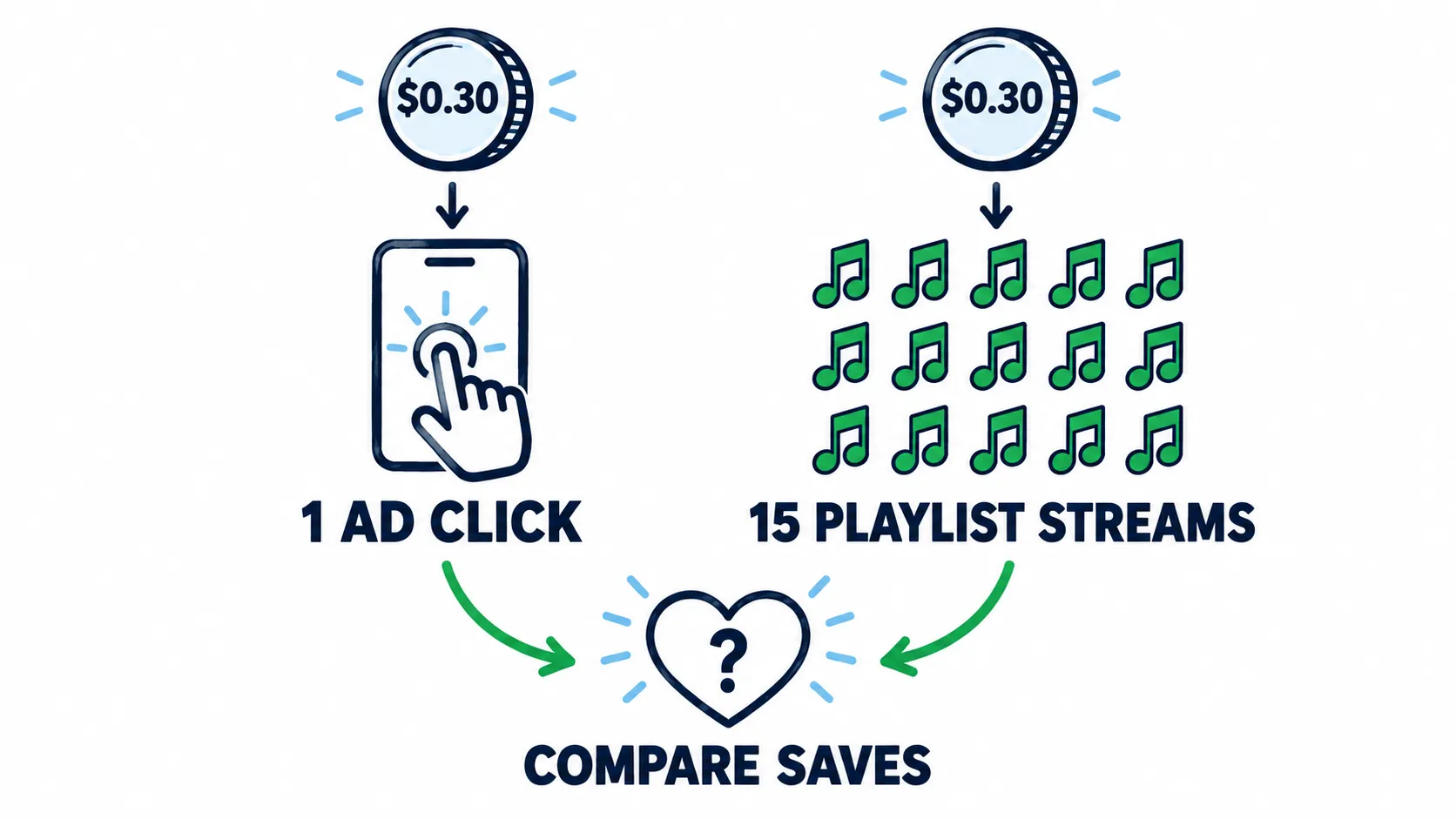
Equal spend buys different first actions. Compare the saves that follow.
Say the playlist gives you one new save for every 100 streams. At 2 cents per stream, those 100 streams cost $2. The cost per save is $2.
At 30 cents per ad click, you would need one new save for every 6.7 clicks to match that cost. That is about 15 saves per 100 paid clicks. If the ad gets fewer, the playlist wins on cost per save. If it gets more, the ad wins.
| Playlist saves per 100 streams | Playlist cost per save | Meta saves needed per 100 ad clicks to tie |
|---|---|---|
| 0.5 | $4 | 7.5 |
| 1 | $2 | 15 |
| 2 | $1 | 30 |
This is break-even math, not a forecast. Use your own prices. A 5-cent playlist stream or an 80-cent ad click changes the target.
To find your own target, divide the ad click cost by the playlist stream cost. Multiply that number by the playlist’s saves per stream. The result is the save rate your ad clicks must reach to tie.
Someone who taps your ad heard the clip and chose to go on. A playlist may play your track before the listener knows your name. So a higher save rate among ad visitors does not settle the budget call. You paid to reach everyone who saw the ad, including those who never tapped. Compare new saves with total spend.
Use new saves above your normal pace, not every save the song earned that week. Spotify counts a save when someone puts the song in their library. It does not label that save “from Meta” or “from this playlist.” If you ran both at once, treat cost per save as a rough range.
Saves may not be your main goal. A tour push may value listeners in cities you can play. An artist with three strong songs may care more about people who reach the second track. A low cost per stream can still be the wrong win for either goal.
The Meta Ads for Spotify calculator helps you set a test budget. The music promotion cost guide covers wider price ranges.
Spotify Shows Where a Play Happened, Not Who Caused It
Spotify’s Source of Streams guide shows the place inside Spotify where a song played. Other people’s playlists are one source. Your artist page, album page, and a listener’s own library are others.
A person may find you through a Meta ad, then play the song from their library next week. A person may first hear you on a curator list, then search your name and play your album. Source of Streams shows where those later plays happened, not what first brought the listener to you.
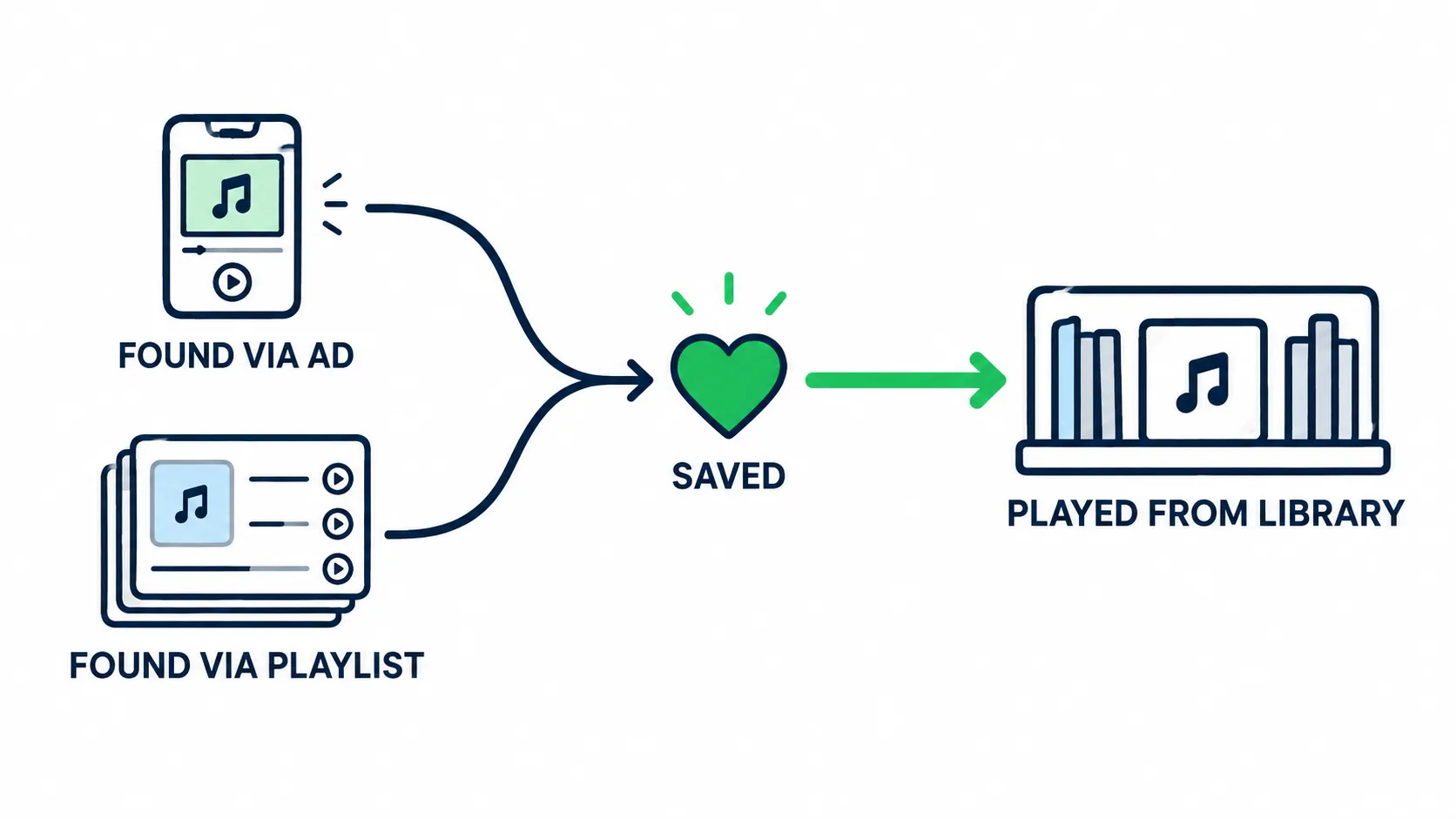
A library play can start with an ad or a playlist. Spotify shows where that later play happened.
Spotify’s Audience Segments guide adds another view. Monthly active listeners chose to play your music in the past 28 days. Programmed listeners heard it through places such as other people’s playlists, Radio, or Discover Weekly.
A new active listener is someone who entered the active group after not being active for at least two years.
The dashboard still cannot tell you which new active listener saw an ad or heard a playlist first.
| Tool | What it can prove | What it cannot prove |
|---|---|---|
| Meta Ads Manager | What you spent and which ad earned a click | That the person played or saved your song |
| Smart link | That someone tapped through toward Spotify | That Spotify counted a stream |
| Spotify for Artists | Streams, listeners, saves, and where plays happened | Which exact ad or pitch caused each save |
| Playlist link | That your track was placed on that list | That its followers played your track or became fans |
Spotify shows only the top 100 playlists for your music, and a playlist needs at least three listeners on your track to appear there. If a small new placement is missing from the dashboard, that alone does not prove it sent no real listeners. Spotify explains the limits in its playlist stats guide.
Use the dashboard to test a claim, not to force a neat story onto messy data. For a full method on source lift and overlap, see our music analytics guide.
Which Song Is Ready for Which Channel?
Before you pick a channel, check the song:
1. Has the song earned a choice already? Look for saves, personal playlist adds, repeat plays, or people moving to another track. If the song only gets first plays, more reach may only buy more first plays. The Spotify saves guide helps you read that signal.
2. Does a clip sell the same song people will hear? If two or three short posts using the track have already pulled interest from people outside your usual crowd, you have a clip worth testing in Meta. You still need a clean link. Meta’s Reels ad guide helps with the phone format.
3. Does the song belong in a specific listening moment? “Indie” is too broad. “Quiet folk for a late drive” gives you a better playlist test. Look at the songs before and after yours, the list’s recent changes, and the part of the track listeners will hear first.
4. Are the listeners in markets that matter to you? A cheap click in a faraway country can be useful if you are building a global streaming audience. It is less useful if this release needs to sell tickets in three cities.
5. What is the second song? If a listener likes the first one, make the next step easy. Set Artist Pick, check the top of your profile, and know which older track should move. A campaign that lifts one song but never touches the catalog may still be fine. Call it a song win, not an artist win.
| What you know now | Better first paid test | What would change the call |
|---|---|---|
| Strong clips, good saves, little reach outside your current fans | Meta to the exact song | Clicks rise but Spotify and saves stay flat |
| Clear mood fit, active lists in that lane, weak clip response | A small playlist test | The add sends streams but no saves or chosen plays |
| Several songs already pull listeners deeper into your catalog | Ads to a song, profile, or your own artist playlist | People follow the playlist but never play your catalog |
| Most recent growth came from other people’s playlists, while active listeners stayed flat | A direct listener test before buying more similar lists | A new list reaches a much better matched crowd |
| Strong response in a city where you can play shows | A tightly aimed ad test in that market | The cost is high and no deeper fan action follows |
Run a Test You Can Learn From
You cannot make a perfect lab out of a music release. You can avoid the mistakes that make the result unreadable.
Before the spend
Pick one focus song, one main goal, and the markets that matter. Record the song’s past 28 days in Spotify for Artists. Note daily listeners, saves, followers, active listeners, source of streams, and plays on the next two tracks in your catalog.
Write one line before you pay: “I will repeat this route if [result] improves at a cost I can keep paying.” Use your own last release as the floor. No stranger’s “good save rate” is a rule for your genre.
For Meta, choose two or three clips from the same song. Keep the destination the same while you learn which clip works. Do not split a small test across ten tiny audiences and change the creative, market, and link in the same week. You will not know what helped.
For playlists, make a short list based on song fit. Ask where the track will sit, how long the add lasts, and what recent listening the list gets. Follower count alone does not predict how your song will do. If you want to choose the exact list up front, Musicvertising Playlist Placement shows named lists and their follower counts. Each placement lasts at least 30 days. You can also start with free playlist submission.
While it runs
Log the day each ad starts and the day each playlist adds the song. Mark your own posts, shows, email, creator shares, and any editorial add. Use Spotify’s listener and follower guide to pull the same dates each time.
Check the first weak step before you touch the budget. If the ad gets taps but the smart link gets few Spotify taps, fix the link. If the link sends people through but Spotify barely moves, check the clip’s promise, the song it opens, and the countries reached. If a playlist sends plays but no one saves, look at fit before buying a bigger list.
After the spend
Review when the push ends. Review again 28 days later, after paid reach has slowed. Compare the song with its own starting pace. Check whether active listeners and plays on older songs held up. If another big event happened in the window, say so.
Never add saves, followers, and active listeners into one “fans gained” total. The same person can appear in all three. Pick one main result and use the others to see if the story makes sense.
What the Result Is Telling You
| What you see | Likely issue | Next move |
|---|---|---|
| Cheap Meta clicks, few taps through to Spotify | The link page may slow people down, or its message may differ from the ad | Test the full path on a phone; change one step |
| Plenty of taps to Spotify, little lift on the song | The audience or clip drew curiosity but not listening | Check market and song match before raising spend |
| Playlist streams jump, saves and active listeners stay flat | The list may fit the mood but not pull people toward the artist | Try a tighter list or a different lead track |
| Modest stream lift, but saves and older songs move | Fewer people came in, but more chose to stay | Compare the cost with your last test before scaling |
| Results are strong in cheap markets you cannot use for this goal | The ad reached cheap listeners outside the markets you need | Move the next test to the markets tied to your goal |
| Ads, playlists, and a viral Reel all hit together | You have a good combined result but no clean channel split | Stagger the next test if the split matters |
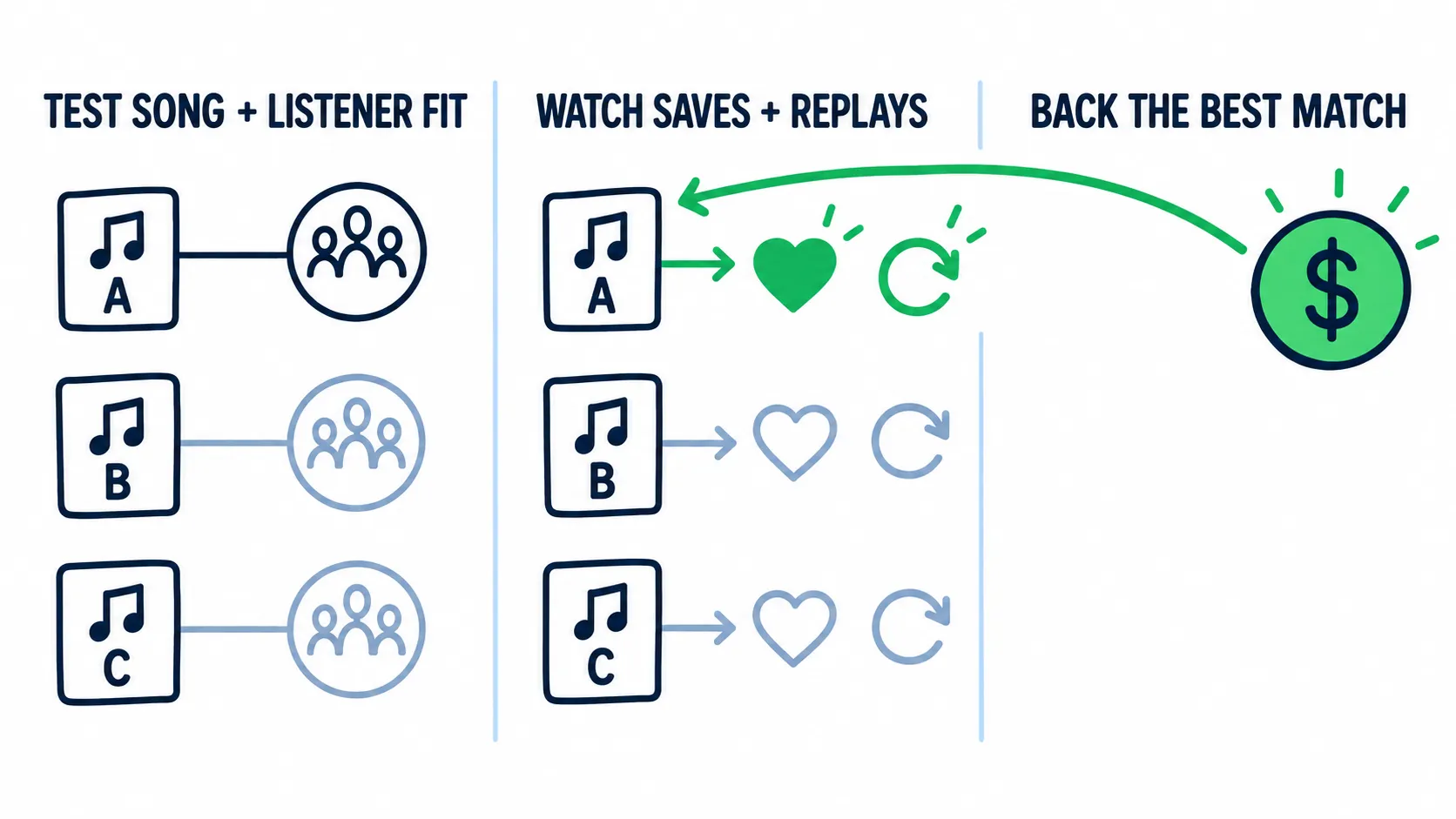
Across later tests, back the song and listener match that earns saves and repeat plays.
Do not chase an exact “algorithm trigger” number. Spotify can show you how listeners acted. It does not give artists a save rate that guarantees Discover Weekly. Build the next campaign from the actions you can see.
When Both Belong in the Release Plan
Send the free editorial pitch at least two weeks before release. Then pick one paid route as the main test.
If a clip has already proved it can pull people into the song, use Meta to extend that reach. Add a playlist if the track fits the songs around it. If the song has a clear playlist fit but the clips have not worked, test the playlist first. A strong response gives you a reason to make better creative for an ad.
You can run both at once when reach matters more than learning which channel won. Write down the dates and call it a combined push. If you need to know where the next dollar goes, give each route a clearer window or market. Our Spotify algorithm launch playbook covers the wider release sequence.
Key takeaway
The same test-and-shift idea can work across a catalog. Musicvertising Spotify Promotion uses mobile ads to test songs, then shifts budget toward listeners who keep listening. It runs outside Meta.
FAQ
At 30 cents per ad click and 2 cents per playlist stream, how can Meta win?
At those prices, Meta needs 15 times as many saves per paid click as the playlist gets per paid stream to tie on cost per save. If the playlist gets one save per 100 streams, Meta needs 15 per 100 clicks. Put your real costs and added saves into that math before you spend again.
Why do smart link clicks not match Spotify streams?
A tap to Spotify is not a counted play. People can leave while the app opens, land on the wrong track, or decide not to listen. Check the same dates and countries in Meta, the link tool, and Spotify for Artists. Then tap your own ad on a phone.
My playlist sent thousands of streams. Why did active listeners stay flat?
The track may have played in a session someone else chose. That is programmed listening in Spotify’s source data. Some listeners may save it and return from their library later, so check after the placement has had time to work. If saves, chosen plays, and older songs stay flat, a bigger list of the same kind may buy a bigger spike without a stronger audience.
Do ad driven streams keep growing after I pause the campaign?
Sometimes, if listeners save the song and return. Check the song 28 days after the ads stop, then look again at a later release. Compare active listeners, library plays, follows, and catalog plays with the pace before the ads. The monthly listeners guide explains why the public count can drop while some fans stay.
Should my Meta ad lead to one song or my own playlist?
Match the destination to the ad. A clip built around one chorus should open that track. An ad that promises a mood or a short trip through your sound may work better with your own playlist. Put your songs near the start and watch whether listeners play them. A follow on your playlist is not the same as a follow on your artist profile.
Choose the song, market, and result first. Then buy the route that gives that song its best shot.