
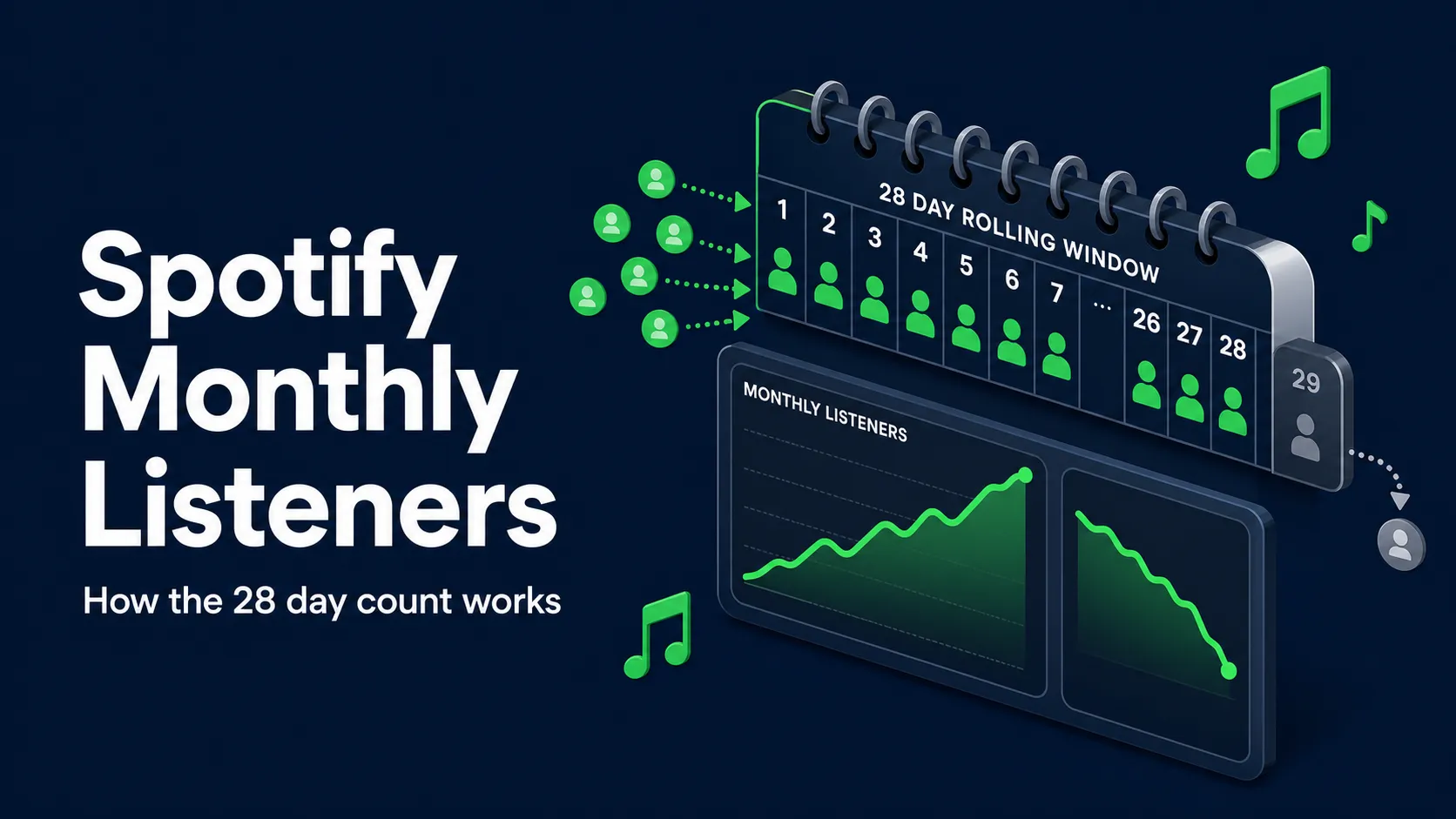
Spotify Monthly Listeners: How the 28 Day Count Really Works
Spotify monthly listeners are a rolling count of who listened to you in the last 28 days. Once you understand that, the number gets a lot less scary.
An artist might run a campaign, jump from 800 monthly listeners to 6,000, feel great for a few weeks, then see the number drop. That drop can feel like something went wrong, but most of the time nothing broke. Spotify is moving the 28 day window forward.
The simple version
Picture monthly listeners as a room that only holds people who listened in the last 28 days. Every day, new people can walk in through the front door. People who have not listened again in more than 28 days walk out the back.
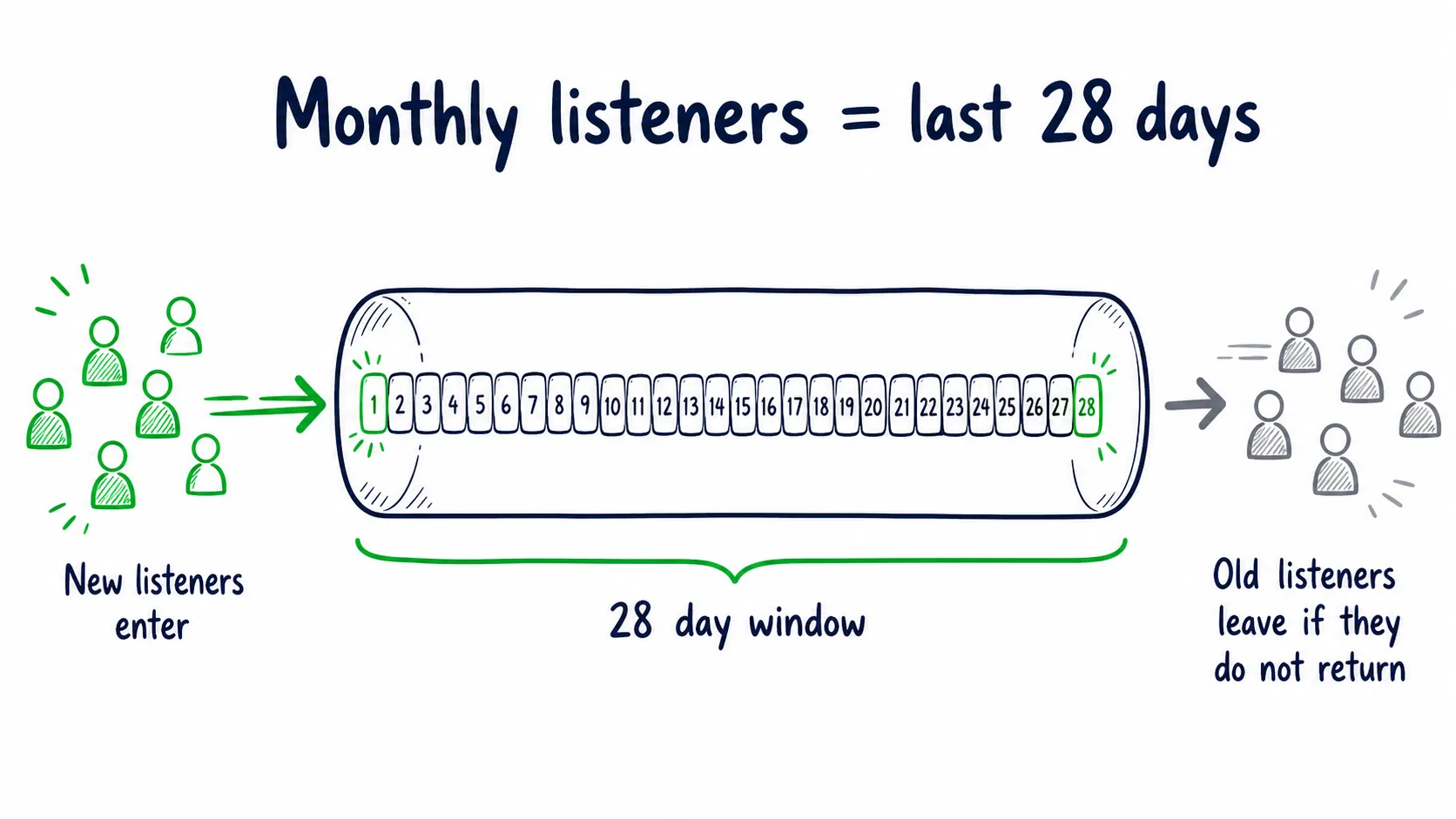
The number moves because the window moves.
Spotify updates monthly listeners every day, so your number can go up, down, or stay flat from one day to the next. It does not track lifetime fans, your total audience, or streams. It only counts how many different people listened to you recently.
What You’ll Learn
- What Spotify monthly listeners count.
- Why the number can drop even after a real campaign.
- Why one listener can create many streams but still count once.
- How the 28 day rolling window works in plain English.
- How to stop panicking when the public number drops.
- What to check before you call a spike good or bad.
- How monthly listeners connect to saves, followers, and promotion quality.
The quick answer
A Spotify monthly listener is one unique person who played your music during the most recent 28 days.
If one person plays your song once, that is one monthly listener. If that same person plays your song 40 times, that is still one monthly listener. The extra plays count as streams.
So monthly listeners and streams can tell two different stories. Monthly listeners show reach. Streams show listening volume. Followers show people who chose to stay connected to your artist profile.
If you want a bigger breakdown of those differences, read our guide on Spotify followers or listeners. This post is only about the monthly listener number and why it moves the way it does.
What are Spotify monthly listeners?
Spotify explains listener and follower stats in its official Spotify for Artists listener stats guide.
Spotify monthly listeners are the number of different people who listened to you in the last 28 days.
The count is people. Plays and streams are tracked separately.So if your song gets 1,000 streams, that does not mean you had 1,000 monthly listeners. It depends on how many people created those streams.
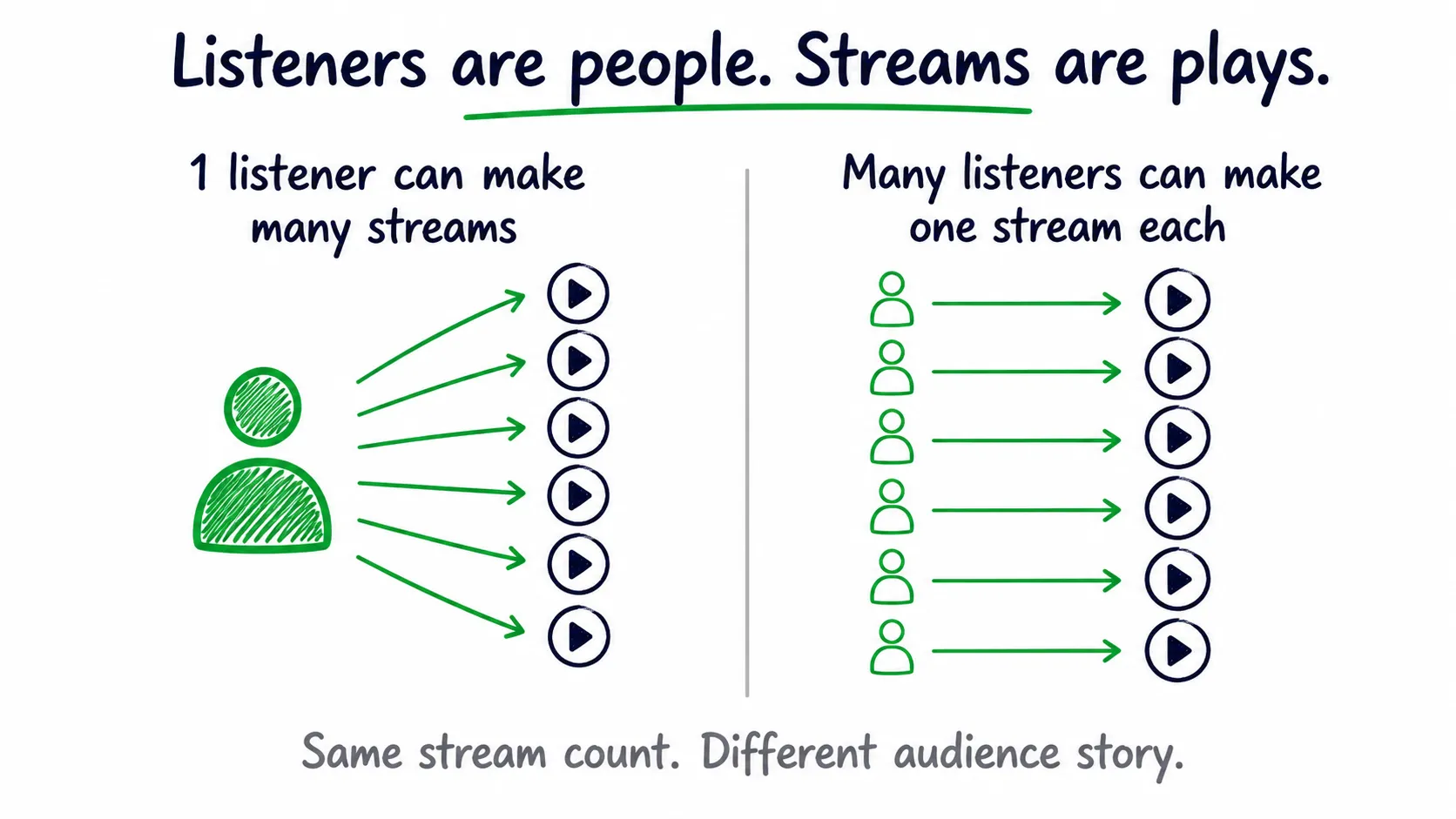
The same stream count can come from one listener or from many.
| What happened | Monthly listeners | Streams | What it means |
|---|---|---|---|
| 1 person played your song 20 times | 1 | 20 | One person kept coming back |
| 20 people played your song once | 20 | 20 | More people heard it, but nobody replayed yet |
| 20 people played 5 tracks each | 20 | 100 | People explored more of your music |
Spotify has a separate official page on how streams are counted, because streams and listeners are different metrics.
If your monthly listeners rise, more different people heard your music recently. That is good, but it does not automatically mean those people became fans. Some may have loved the song. Some may have heard it once on a playlist and moved on. Never judge your growth from monthly listeners alone.
Key takeaway
How the 28 day rolling window works
The easiest way to understand Spotify monthly listeners is to forget the word monthly for a second. It means recent, not January, February, March.
Spotify is always looking at the most recent 28 days. Each day, that window moves forward by one day. The new count adds that day’s listeners and drops anyone whose last listen is now more than 28 days old.
Key takeaway
Day by day, it looks like this:
| Day | Who gets added | Who can leave | Why the number moves |
|---|---|---|---|
| Today | People who listened today | People who last listened 29 days ago | More people in than out means the number rises |
| Tomorrow | People who listen tomorrow | People from the oldest day in the old window | More people out than in means the number drops |
| Every day | New unique listeners | Old unique listeners who did not return | The window keeps sliding forward |
This is why an artist can say, “My monthly listeners reset,” even though Spotify is not doing a hard reset. What usually happened:
- A playlist, ad campaign, social post, or release brought in new people.
- Those people counted as monthly listeners.
- Some listened once and did not come back.
- After more than 28 days, those people aged out of the count.
- The public number dropped.
That drop is normal. It can still feel rough to watch, but the count is doing what it is supposed to do.
Why monthly listeners drop after promotion
Promotion often gives artists a quick lift in monthly listeners. That lift can come from ads, playlists, social content, Spotify Radio, Autoplay, Release Radar, Discover Weekly, search, or your artist profile.
The lift is real if real people listened, but it may not last at the same level.
Some listeners will save the song. Some will follow you or play another track. Some will do nothing and never come back. All of those people can raise your monthly listeners at first, but only the ones who listen again stay in the count after the window moves.
So instead of asking why the number dropped, check what the spike left behind:
- Did your saves go up?
- Did your followers go up?
- Did your streams keep coming after the campaign slowed down?
- Did more people visit your profile?
- Did Spotify start sending more streams from Radio, Autoplay, Release Radar, or other algorithmic sources?
Spotify explains stream source categories in its official source of streams guide. Check that source data after every spike.
If a spike came from one playlist and then vanished, it was probably mostly temporary reach. If it led to more saves, followers, repeat streams, and healthier sources, it probably did more for your career.
A smart Spotify promotion plan cares about listener quality, not a big screenshot. Judge any campaign by whether every result shows up in your own Spotify for Artists, where you can read the sources, saves, and follows yourself.
Monthly listeners vs streams vs followers
Artists get stuck when they treat one number like it explains everything. Each metric has a different job.
| Metric | What it means | What it does not prove | How to use it |
|---|---|---|---|
| Monthly listeners | Different people who heard you recently | That they became fans | Use it to measure reach |
| Streams | Total plays your music earned | How many people listened | Use it to measure listening activity |
| Followers | People who followed your artist profile | That they will hear every new release | Use it to measure connection |
| Saves | People kept a track in their library | That the song has enough reach yet | Use it to measure song interest |
High monthly listeners and low streams per listener usually means lots of people heard the music once. Lower monthly listeners and higher streams per listener can mean fewer people, but stronger interest.
High monthly listeners with saves, followers, and repeat streams is the best pattern, because it means some people are coming back.
Spotify also has an official page on audience segments, including active listeners and super listeners. Those numbers can tell you more about real fan depth than the public monthly listener number.
How to check if a listener spike was actually useful
Do this after a campaign, playlist add, or viral moment. It only takes a few minutes.
Step 1: Write down the dates
Write down when the campaign started and when the spike started. Then look about 28 days after the first big jump. That is when some early listeners may start leaving the count, so a drop around that date will not catch you off guard.
Step 2: Compare listeners and streams
If listeners jumped but streams barely moved, many people may have listened once. If streams rose much more than listeners, people were replaying or checking more songs.
Neither result is automatically good or bad. You need to know which one happened.
Step 3: Check saves and followers
Monthly listeners tell you who showed up. Saves and follows tell you who cared enough to take a small extra step.
If those numbers did not move at all, the traffic may not have been a strong fit. If they moved with the listener spike, that is a healthier sign.
Step 4: Check where streams came from
Open Spotify for Artists and look at stream sources. If most streams came from one passive playlist, the spike may fade fast. If streams also came from profile, listener library, search, Radio, Autoplay, and personalized playlists, the result is stronger.
Write down which song and which countries picked up the saves and follows. That note carries into your next release, so it starts with a warmer audience instead of from zero.
For more on those algorithmic sources, read our guide to Spotify algorithmic playlists and our Spotify algorithm launch playbook.
Step 5: Look at your new floor
Do not only compare today to the peak. That will make every campaign look disappointing. Compare today to where you were before the campaign.
If you started at 500 monthly listeners, peaked at 5,000, then settled at 1,200, you still raised the floor.
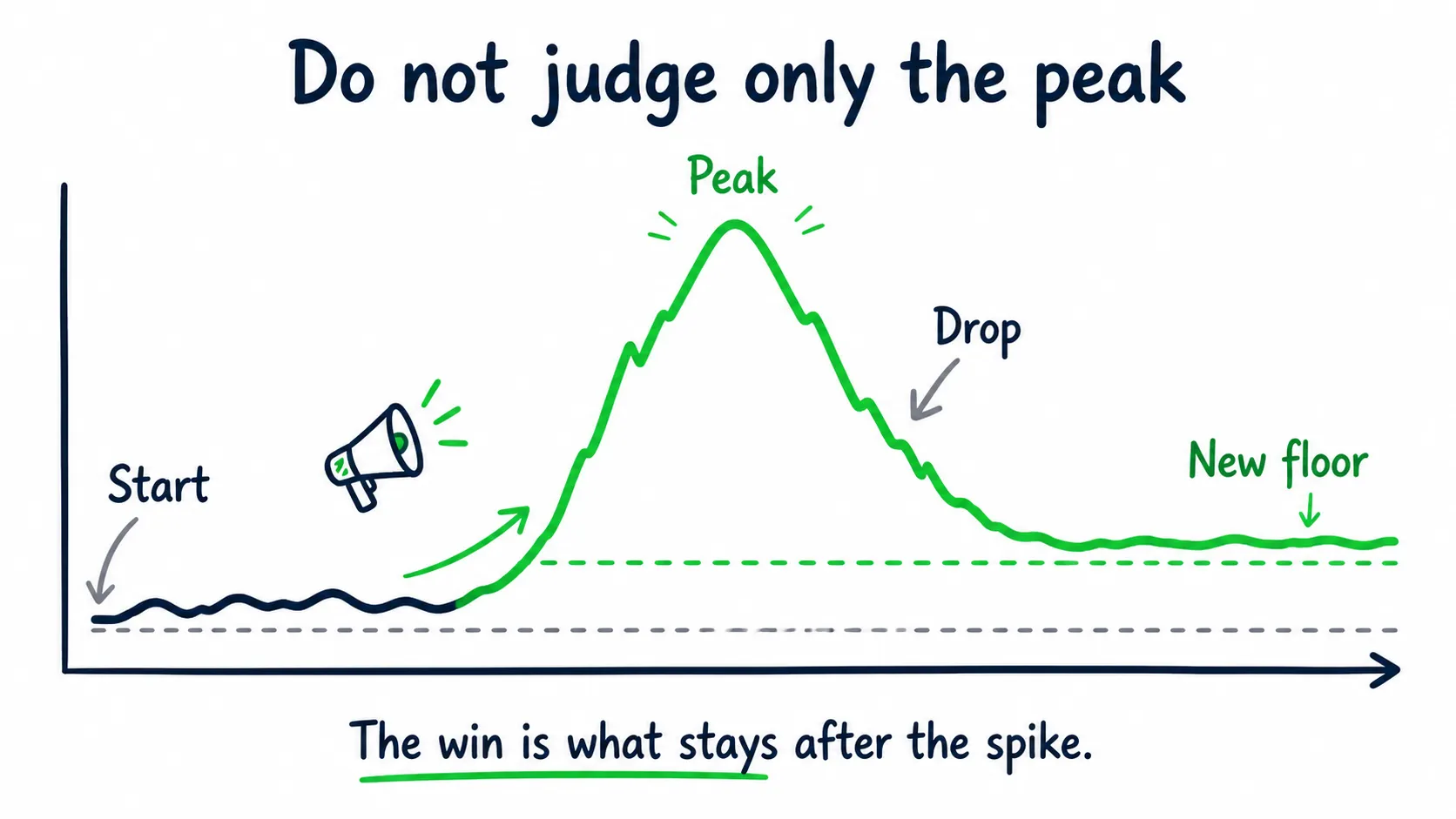
Judge the campaign by what stays after the spike.
What healthy monthly listener growth looks like
Healthy growth does not mean the number goes up every day. Even good campaigns rise, dip, and settle. Aim for better reach that brings better listeners, not a perfect line.
Good Signs
- Monthly listeners rise with saves, follows, and repeat streams.
- Streams come from more than one source.
- Your listener floor is higher after the campaign.
- New releases perform better than before.
- You see more active listeners inside Spotify for Artists.
Bad Signs
- Monthly listeners spike, then disappear with no saves.
- Streams mostly come from one weak source.
- Followers stay flat after a big listener jump.
- Your next release gets no benefit from the past campaign.
- You keep paying only to keep the public number high.
Playlist quality shows up here. A good playlist can introduce the right people to your music. A weak playlist can make the number look good for a few weeks and then leave nothing behind.
If playlisting is part of your plan, choose placements that can reach the right listeners. You can compare that with our playlist placement options, or start smaller with free playlist submission.
If you want to understand what curator quality should look like, see how to vet curators in our playlist guide.
How promotion changes monthly listeners
Promotion can raise monthly listeners because it puts your music in front of more people. The problem starts when artists expect every new listener to become a long term fan.
Most people will hear a song once and move on. Some will stick, and your job is to find more of them.
Good promotion does three things:
- It reaches people who already like music close to yours.
- It gives them a clear reason to press play.
- It creates real listening signals you can learn from.
Bad promotion only chases the public number. A spike bought with a fixed stream package can make the profile look busy for a few weeks, then age out of the window with nothing underneath. Listeners who save and follow keep showing up inside the 28 days, so they hold your floor.
If you promote a release, do not buy attention just to keep monthly listeners high. Use promotion to find people who might save, follow, replay, and come back.
The practical way to do that is to move budget. Run ads to a few separate listener groups, then shift spend toward the groups and tracks that save, follow, and replay, and away from groups that only tap once. Testing groups, reading what stayed, and moving money toward it is the core of the audience intelligence loop.
You can test this yourself on a small budget. Build two or three ad audiences, each around one similar artist, and give each group its own country so you can tell them apart in Spotify for Artists. Rotate two of your tracks. After 7 days, compare new listeners by country against what you spent on each, and check that saves and follows moved with them. After 28 days, check which country still shows listeners, because that is the group that stayed. Doing this at scale means running many audience pockets at once, shifting budget daily, and rotating tracks as the data comes in.
That is the kind of growth worth paying for. Look for promotion that moves budget toward listeners who save and follow, tests more than one track, and shows every result in your own Spotify for Artists.
For release planning, our guides on Spotify Release Radar and Spotify editorial playlists explain how to connect reach with better rollout timing.
Spotify also explains Release Radar on its own site, which is useful because followers and likely listeners can affect how new music gets surfaced.
What to do when your monthly listeners drop
First, do not panic.
Then look for what stayed after the spike: saves, followers, repeat streams, better sources, and a higher listener floor. The peak shows how many people your song reached. The drop shows how many did not come back yet.
Reading it this way keeps you honest about the drop without treating it like a failure. It also helps you plan a better next move.
If nothing stayed, the issue may be traffic quality, song fit, playlist fit, ad targeting, or release strategy. If something stayed, you have clues you can build on.
Should you worry when monthly listeners go down?
Not always. Worry if monthly listeners drop and every other signal is weak too. That means the traffic probably did not stick.
Worry less if monthly listeners drop after a spike, but saves, follows, repeat streams, active listeners, or your listener floor improved. That means the campaign may have done its job.
Monthly listeners are useful. They help with social proof, show that your music is reaching people, and can make your artist profile look alive. On their own, they do not show whether those people will come back.
If you are not sure what your Spotify data is saying, start with a free Spotify audit before spending more money. Understand the profile first instead of buying more short term reach.
FAQ
Do Spotify monthly listeners reset every month?
No. Spotify monthly listeners do not reset on the first day of the calendar month. They update every day through a rolling 28 day window.
New listeners can enter the count each day. Older listeners can leave if they have not listened again inside the current 28 days.
Why did my Spotify monthly listeners drop after promotion?
They likely dropped because the first listeners from the campaign aged out of the 28 day window. That is normal.
What counts is whether the campaign left behind saves, followers, repeat streams, profile visits, and a higher listener floor.
Can one person count as multiple monthly listeners?
No. One person can only count as one monthly listener during the 28 day window.
If they play one song once, they count as one listener. If they play your catalog all week, they still count as one listener, but they create more streams.
Are monthly listeners more important than Spotify followers?
They measure different things. Monthly listeners show recent reach. Followers show people who chose to stay connected to your artist profile.
For real growth, you want reach from new listeners and signs that some of those listeners are coming back.
Can playlists or ads raise monthly listeners without building real fans?
Yes. Playlists and ads can raise monthly listeners by putting your music in front of more people.
That only helps long term if some of those people are a real fit. If they do not save, follow, replay, or return, the number can fall once those listeners leave the 28 day window.