
How to Get Followers on Spotify Who Want Your Next Release
A song can earn thousands of plays without giving listeners a reason to care about your next release. That gap gets expensive when you’re funding promotion, making content, and seeing the same weak follower growth each month.
The Short Answer
To get followers on Spotify, build a campaign around one question: what has this listener heard that makes the next song worth following for? Choose the audience, the music, and the follow request together. Then compare follower growth during the campaign with your usual pace.
Give The Campaign A Job
You already have releases, listener data, and proof that people like the music. Choose where to put the next push: turn interest in a strong single toward the next one, reach fans of a close collaborator, or keep a live audience listening between shows.
For metric definitions or a full profile review, use the followers versus listeners guide and artist profile guide.
What You’ll Learn
- How to choose which audience deserves the next push.
- How to sell the next release through the music fans like now.
- How to test a follow request without changing five things at once.
- How to account for the follows you already get each week.
- How to judge whether more spend is still buying useful growth.
Choose One Audience For Your Spotify Follower Campaign
Start with a group you can reach again. A large listener total doesn’t give you a contact list. Spotify for Artists shows follower counts, not individual names.
Group listeners by how much of your music they’ve heard. Someone who knows one hook needs a different reason to follow than someone who came to your show.
| Audience | What they already know | Campaign to try |
|---|---|---|
| People who just found one clip | The hook, and perhaps your face | Show enough of the song to earn interest before asking for more. |
| People who return for your music posts | Your sound across several clips | Connect the track they like to the release coming next. |
| Fans of a close collaborator | Their artist’s part in your shared track | Let that artist introduce your work, then show a solo track that fits. |
| Your email list or recent show crowd | You as an artist, beyond one recording | Give them a reason to follow on Spotify before the next release. |
Pick the group with a way to reach them, a sign they like the music, and a reason to hear more. That reason can be a new release or older tracks they haven’t found yet. A big group with no clear way to reach it may be less useful than a smaller group that keeps asking for a full song.
Suppose a funny studio clip gets ten times the views of a live performance. The live clip draws fewer comments, but people ask about the song and name other tracks they like. Start the follow push with those music fans. Test wider reach after that.
For new listeners, let the music shape the targeting. Start with the track’s sound, artists who sound like you, and places where your music already gets a response. “People who like hip hop” gives you less to work with than “fans of sparse beats and close, spoken vocals.” Use that description to choose both the listeners to reach and the song to show them.
If you use paid social, build any eligible audiences from activity on that platform or your own permitted site data. Don’t assume you can target everyone who saved your Spotify song. Spotify’s audience segments help you read listening habits; they aren’t a list of people you can load into an ad account.
Don’t Keep Spending To Ask The Same Fans
Your closest fans may already follow. If a small group has seen the request several times, another post may add little. Keep them engaged with the music, but spend your next test reaching a new group.
If the cost of more reach rises while net follows stay flat, test a fresh audience or song before adding spend.
Make The Next Release Part Of The Reason To Follow
Someone who saves a track wants to hear it again. To earn a follow, give them a reason to keep up with the artist too.
Play the song that’s drawing people in, then the next two releases you plan to promote, and listen for what carries across them. It might be the bass sound, the way you write about a breakup, or the stripped live feel. Make that connection in your posts and ads.
For a release campaign, lead with a song that represents what fans will hear next. Your biggest track may be a poor choice if it is a remix or a one-off release that sounds nothing like your next project.
You can still promote that track. Give its listeners a sample of the next one before asking them to follow for more. See whether they want to hear where you’re going. Between releases, build the same connection with two or three tracks already in your catalog.
An older track can also be the right first song for a new listener. Your acoustic song may open the door for one group, while your heavier track works for another. Let each group discover the part of your catalog most likely to hold their interest. Both can lead toward the same artist and upcoming release.
Choose The Songs For The Campaign
For one follow campaign, prepare three pieces:
- The entry track: the song or section that gets this audience’s attention.
- The second song: a track that shows the appeal holds beyond one hook.
- The next release: a real reason to stay, such as a new single, EP, or live version.
You don’t need to put all three in every ad. Use them across the campaign. One post draws people in; another shows the range they can expect; the follow request points to what comes next.
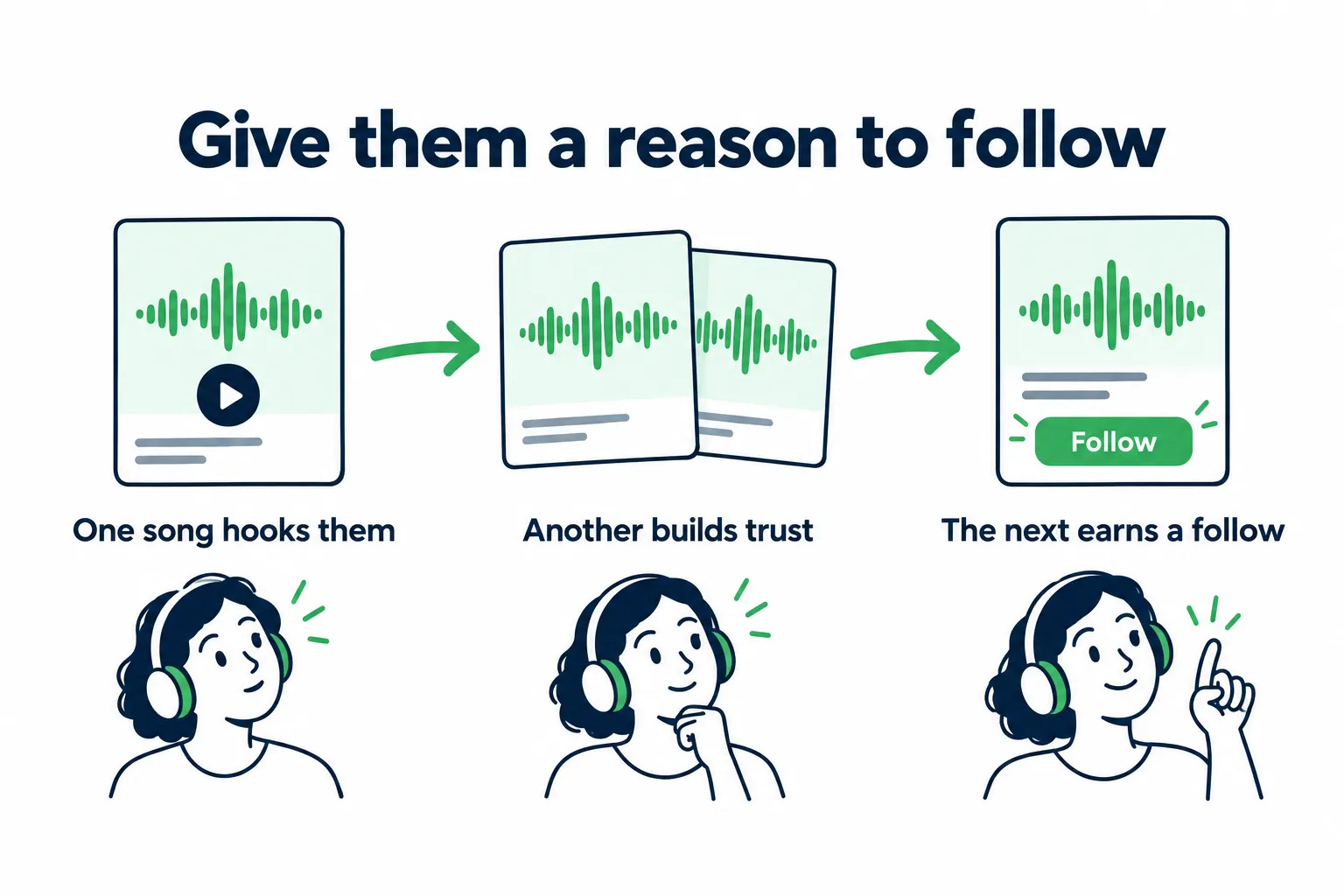
Show what carries from one song to the next so fans have a reason to follow the artist.
Make the same connection on Spotify. Artist Pick can point to the release or playlist that supports this campaign. Check Spotify’s Artist Pick options if you need to change it. The page should deliver what the post led people to expect.
Match The Follow Request To What The Fan Has Heard
When you say “Follow for more,” tell people what “more” means.
Write one sentence that names the music they liked and what comes next. Here are examples you can adapt:
| Situation | Follow request to test | What makes it worth testing |
|---|---|---|
| A live clip keeps getting song requests | “That last chorus is from ‘Night Bus.’ The next single has that same live band feel. Follow us on Spotify before it drops.” | Links interest in this performance to the next release. |
| A joint track is bringing in another artist’s fans | “If you found me through Maya’s verse on our track, try ‘After Hours.’ Follow my Spotify for the next song in that set.” | Gives listeners a way to judge your own work. |
| A release is the start of a larger project | “This is the first track from the EP. The next one picks up where it ends. Follow on Spotify to keep up with the release.” | Gives the single a place in a project fans can follow. |
| A show crowd knows one track well | “You sang that one louder than us. The full live version is coming next. Follow our Spotify to find it when it’s out.” | Builds on something the audience took part in. |
Only promise music you plan to release. A vague weekly schedule adds pressure without giving fans a better reason to follow.
Followers can find your releases in What’s New and through Release Radar. Keep promoting the release through your own channels too.
Give Collaborators A Specific Role
“Please share the track” leaves a lot to chance. For a follower push, agree on the clip, the solo song it leads to, the artist named in the caption, and the day each person posts.
Ask for an introduction that gives their fans context: why you worked together, what part you wrote, or what they like about your sound. Send a ready clip and link so they don’t have to build the post themselves.
Add those posts to your collab release plan so both artists know when they’ll introduce each other’s music.
Test The Message Before You Change The Whole Campaign
Pick a question whose answer would change what you do next. For example: does showing a second song give people more reason to follow than a direct request after one hook?
Take this fictional campaign. An artist’s live clip of “Night Bus” keeps drawing song requests. Their next single has the same band sound. They want those viewers to care about the next release, and have $420 set aside for a later follower test.
First, they make two clips to test the music sequence. Both last 20 seconds and end with the same four-second request: “More of this sound on the next single. Follow on Spotify.”
| Version | First 16 seconds | What the artist wants to learn |
|---|---|---|
| A | One strong section of “Night Bus.” | Is one song enough to earn the next step? |
| B | Eight seconds of “Night Bus,” then eight of a related track. | Does hearing more of the artist help, despite less time with the first hook? |
Keep the audience, spend, and link as close as you can. This tests the edited music sequence as a whole. It won’t tell you which second of footage caused the response.
The extra music may help, or you may lose people who loved the first hook.
Don’t split a small budget across six songs, four audiences, and three captions. You may get a lot of numbers and no clear next move. Answer the question that would change your plan most, then test the next one.
Know Which Part Of The Result You Can See
Use separate links or campaign labels to track clicks for each version where your tools allow it. Those labels show which post sent traffic. They don’t tell you who followed inside Spotify.
If A and B run at the same time, the artist’s total follower change can’t tell you which version caused it. Use the split to learn about clicks and listening interest you can measure. Then run the stronger idea in a separate test of the whole follower campaign.
For that test, use equal time windows at the same spend. Compare with your normal growth and repeat the idea in another similar window. Record releases, shows, playlist adds, and other posts. Two weeks with different release activity are not a fair comparison.
Wait for the stats to update after each test window before judging it. Spotify explains its update schedule. Don’t shut down a test because today’s count hasn’t caught up.
Check the full phone journey once before launch, including the app’s browser and any smart link. Use Spotify’s share links and send fans to what the post promised. The artist profile guide covers destination choices in depth.
Measure Follower Growth Above Your Normal Pace
If you already gain followers each day, a campaign shouldn’t get credit for all the follows during its run.
Take two or more recent weeks with roughly similar release and promo activity. Work out the net follower gain per day for each. Use the spread as a rough range for what might happen without the new test.
Avoid a baseline built from your best release week or a dead month after a long break. Neither is a fair match for an ordinary campaign week.
A Worked Example
In the fictional campaign, the artist runs the chosen clip for 14 days at a fixed budget, finishing before the single comes out. The numbers below are made up for this example.
| Item | Example |
|---|---|
| Usual growth across similar weeks | 3 to 5 net followers a day |
| Length of the new test | 14 days |
| Growth you might expect at the old pace | 42 to 70 followers |
| Net growth during the test | 126 followers |
| Growth above that rough baseline | 56 to 84 followers |
| Test spend | $420 |
| Spend divided by all net growth | $3.33 per follower |
| Spend divided by growth above baseline | About $5 to $7.50 per extra follower |
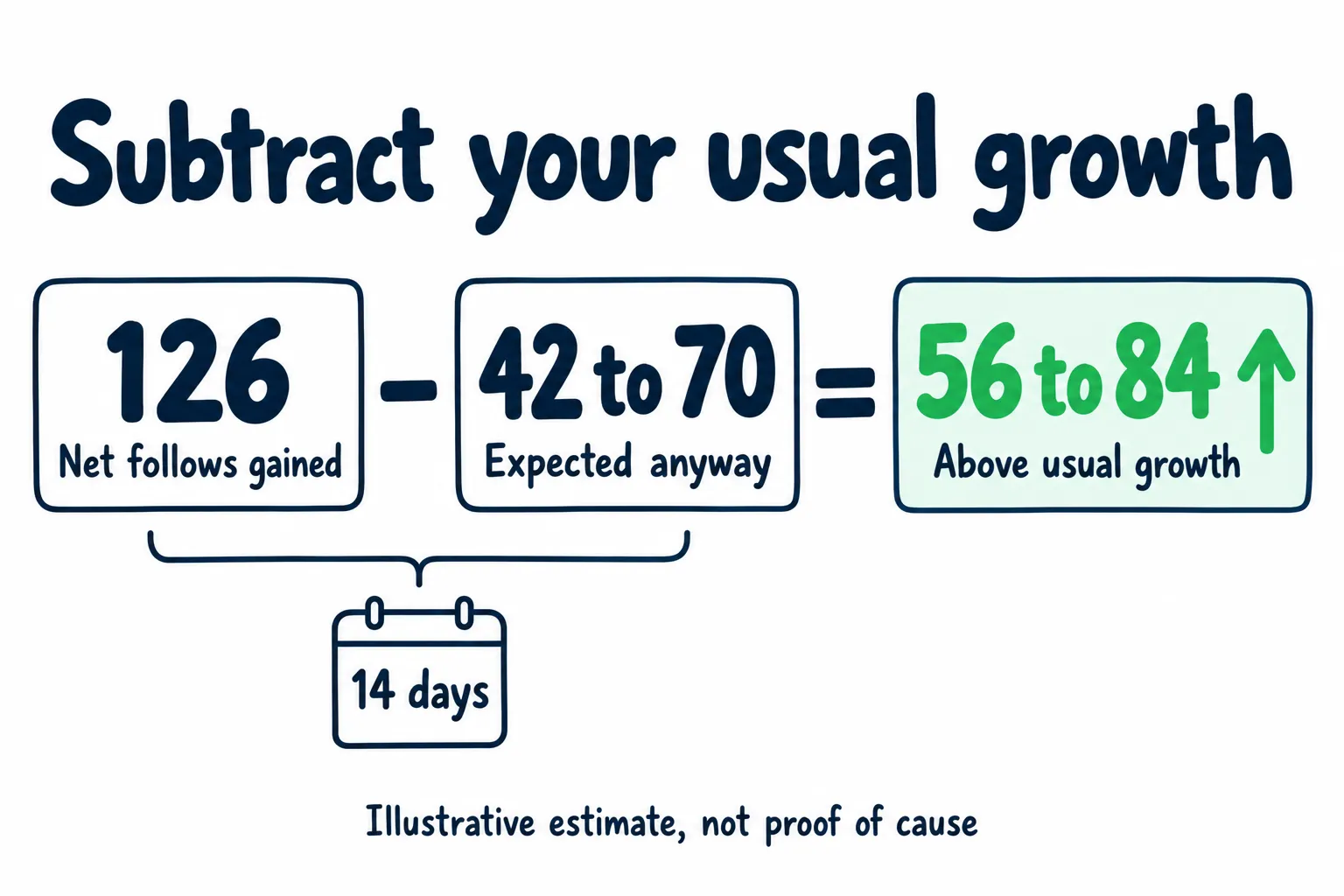
Compare campaign growth with what you might have gained anyway. These figures are illustrative.
The $5 to $7.50 range is still an estimate. A new playlist add, press mention, or release could explain some of the extra growth.
Suppose the artist can afford another $420 test, but cannot keep paying $10 or more for each follow above their normal pace. The $5 to $7.50 range gives them a reason to repeat at the same budget. It doesn’t yet justify doubling the spend. That $10 limit comes from their budget, not an industry benchmark.
If the result falls inside your usual range, you haven’t shown clear extra growth yet. Extend a steady test if the budget allows, or change the idea. Don’t turn a tiny rise into a confident success story.
Check That More Follows Come With More Music Interest
Alongside the count, watch plays on the second track and how intentional listening changes. Spotify’s source of streams helps you see where plays happened. Its artist profile and catalog category counts plays, not profile visits.
If follows rise but only the advertised track moves, keep working on the link to your wider music. If other tracks also gain listeners, you have more reason to repeat the campaign.
Those numbers cover the whole artist profile. They don’t prove that the new followers are the people playing the second song. Keep that distinction in your report.
Decide What The Next Dollar Should Do
Cheap follower growth from your closest fans may be hard to repeat with people who don’t know you. Budget for that change before expanding the campaign. Judge each added round of spend by the extra follows it brings on its own.
Suppose the first $200 goes with roughly 40 follows above baseline. You raise spend to $400 and see roughly 50 above baseline in a comparable period.
The total looks like $8 per extra follower. But the added $200 went with only ten more, or $20 each. These figures are also made up. Other changes between the two periods could explain part of the result.
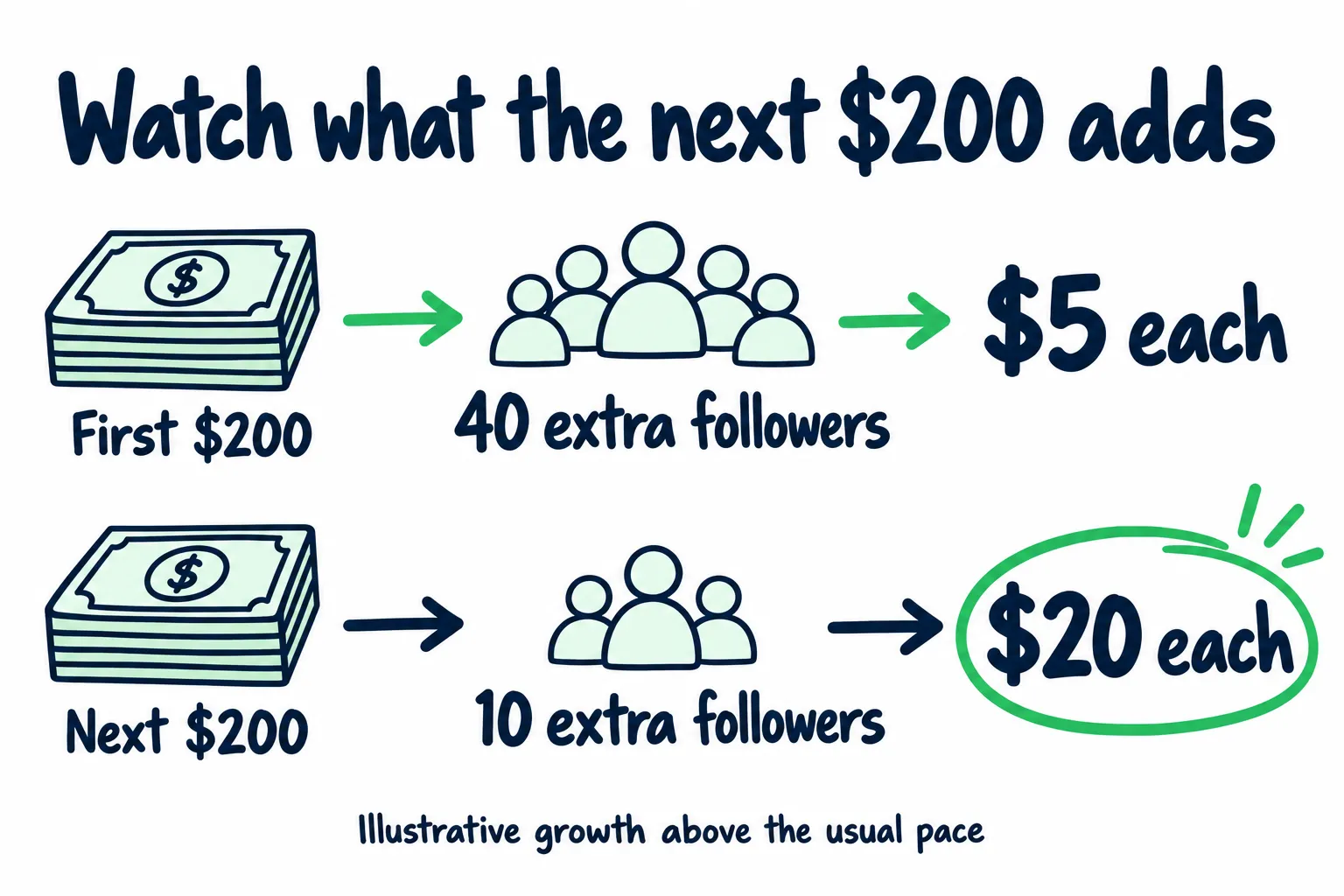
The next round can cost much more per added follower than the first. Judge the added spend on its own.
There is no useful universal price for a Spotify follower. Decide what you can fund across the release, then compare the results with your other tests and goals for the music.
| What your repeat tests show | Next decision |
|---|---|
| Growth above baseline holds at the same spend | Repeat with a fresh clip before raising the budget. |
| More spend adds few extra follows | Hold spend. Try a new audience or reason to follow. |
| A small warm audience responds, then slows | Keep it engaged and test a new group. |
| Extra follows and interest in other tracks rise | Fund a measured next round and keep the same reporting. |
| Nothing clears the usual growth range | Change the campaign idea before buying more of the same traffic. |
Use the music promotion budget calculator to protect the rest of the release budget. Keep enough for the next song. A campaign that leaves you unable to finish the project defeats the reason you asked fans to follow.
Carry The Learning Into The Next Campaign
Once a test holds up, record the song, listener group, and response together. “This song worked” leaves out the part you need to repeat. Note which clip you ran, which audience you reached, and how follows and plays on other tracks changed during those dates.
Give more of the budget to the song and audience pairs that keep bringing growth above your usual pace. Keep a smaller, fixed amount to test a new track or listener group. That way you keep funding what works while you try new ideas.
Say the full band version works with one group, but a stripped track draws a better response elsewhere. Keep promoting both at budgets you can support. When a new single arrives, test it with the group whose taste fits it best.
With Spotify promotion built around listener fit, you test which songs appeal to each group, then put more effort behind the pairs that keep bringing people back.
Automation is useful when it keeps this work running between releases. It can help test tracks, adjust targeting, and move budget as results come in. Give it a clear job, a spending limit, and a review date. Keep judging the wider result in Spotify for Artists: follows, listening on other tracks, and people coming back.
During a test, hold other choices steady so you can learn from the change. Between tests, use those results to decide which tracks and audiences get more of the budget.
If playlists are also part of the plan, use the playlist pitching guide to choose relevant lists, or send a free curator submission. Log any adds beside the paid work when you review follower growth.
Turn The Next Release Into A Follower Campaign
This sample plan is for an artist with an upcoming single, a small email list, and several clips that have drawn song requests. Adjust it around your actual release dates.
| Stage | Work to ship | Decision it helps you make |
|---|---|---|
| Before the push | Choose the entry track, second song, and next release. Bring forward the listener groups that responded before. Record normal follower growth. | Is the campaign aimed at fans who may want the next song? |
| First week | Test two reasons to follow with otherwise similar posts or ads. | Which idea gets people to take the next step? |
| Next test window | Run the chosen idea at a set budget. Log all other promotion. | Does the whole campaign bring growth above the usual pace? |
| Repeat window | Try the same idea with fresh footage and similar spend. | Does the result hold beyond one good post? |
| Release and review | Give fans the music you promised. Review follows and wider listening. | What deserves funding for the next release? |
Put those dates in your music release checklist. If the single arrives during a test, label that window as a release period and compare it with suitable release history. Don’t treat it as an ordinary week.
Put one person on your team in charge of the log. Include the song, audience, message, link, dates, spend, follower change, and other events. For each round, leave one decision: repeat, revise, or end the test, with a reason.
Before the next release, revisit the promise that earned the follow. If people came for the live band sound, lead with that part of the new song.
Keep the findings for your next Spotify growth audit: which songs brought people in, which groups were worth reaching again, and what you’ll test next.
FAQ: How To Get Followers On Spotify
How Do I Get 1,000 Followers On Spotify?
Build a campaign you can repeat beyond your current fans. Choose a listener group, lead with a song that fits their taste, and show why your next release is worth following for. Keep the song and audience together when you review results.
Set the timeline from your recent net growth. A gap of 600 followers at 30 a week would take about 20 weeks if that pace holds. To shorten it, test a stronger song and audience match before raising spend.
Why Is My Instagram Growing But My Spotify Followers Aren’t?
People may like your posts without yet wanting your music. A joke, studio story, or viral clip can earn a social follow on its own.
Test a post that keeps the style they enjoy but makes the song central. Give them a reason to hear another track and a clear route to your artist page. Track clicks to Spotify alongside follower growth. If clicks rise but follows don’t, check what the post promised against the music they find. More views alone won’t resolve that gap.
How Much Does It Cost To Get 1,000 Spotify Followers?
There is no fixed campaign cost for 1,000 real Spotify followers. Work from your own repeated tests: compare spend with follower growth above your usual pace, then check whether the next round holds up.
Don’t multiply the cost per follower from your cheapest test by 1,000. You may reach most of a small group of keen fans quickly. Reaching the next group may cost more. Use the worked example above to estimate a range before setting a larger budget.
Is 5,000 Followers On Spotify Good?
With 5,000 real followers, check how many keep listening. Across the next few releases, do fans return, explore other tracks, and keep choosing your music between campaigns?
Use the count as one sign of progress. Don’t divide total followers by monthly listeners and call it a conversion rate; those numbers cover different time spans. The followers versus listeners guide explains how to read them together.
Do More Spotify Followers Help Trigger The Algorithm?
Follows help Spotify connect your new music with people who chose to keep up with you. Spotify lists followed artists as one source for Release Radar.
That doesn’t mean reaching 1,000 or 5,000 followers guarantees Discover Weekly placement. Build a following around people who want the next song, then keep giving them music they return to. The algorithmic playlists guide covers how those discovery routes differ.