
Music Collaboration Guide: Choose Better Partners and Grow
A music collaboration can make the song stronger while making the career math worse. The difference is usually decided before either artist announces it.
Once you have traction, adding another name to a record puts scarce career assets at risk.
What Is Actually on the Line
- Release slot: The collaboration may delay a solo single, video, or live campaign.
- Catalog position: The record changes what fans expect from both artists.
- Rights and control: More people may own, approve, license, or block the song.
- Audience signal: A poor match can bring attention that never moves into either catalog.
- Team capacity: One side may end up funding and running a campaign built for two.
Landing a specific artist on the track only pays off if the two of you can build something neither catalog can do alone.
The 30 Second Decision
| Test | Question | A strong answer sounds like |
|---|---|---|
| Creative lift | What gets better because this person is involved? | The song loses a clear voice, part, tension, or idea without them |
| Audience logic | Why would either fanbase care about the other artist? | The catalogs share a listener need but offer different value |
| Deal clarity | Can ownership, control, money, and release duties be settled early? | The right people can approve plain terms before major costs begin |
| Delivery strength | Can both teams finish and support the release? | Files, decisions, assets, dates, and campaign work have named owners |
If the public name is the only strong answer, pass. If the creative idea is strong but delivery is still unknown, test the relationship in private before taking a release slot.
A collaboration earns its release slot when the song gets stronger, the audience fit is believable, and both teams can carry the work after the master is done.What You’ll Learn
- Judge a collaboration against the solo release it may replace
- Vet the partner, audience, approval chain, and delivery history
- Separate composition, master ownership, control, fees, costs, and royalties
- Prevent approval deadlocks, bad metadata, and shelved songs
- Build a remote handoff another team can open and trust
- Route each audience into the right part of the other catalog
- Measure whether the partnership created value that can compound
Treat Music Collaboration Like a Catalog Decision
Your release calendar is limited, and so are your budget, fan attention, and team energy. Every collaboration takes a release slot that could have gone to a solo single, live campaign, video, or follow up, so the upside needs to be clear.
Use a simple removal test:
If we removed the other artist’s name and contribution, what would this song and campaign lose?
“More reach” is a weak answer, because reach can disappear after one post. A better answer names a creative change, a fan connection, or a market path. Maybe the second artist gives the hook tension it lacks. Maybe both artists already draw listeners from the same cities but serve different parts of the scene. Maybe one artist has live demand where the other has strong streaming demand.
| Format | Best fit | Hidden cost to price in |
|---|---|---|
| Co writing session | The song needs a new writer’s ear | More shares and approvals if the song is released |
| Featured artist | One part needs a distinct voice or point of view | The name may add little if the guest does not support the launch |
| Artist and producer partnership | The production is central to the artist story | Writing, master, fee, and control can blur together |
| Joint artist release | Both names belong at the center of the song and campaign | More approvals, metadata risk, and shared release work |
| Remix | A finished song can reach a new setting or scene | The new version may split attention from the main record |
Music Collaboration vs Feature
The choice comes down to whose artist story the record belongs to after the campaign ends.
If one artist owns the main story, a feature often fits. A joint release may fit when both artists shape the record, carry the public story, and plan to move fans into both catalogs.
Use the smallest public role that matches the real partnership. Calling a track a joint release for reach can create more admin without creating more fan interest.
Price the Opportunity Cost
Before you say yes, answer five questions:
- Which release or campaign moves if this song takes the slot?
- Would the record still matter without the other artist’s public name?
- Does the partner bring a new but relevant audience?
- Can the launch survive if their team misses a date?
- What would a strong result prove for your next move?
Spend the most time on the last one. A good collaboration can prove demand in a new city, show that your sound travels into another scene, or strengthen your case with agents, managers, labels, and future partners.
Write a Collaboration Thesis Before You Pitch
A collaboration thesis is one sentence that explains why this pairing should exist.
Use this structure:
[Artist] adds [specific creative value] to [song]. The pairing makes sense for [shared listener]. We will move those listeners toward [catalog or fan action] and judge the result by [behavior].
For example:
The guest’s restrained vocal gives the second verse a point of view my lead cannot carry alone. Both catalogs already connect with late night alternative R&B listeners. The campaign should move those listeners into each artist’s darker catalog tracks. Follows and repeat plays will show whether they stayed.
That is much sharper than “our audiences are similar.”
Know Which Kind of Value You Are Buying
| Source of value | What it can change | Evidence to check first |
|---|---|---|
| Creative lift | Song quality, contrast, replay value, or performance | Demos, credits, live takes, and past work |
| Audience fit | The chance that fans care about both names | Top cities, comments, show bills, sound, and culture |
| Market access | Entry into a city, scene, press lane, or live network | Real local response and active relationships |
| Career signal | Trust from stronger artists and industry teams | Finished credits, delivery history, and public support |
| Catalog extension | A believable new edge without losing identity | How the song connects to past and next releases |
Before you count on reach, know why those people would stay. The Spotify artist profile guide shows how to inspect catalog paths and source quality before public numbers make the decision for you.
How to Find Music Collaborators Who Can Deliver
A private demo can sound perfect while the working relationship is a bad bet. Before you promise a release, check the artist, their rights, and their team with the same care you give the music. All three need to support the same plan.
| What to inspect | Strong sign | Reason to slow down |
|---|---|---|
| Finished work | Clean credits and a steady history of completed releases | Many announced projects that never appear |
| Audience shape | Cities, content response, and live demand fit the music | Large spikes with no clear source or lasting response |
| Work habits | Clear replies, usable files, and dates that hold | Vague answers, missed calls, or constant scope changes |
| Rights | Manager, label, publisher, producer, and sample duties are known | “We will sort that later” from anyone who needs approval |
| Release capacity | The team can make assets, approve them, and support launch week | The artist is already buried under another campaign |
| Commercial fit | Fee, budget, rights, and promo expectations can be discussed early | The price is clear but the actual deliverables are not |
Check the Approval Chain
Ask who can say yes before you build the schedule.
An artist may need approval from a manager, label, publisher, producer, or brand partner. A producer may have an exclusive deal. A beat may carry sample or lease limits. A guest may have another release that blocks your date.
None of those facts kills the collaboration, but hidden ones can. Get the right people into the deal before you pay for the master, artwork, or campaign.
Test the Relationship in Private
When the fit looks good but the work habits are unknown, test one section or one session.
Watch how the person handles notes, files, timing, disagreement, and credit. Keep it to a small paid or agreed test before both teams lock a public plan. You are checking the relationship, not collecting free work.
Your pitch should show that you have thought past the verse:
Hey [name], your vocal on [song] has the restraint this second verse needs. I hear you adding a new point of view, not filling an empty feature slot. The track is planned as [feature or joint release], with mix, master, and content budget covered. We are aiming for [release window], subject to the right deal. Can I send the private demo and a one page plan?
Use one relevant signal from your own work, such as a strong save rate, sold out local show, useful press result, or clear audience overlap. One signal like that says more than a list of every number you have.
Key takeaway
Separate Songwriting Splits, Master Ownership, Control, and Money
Many collaboration fights begin with one vague word, “split,” because people use it for different things: ownership, control, money, and credit.
| Layer | What it covers | Question to answer |
|---|---|---|
| Ownership | Composition and master shares | Who owns which copyright, and how much? |
| Control | Release, changes, licenses, approvals, and takedowns | Who can make which decision? |
| Money | Fees, royalty base, costs, timing, and statements | What gets paid, from which income, and when? |
| Credit | Public names and roles | How will every person be named across stores and assets? |
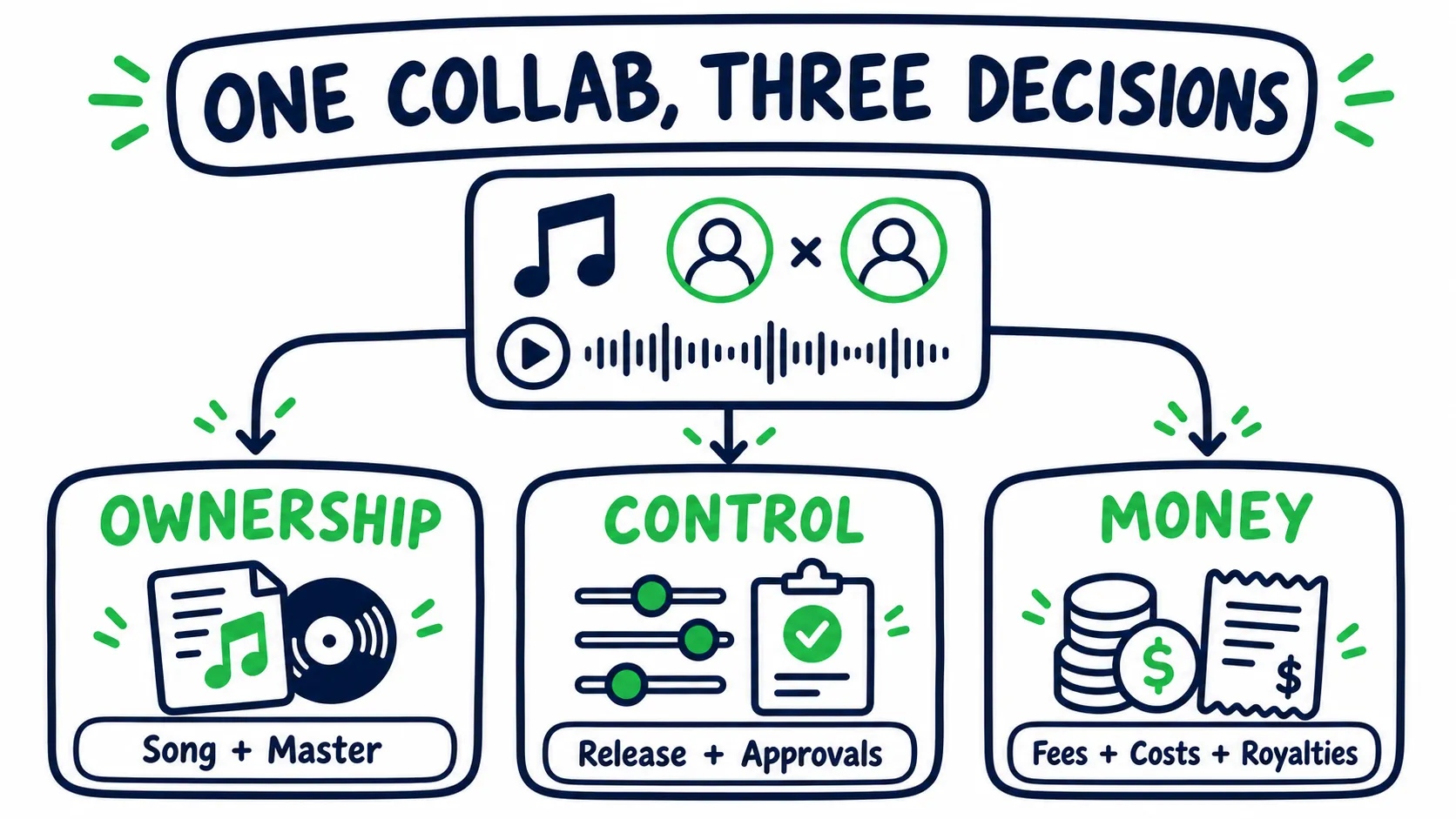
One collaboration needs three separate decisions: who owns it, who controls it, and how the money moves.
The U.S. Copyright Office explains that the composition and sound recording are separate works. The composition is the music and lyrics. The master is the exact recording people hear. Each can have its own owners and split.
A Worked Example
Imagine three people make one record:
- Artist A writes the first verse and hook, funds the recording, and leads the release
- Artist B writes a new second verse and changes part of the hook melody
- The producer builds the chords, drums, arrangement, and final production
They could agree to this fictional deal:
| Person | Composition | Master | Other payment |
|---|---|---|---|
| Artist A | 50 percent | 70 percent | None |
| Artist B | 25 percent | 20 percent | Agreed feature fee |
| Producer | 25 percent | 10 percent | Agreed producer fee |
Both ownership columns total 100 percent, but they are different. The feature and producer fees sit outside both columns.
This is an example, not a suggested split. The right deal depends on the real work, bargaining power, cash, rights, and terms each person accepts.
Music Collaboration Agreement vs Split Sheet
A split sheet mainly records the writers and their composition shares. It may say nothing about the master, fees, costs, release control, or promotion.
A full music collaboration agreement needs a wider set of answers. Some teams call this a music collaboration contract. The name matters less than the terms inside it.
| Term artists often skip | The question to put in plain language |
|---|---|
| Royalty base | Does the percentage apply to gross money received or net receipts after named deductions? |
| Cost recovery | Which costs get paid back, who approves them, and is there a cap? |
| Release promise | By what date must the song come out, and what happens if it is shelved? |
| Approval rules | Who approves the mix, art, date, licenses, and paid ads? |
| Deadlock | What happens when both sides have a veto and cannot agree? |
| Accounting | How often are statements and payments sent, and what records can be checked? |
| Name and image use | Where may each team use the other artist’s name, photo, voice, and content? |
| Outside rights | Who clears samples, beats, publishers, labels, and other third parties? |
| Exit and takedown | What happens after a breach, dispute, or agreed end to the campaign? |
“Net receipts” needs an exact definition. Name each allowed deduction. Do not leave an open list for fees, refunds, taxes, ads, video, or legal costs.
The same rule applies to cost recovery. Name the approved costs and require receipts. State whether one team may go over budget without the other side’s consent.
Protect the Shelved Song
A strong song can sit for months because one manager stopped replying or one artist changed plans.
The agreement should set a release deadline and a path if that date is missed. Can either party use their own contribution? Must all files stay private? Does control return to one side? A music lawyer should draft the actual clause for your deal.
Keep the Registrations Aligned
Every writer should register matching shares. The MLC says each eligible party should register their part. Its work registration guide explains the United States process.
The music royalties guide maps the wider payment system. The Spotify royalties calculator can test different master income scenarios.
Pick the Release Architecture Before Upload
Main artist, featured artist, and joint artist roles shape the public release, the metadata handoff, and the approval load.
Choose the role that matches the real creative and campaign plan. Then choose one release operator.
The operator controls the distributor account, gets notices, fixes delivery problems, and often receives the first payment. That role gives them access and power, but not sole ownership.
| Release job | Named owner | Shared evidence |
|---|---|---|
| Store delivery | Release operator | Delivery receipt, release data, and live links |
| Artist mapping | Operator with each artist team | Correct artist IDs and profile links |
| Audio approval | Named creative leads | Approved master and version record |
| Art and copy | Named brand lead | Final files and written approvals |
| Campaign assets | Each artist team | Asset list, dates, and usage rights |
| Income and costs | Accounting lead | Statements, receipts, and payment log |
Build One Metadata Packet
Do not collect credits from old messages on upload night.
Keep one approved page with:
- Artist names exactly as they should appear
- Artist profile IDs or links for every store
- Main and featured artist roles
- Writer legal names, shares, PRO details, and IPI or CAE numbers
- Publisher or publishing admin details
- Producer, performer, engineer, and studio credits
- Master owners and copyright lines
- ISRC, version name, explicit status, and final track title
- Label, manager, and accounting contacts
Spotify says visible song credits come from distributor metadata. A correct credit in a contract will not fix bad data sent to stores.
Save the ISRC beside the final master. The official ISRC authority explains that an ISRC identifies one recording. It does not identify the composition or prove ownership.
The music distribution guide covers split payments, credits, and catalog control. The music release checklist covers the full delivery and launch schedule.
Set Decision Rights Before the Session Gets Expensive
“We both approve everything” sounds fair until one person stops replying.
Give each decision an owner, a reply window, and a fallback. The exact rule depends on the relationship, but the question cannot stay blank.
| Decision | A rule you could agree on |
|---|---|
| Arrangement and production | Creative lead decides after one full note round |
| Each artist’s performance | That artist approves their own final take |
| Final master | Both artist leads approve before delivery |
| Artwork and campaign copy | Brand lead decides after names and usage are approved |
| Release date | Release operator chooses inside the agreed window |
| Sync, brand, or master license | Rights owners approve as the agreement requires |
| No reply | Move to a named manager or pause after the agreed window |
Adapt these examples to your project so nobody is surprised by who decides.
Use Four Gates
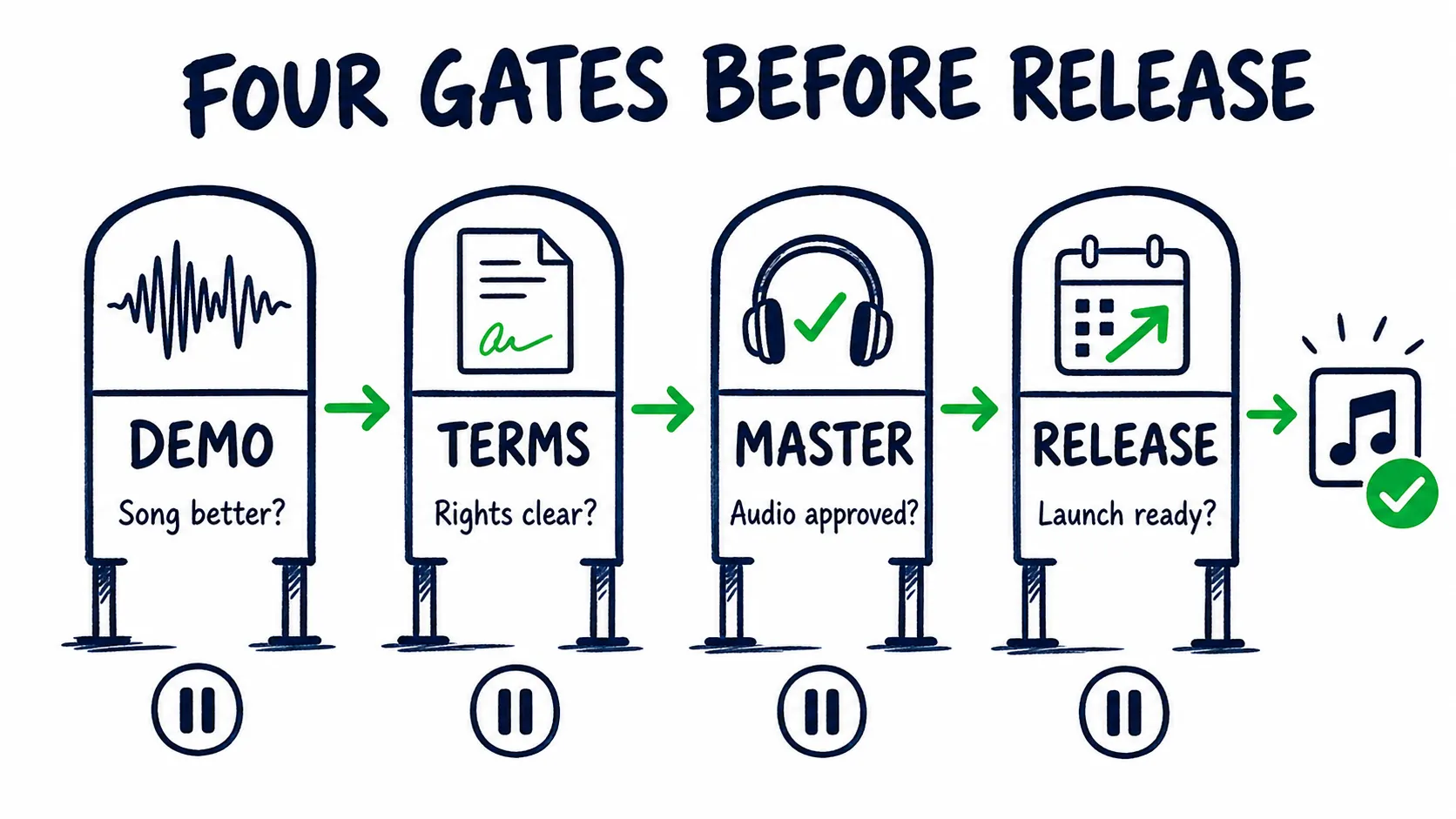
Each gate answers one hard question. If the answer is no, the project pauses before the next cost or public promise.
Demo gate: Does the partner make the song meaningfully better? Make no public promise yet.
Terms gate: Are the roles, rights, fees, and outside approvals clear? Do this before costly production.
Master gate: Is the audio approved and are all samples and credits clear? Do this before the main content spend.
Release gate: Are delivery, assets, dates, links, and promo duties ready? Do this before upload or announcement.
A gate should stop the project when a core condition fails, such as an uncleared sample, a missed deal deadline, lost release support, or a version that no longer beats the solo track. Stopping at a gate protects both catalogs from a release nobody can support.
How to Collaborate on Music Remotely at a Professional Level
Serious remote work needs more than a folder full of WAV files. The other team should open the package, know the exact version, hear the intent, and begin without a rescue call.
| Handoff item | What belongs in it |
|---|---|
| Session note | Tempo, key, time signature, sample rate, bit depth, and song map |
| Reference mix | One file that shows the intended balance, effects, and arrangement |
| Consolidated stems | WAV files from the same start point so every part lines up |
| Sound options | Printed effects plus dry files when later editing may be needed |
| Vocal packet | Comp, tuned lead if approved, doubles, harmonies, ad libs, and lyric sheet |
| Version record | Date, version number, changes, owner, and approval status |
| Credit record | Every person, role, studio, and change added during the session |
If both teams use the same DAW and plugin setup, share the session too. Still send consolidated audio. A missing plugin should not stop the record six months later.
Use names such as SongTitle_96BPM_LeadVocal_ArtistB_V04.wav. Never make the mix engineer guess whether final2newREAL.wav is current.
Make Feedback Traceable
Every note needs a version, time, problem, request, and reason.
Mix V04, 1:12. The synth masks the final word of the lead line. Please lower or thin it for that phrase so the lyric stays clear.
Send one note batch per version. Mark each point as fixed, rejected, or open. Keep the approved master and the written approval together.
The best music collaboration tools are the ones both teams will use every time. You need storage, version history, time based notes, and an approval record. The Recording Academy’s technical guidance also includes a useful credit resource.
Design the Audience Transfer Before Release
Two names on one track create shared reach. Turning that reach into shared fans takes five steps:
Reach → context → artist recognition → catalog path → return
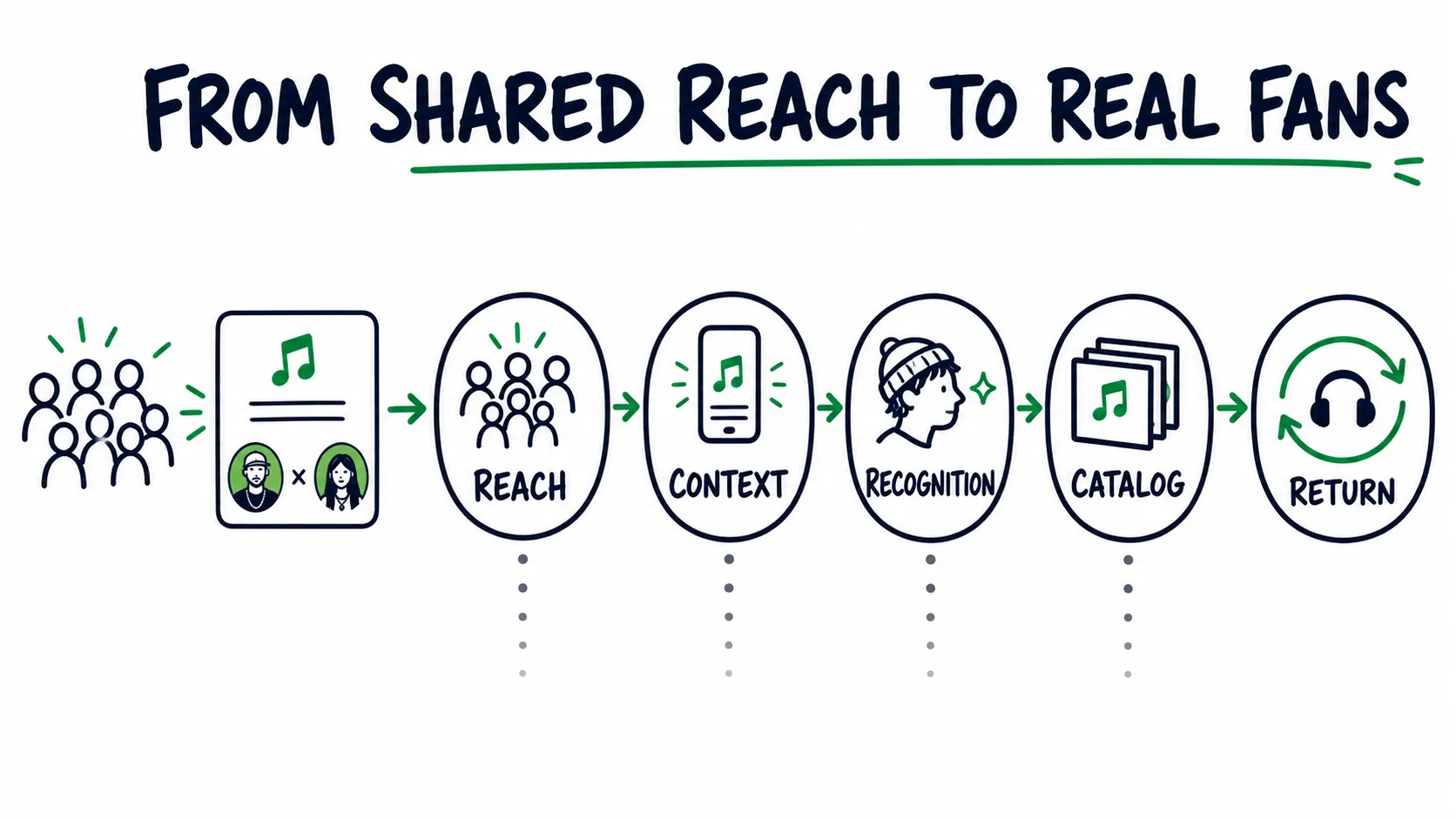
Shared reach has value only when listeners can place the artist, enter the right catalog path, and come back.
Each step can leak.
| Stage | Common leak | Better move |
|---|---|---|
| Reach | Only one artist posts or spends | Give each team named assets, dates, and channels |
| Context | Fans hear the song but do not understand the pairing | Tell one clear story about why these artists made it |
| Recognition | The guest becomes a voice with no identity | Show the person, tag the right profile, and use correct credits |
| Catalog path | Every link ends at the new single | Point each audience toward one fitting catalog track or profile path |
| Return | The campaign stops after launch week | Plan the next clip, live moment, message, or release connection |
Commit to Promotion in Writing
“We will both post” is not a plan. Name who makes each asset and who may edit it. Set where it can run and when it needs approval. Cover posts, fan messages, press, playlist work, live use, and paid media.
One team may want to run ads with the other artist’s name, image, voice, or account. Put that permission and approval process in writing. Do the same for raw footage and unreleased audio.
Equal effort is not always the right goal. One artist may have the stronger video channel. The other may have a better email list, live draw, or press network. Name each side’s real contribution before launch.
Build a Catalog Path for Each Audience
Pick the next best song for fans of the collaborator.
Artist B may bring darker, slower listeners. Sending them to Artist A’s brightest song may break the path, even if it has more streams. Pick the track that keeps the same promise.
This step makes audience fit measurable, because the new listener either takes another step or leaves after the feature.
The pre release strategy guide sets the timing. The content strategy guide shows how to build several strong angles from one record. The broader music marketing strategy guide connects the release to long term fan growth.
Once the song is live, Spotify Artist Pick can make the next profile action clearer.
Scale the Listener Path, Not the Launch Spike
A collaboration gives you a useful live test. It shows which fans care about the pairing, which song opens the other catalog, and whether that attention survives after launch week. Do not waste that signal on a broad push built to buy the cheapest stream.
Most campaigns optimize for the first event they can count, such as an impression, click, or first play. Cheap entry can hide weak fit. A person who taps once and leaves is not the same as a listener who saves, follows, tries a second song, and returns.
The more useful unit is the listener and track pair:
Which type of listener entered through which track, and what did they do next?
The audience intelligence loop is built around that question. Start from music evidence in both catalogs, including each artist’s profile, full catalog, similar artists, and listener locations. Split the listeners each artist brings into separate audience pockets, so you learn which fit worked. Then send real people through mobile ads that open Spotify.
Rotate the shared song with fitting tracks from both catalogs, because the song the team picks is not always the best first song for a new listener. Move later budget toward the audience and track combinations that save, follow, and replay. Verify every result in each artist’s own Spotify for Artists, and carry the winning audiences and tracks into the next release.
| Learning stage | Question to answer | Evidence worth keeping | Action |
|---|---|---|---|
| Map | Who is likely to fit this sound? | Related artists, genre edges, strong markets, and current listener sources | Build narrow starting groups instead of one broad audience |
| Test | Which groups enter at a useful cost? | Ad visits, external source movement, and track level listener change | Remove placements that create cheap visits but weak listening |
| Rotate | Which track holds each group? | Saves, repeat behavior, profile activity, and movement into older songs | Keep fitting tracks in rotation and pull weak paths |
| Reallocate | Which audience and track pair earns more budget? | Several aligned signals across more than one day | Move spend toward the pairs creating deeper behavior |
| Retain | What remains when paid traffic slows? | Followers, direct listening, catalog breadth, and return behavior | Carry the learning into the next campaign |
For a collaboration, build two bridge paths:
Artist A listener → shared song → Artist B bridge track → Artist B profile
Artist B listener → shared song → Artist A bridge track → Artist A profile
The bridge track is the song that keeps the promise the collaboration made, which is not always the biggest song.
Catalog rotation means using a small set of fitting songs as probes, not giving every release equal spend. One audience may hold on the new single. Another may respond to an older track with a closer mood, tempo, or point of view.
Run the smallest test that can change a decision. If people play the collaboration but ignore both catalogs, fix the context, profile path, or bridge track before adding budget. More traffic only makes a leak more expensive.
Be honest about attribution. Spotify for Artists will not give you a clean row that says one ad created one save or follow. Read the pattern across ad delivery, external source traffic, track movement, saves, follows, catalog lift, and return. Treat the result as a strong inference when several signals move together.
If a campaign resets its targeting every month, forces one song on every listener, or hides the result in an outside report, it is renting a spike. A strong audience system keeps learning which listeners fit, which tracks hold them, and where the next dollar has the best chance of creating a real return.
Measure the Incremental Value of the Collaboration
Judge the collaboration against real alternatives: a recent solo release, your expected baseline, and the next best use of the same budget and release slot.
Take a snapshot for both artists before launch. Use the same length window after the first campaign phase.
Track:
- Active audience and follower movement
- Stream sources and source concentration
- Top cities and countries
- Saves, repeat listening, and playlist adds where available
- Spillover into older catalog tracks
- Content response and link traffic by artist
- Spend, approved costs, net income, and unpaid balances
- Days late, extra revision rounds, and team time
No platform will show a perfect list of Artist A fans who became Artist B fans, so treat audience transfer as an inference. Use several signals and state what you cannot see.
Use a Collaboration Scorecard
| Dimension | The hard question | Evidence to keep |
|---|---|---|
| Creative lift | Is the released version clearly stronger than the solo path? | Demo comparison, team review, and listener response |
| Delivery | Did both sides hit dates, budget, files, and approvals? | Task record, revision count, and final timeline |
| Qualified reach | Did the song reach relevant new listeners? | Sources, cities, content response, and traffic |
| Catalog lift | Did listeners move beyond the collaboration? | Older song lift, profile activity, follows, and return behavior |
| Campaign balance | Did each team deliver what it promised? | Assets, posts, outreach, spend, and approvals |
| Economics | Did the result justify cash and opportunity cost? | Net receipts, costs, team time, and the delayed alternative |
| Relationship value | Did this create a stronger next opportunity? | Repeat work, live offers, referrals, or new team trust |
A stream total can look good while the collaboration fails most of this scorecard.
The music analytics guide shows how to measure lift, source quality, catalog spillover, and cost without false precision. The Spotify for Artists guide explains the platform data behind those checks.
Do not let monthly listeners carry the whole verdict. A collaboration becomes more valuable when some of those people return and move deeper into each artist’s catalog.
Decide if a Second Song Earned Its Slot
Repeat the partnership when the creative gain is real or the audience gain is useful. A stronger next opportunity can also earn the pair another slot.
Stop when the name created a spike but the fans did not move. Stop when the deal stayed messy or one team carried the full cost.
The debrief should end with a decision, not a warm group chat.
Advanced Music Collaboration Checklist
Strategy
- The pairing has a written creative and audience thesis
- The collaboration beats the solo alternative on a named goal
- The opportunity cost and release slot are accepted
- The feature or joint artist role matches the real plan
Partner and rights
- Audience quality, release history, and team capacity were checked
- Label, manager, publisher, producer, beat, and sample duties are known
- Composition, master, fees, costs, and royalty base are written down
- Release deadline, approvals, deadlock, accounting, and exit rules are clear
Production and delivery
- Creative decisions have named owners and reply windows
- The project passed the demo, terms, master, and release gates
- Stems, sessions, versions, notes, and credits follow one handoff rule
- One approved metadata packet feeds the distributor and both teams
Audience and measurement
- Each team has named promotion duties and usage rights
- Both audiences have a clear path into the other catalog
- Paid reach starts only after a listener path shows useful behavior
- Targeting, track rotation, budget movement, and retained learning have clear rules
- Baselines, costs, and campaign evidence are saved
- The debrief will decide whether a second collaboration earns a slot
Key takeaway
Turn the Collaboration Into Career Proof
A respected name can open the first door. The finished work decides whether the next one opens.
Artists, managers, agents, and producers notice who can make the record. They also notice who solves the business, delivers the campaign, and accounts for the result.
A Spotify profile audit should answer three things before new attention arrives. Can a stranger place the artist in seconds? Is the next catalog step clear? Can the team measure where the traffic went? If not, the collaboration will feed an existing leak.
Music Collaboration FAQ
How Do I Find Serious Music Collaborators Who Will Finish the Song?
Look for proof that they finish, not proof that they network.
Check four things:
- Release history: Do completed records appear behind the announcements?
- Repeat collaborators: Have credible people chosen to work with them again?
- Approval chain: Can the artist, manager, label, publisher, or producer approve the deal and date?
- Delivery habits: Do replies, files, notes, and dates arrive as promised?
When the music fits but the work habits are unknown, test one session or one section in private. Do not announce the collaboration until both sides have delivered something real.
Should a Featured Artist Be Paid Upfront or Receive Royalties?
Use the payment structure that matches the contribution, bargaining power, and risk.
| Contribution | A structure that may fit |
|---|---|
| Performs a finished part with limited campaign duties | Fixed feature fee |
| Writes lyrics, melody, or another part of the composition | Songwriting share, with any fee handled separately |
| Adds lasting value to the master and public campaign | Master royalty or ownership share, sometimes with a fee |
| Shares creative work, promotion, and commercial risk | A mix of fee, ownership, royalties, and clear duties |
Write down:
- when the fee becomes due
- whether any payment is recoverable from future income
- which income the royalty uses as its base
- what must be delivered and approved first
A fee, songwriting share, and master share solve different problems. Do not trade one for another without naming the difference.
How Should Songwriting and Master Ownership Be Split?
Negotiate the composition and master as two separate ownership talks.
- Composition: Credit the people who created the music and lyrics.
- Master: Price the finished recording, cash, production, bargaining power, and release duties.
- Fees: Keep upfront payments separate from both ownership columns.
- Control: State who can approve releases, edits, licenses, and takedowns.
Before anyone signs, confirm:
- composition shares total 100 percent
- master shares total 100 percent
- every writer and owner uses matching names and shares
- costs, deductions, royalty timing, and statements are defined
Paying for the session does not create songwriting credit by itself.
Who Should Distribute a Music Collaboration?
Choose one release operator based on execution, not status.
The stronger operator can:
- deliver clean metadata and correct artist profile IDs
- answer distributor notices and fix store mapping fast
- keep credits, versions, and release dates aligned
- issue clear statements and payments
- share evidence with every rights holder
Both teams should receive the metadata packet, delivery receipt, live links, statements, approved costs, and payment record.
The distributor account holder runs the release. That role does not make them the sole master owner unless the agreement says so.
What Files Should I Send for a Remote Music Collaboration?
Send a package the other team can rebuild without a rescue call.
Include:
- one reference mix that shows the intended sound
- consolidated WAV stems from the same start point
- tempo, key, time signature, sample rate, and bit depth
- printed effects plus dry files when later changes may be needed
- lyric sheet, credits, and current split information
- version number, change record, and approval status
- the DAW session when useful, but never as the only handoff
Final test: open the package on another system. If the song lines up, the current version is obvious, and the credits make sense, the handoff is ready.