
Spotify Saves: What They Mean And How To Get More Real Saves
A Spotify save is a listener saying, “I want this song again.”
A stream can happen by accident. Someone might hear your track because a playlist served it, Radio kept playing, or an ad got one curious tap.
A save takes one more step. The listener decided the song was worth keeping.
The Real Meaning
Spotify says it counts a save when someone taps the plus button on your music and saves it to their library. You can check Spotify’s own page on how saves are counted.
For artists, a Spotify save means the song earned a place in someone’s library.
That does not make the person a fan for life, and it does not mean Spotify will push the song everywhere. It does mean the song did more than pass through someone’s ears.
Why Artists Misread Saves
You drop a song. You run a small campaign. The stream count moves. Then you open Spotify for Artists and start asking questions nobody explains clearly:
- Why did 5,000 streams bring almost no saves?
- Why did 300 listeners bring a strong save rate?
- Why did people save the song but not follow?
- Why does your playlist say “2 saves”?
The answers decide whether you should spend more, change the audience, fix the profile, or stop pushing the song.
What You’ll Learn
- What Spotify saves mean for songs, albums, videos, and playlists
- How saves are different from streams, followers, playlist adds, and downloads
- How to calculate Spotify save rate without fooling yourself
- What a good Spotify save rate can look like
- Why buying Spotify saves is a bad read on real demand
- How to get more real saves from better matched listeners
- How to diagnose weird save data in Spotify for Artists
What Are Spotify Saves?
Spotify saves happen when a listener keeps your music in their library. Someone hears your song and thinks, “I do not want to lose this.”
Spotify used to show a heart button. Now the main save action uses the plus button. The button changed, but the meaning for artists did not: a listener found the track and kept it.
| Action | What it means | How to read it |
|---|---|---|
| Track save | A listener saves one song | The song had enough pull to keep |
| Album save | A listener saves a full release | The project may have deeper interest |
| Music video save | Spotify says this saves the audio track too | Video interest can still support the song |
| Playlist save | Someone saves or follows a playlist | This is about the playlist, not one track |
| Offline download | A Premium listener downloads music for offline listening | This is not the same thing as a save |
Artists mix these up all the time, so keep them apart:
- A track save is a song signal.
- A playlist save is a playlist signal.
- An offline download is a convenience feature.
- A pre save before release is a campaign action that may place the song in their library when it comes out.
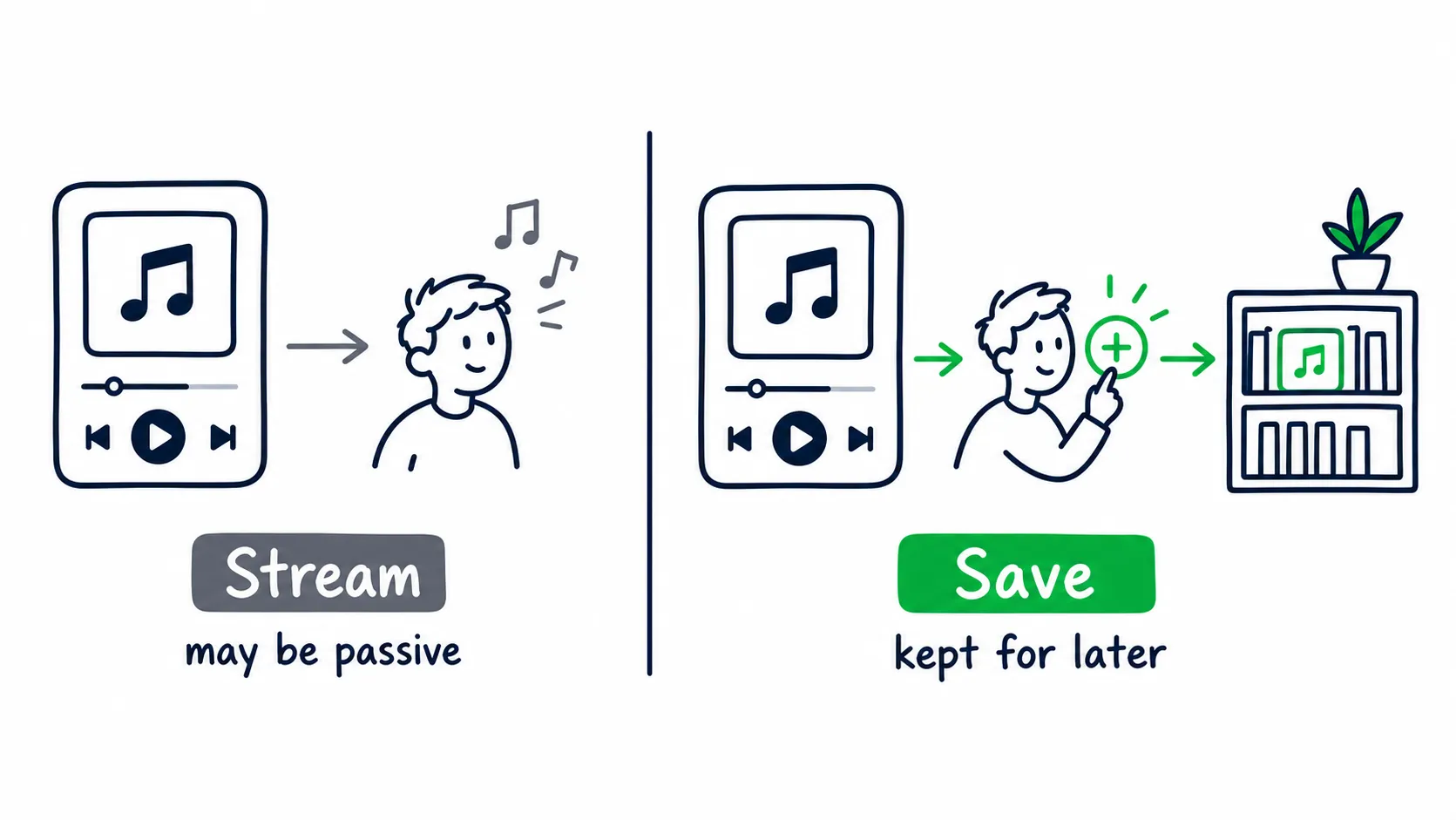
A stream can be passive. A save shows the listener wanted the song close enough to keep.
Key takeaway
Spotify Saves Vs Streams, Followers, And Playlist Adds
Do not make saves fight every other metric. Each number answers a different question.
| Metric | What it tells you | What it does not prove |
|---|---|---|
| Streams | How many plays the song got | That people cared after the play |
| Listeners | How many different people heard it | That those people became fans |
| Saves | How many people kept the song | That the song has enough reach yet |
| Playlist adds | How many people put it into a personal playlist | That every playlist will be used often |
| Followers | How many people chose to stay linked to the artist | That they will stream every new release |
| Repeat listens | Whether people came back | Why they came back without more context |
Read them like this:
- Streams show reach.
- Saves show the song stuck a little.
- Playlist adds show the song fits a moment in someone’s life.
- Followers show interest in the artist beyond one track.
- Repeat listens show the song still had pull after the first play.
Spotify’s source of streams page helps you read this without guessing. Spotify separates streams into active and programmed sources.
Active sources are places where listeners intentionally seek your music, like your artist profile, release pages, their own library, their own playlists, or their queue.
Programmed sources are places where Spotify or another listener serves the music, like editorial playlists, personalized playlists, Radio, Autoplay, Discover Weekly, Release Radar, daylist, and other listeners’ playlists.
Neither source is automatically good or bad. If a playlist gives you streams, then people save the song and later play it from their library, that is a good sign. If a playlist gives you streams and nothing else moves, you got exposure but no fan growth yet.
For the wider algorithm picture, read Spotify algorithmic playlists. This page stays focused on saves.
How To Calculate Spotify Save Rate
Spotify save rate is the percent of listeners who saved your song.
Use listeners, not streams, if you want the cleanest read of human interest.
Spotify save rate = saves divided by listeners, then multiplied by 100Example:
100 saves
1,000 listeners
Save rate = 10 percent
That means 10 out of every 100 listeners saved the song.
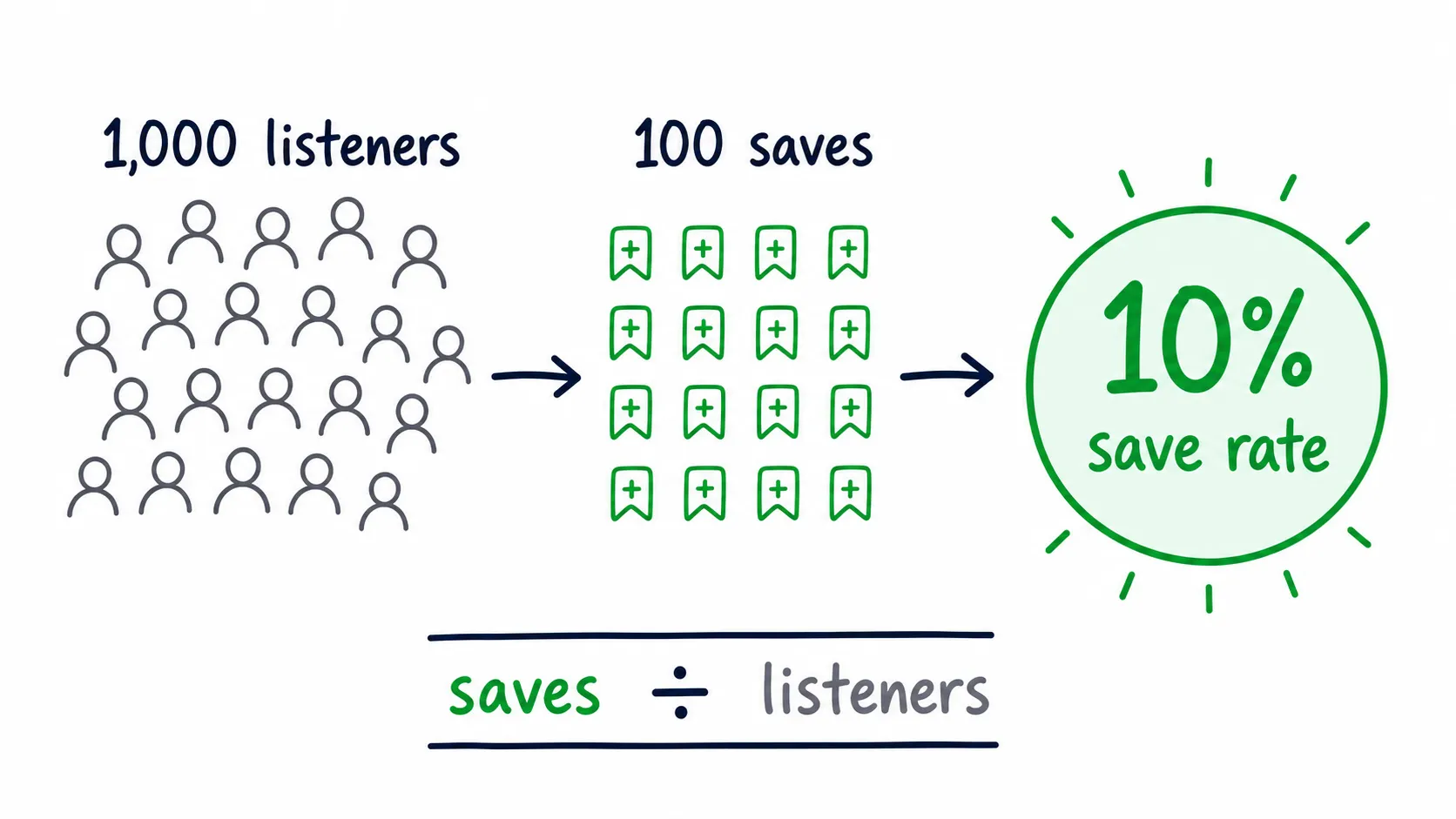
Save rate is simple math, but the source of those listeners still matters.
The math is easy. The hard part is not lying to yourself with it. A save rate can mean very different things depending on where it came from:
- 40 close fans on release day vs 4,000 cold playlist listeners
- A song that has been out for months vs its first day
- One country vs another
Spotify’s audience segments page is useful here. It separates monthly active listeners from programmed listeners. A save from someone who later chooses your music again is stronger than a save that never turns into another action.
What Is A Good Spotify Save Rate?
There is no official save rate that unlocks Spotify’s algorithm. If someone tells you, “Hit this exact percent and Discover Weekly turns on,” they are guessing.
Use save rate to decide where to look next. It does not predict what will happen.
| Save rate | What it may mean | What to check next |
|---|---|---|
| Under 3 percent | The song may be getting passive or mismatched reach | Source, playlist fit, ad targeting, hook, and skip behavior if you have it |
| 3 to 8 percent | Mixed signal | Compare it against your catalog and traffic source |
| 8 to 15 percent | Promising listener fit | Look for repeat plays, playlist adds, followers, and active sources |
| Above 15 percent | Strong interest, or a very warm sample | Make sure the source is real and the sample is large enough |
Do not treat this table like law. Genre, source, fan warmth, and song age all move the number.
A niche song with fewer listeners can have a better save rate because the people who find it are better matched, and that tells you which listeners care.
If monthly listeners are making the read messy, the Spotify monthly listeners guide will help you separate reach from demand.
Why Spotify Saves Matter For Growth
Saves sit closer to intent than a passive stream. When someone saves your song, they are saying, “I may want this later.” That helps in three ways:
- The song can get played again from the listener’s library.
- You can judge whether a campaign is sending the right people.
- You can decide which song deserves more budget.
That last one is where most artists lose money. If you spend money and get streams but no saves, you got exposure with no proof of demand. Exposure still tells you the song reached people. Demand looks more like this:
- People save the song
- People add it to playlists
- People follow the artist
- People stream another song
- People come back from their own library
- People show up in active sources
That is the kind of signal a real music marketing strategy should care about. It also raises the bar for any promotion source. Beyond plays, a promotion source should help you learn which listeners save, follow, come back, and explore the catalog.
If a song already gets saves and repeat plays but does not have enough reach, the problem may be distribution. If a song gets reach but no saves, the problem is usually fit: the audience, the song promise, or the profile path is off.
Raw stream packages feel cheap at first and expensive later because they rarely tell you what to do next.
Should You Buy Spotify Saves?
No, not if the offer is a fixed number of saves with no real listener path. That is a rented number.
Spotify warns that paid third party services that guarantee streams are not legitimate. Read Spotify’s official warning on artificial streaming and paid third party services before paying for anything that promises guaranteed activity.
Even when a “buy Spotify saves” offer does not mention streams, the business problem is still there. Your goal is to find real listeners who want the song again, and bought saves hide them.
Fake or low intent saves make the dashboard harder to trust. They can make you think a song is working when it is not, scale the wrong source, and learn the wrong lesson.
The better move is slower, but it teaches you something. Put the song in front of people who already have a reason to like it, then watch what they do.
The Better Way To Create Saves
The best way to get more Spotify saves is to build a cleaner listener test instead of chasing saves directly. The song reaches people who are already close to the sound, mood, genre, or artist world. You watch which people keep the song, then put more energy behind the listeners who act like they care.
That sounds basic, but most promotion skips it. Artists are usually offered one of three things:
- A playlist spot with little control over who hears the song
- A stream number with no clear listener path
- A short ad test that starts from zero every time
None of those are automatically evil, but they are incomplete. They push one song, hand you a number, and start over next time. A better process has five parts.
| Part | What it does | Why it helps saves |
|---|---|---|
| Audience map | Starts from your sound, catalog, similar artists, and current listener data | The first listeners are more likely to understand the song |
| Direct discovery | Sends people straight to Spotify from outside the platform | You can see if outside interest turns into library behavior |
| Source proof | Shows up inside Spotify for Artists, not only in a private report | You can compare saves with source, country, listeners, and timing |
| Catalog testing | Watches which songs get kept by which listener groups | You learn whether one track or the artist world is connecting |
| Learning loop | Moves budget toward the listener groups and songs that save, follow, and return | Each round gets less random because the data carries forward |
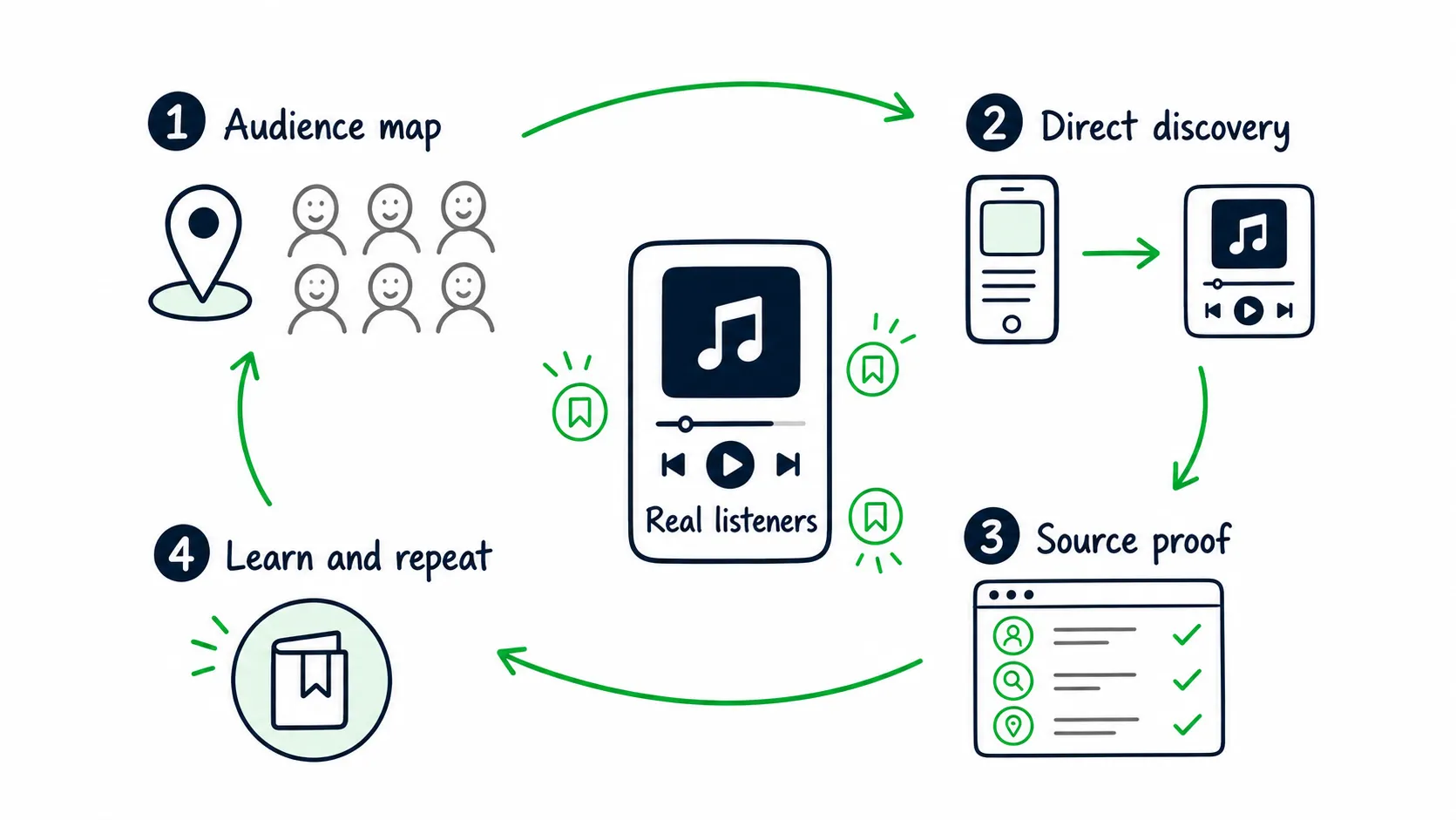
Cleaner promotion turns each round into a better listener test.
Hold any promotion source to this standard. Instead of asking how many streams it can show you, ask how it will help you find the listeners most likely to save, return, and make the next campaign smarter.
That question makes saves useful and stops you from treating every listener as equal. One person streams once and forgets you. Another saves the song, follows the profile, plays two more tracks, and comes back next week. Those two people should not teach you the same lesson.
A source that passes this test runs the audience intelligence loop, where each round of listeners makes the next round smarter. Look for one that:
- Tests more than one song, so you learn which track new listeners keep
- Moves budget toward the listener groups that save and follow
- Shows every result in your own Spotify for Artists, not only in a screenshot report
- Carries the winning listener groups, songs, and countries into your next release
How To Get More Real Spotify Saves
You cannot force real saves, but you can make them more likely.
1. Send The Song To Better Matched Listeners
Most save problems are listener fit problems. If your sad acoustic song lands in front of gym rap fans, the save rate is not mysterious. The audience is wrong.
Start with people who already like the mood, genre, scene, or moment your song fits.
That can mean:
- Fans of similar artists
- Cities where your music already gets saves
- Playlist audiences that match the song mood
- Short form viewers who watched the strongest hook
- Email subscribers or past buyers
- Listeners who saved older songs
For playlist based testing, compare the playlist’s audience, song fit, recent activity, and what remains after the spike. The free playlist submission and playlist placement pages explain those paths in more detail.
2. Ask For The Save After The Song Earns It
Do not ask cold strangers to save a song they have not heard. That asks for the reward before the song did the work.
Ask after the hook, the chorus, the lyric, or the moment that makes the song worth keeping.
Try language like this:
If this one hits, save it so it does not disappear after today.

If this lyric feels a little too close, save the song for later.

If you want more songs in this lane, save this track and follow before the next drop.
That sounds like a real person. “Please save my song for the algorithm” does not.
3. Make The Song Easy To Remember
A save often happens when the listener knows when they would play the song again. Give them that reason.
Weak post:
My new single is out now.Better post:
I wrote this for the part of the breakup where nobody is angry anymore, but nobody is coming back either.Now the listener has a moment for the song, and saving it feels natural.
4. Fix The Spotify Profile Before You Send Traffic
Some listeners save the song but never follow because the profile gives them no reason to care about the artist. Fix that before bigger promotion. Check that:
- Artist image looks current
- Bio says what world the music lives in
- Artist Pick points to the right release
- Top songs make sense for a new listener
- Canvas supports the song instead of distracting from it
The Spotify for Artists guide goes deeper on this setup.
5. Compare Saves By Source
Do not stop at “How many saves did I get?” Look at which source created saves from listeners who might come back.
Spotify source data can help you separate active behavior from programmed reach.
If listener libraries and personal playlists show up later, that is a healthier sign than a one day spike from a mystery playlist.
Then let that behavior decide where your money goes. Shift budget toward the listener groups that save, follow, and replay, and pull it away from groups that only tap. Cheap clicks never tell you who wants the song again.
You can test this yourself with a small ad budget. Build two or three listener groups, each around one similar artist, and rotate two of your songs across them. Run each group for its own week so each one shows up separately in Spotify for Artists. After the last week, compare saves, follows, and streams per listener, then move the budget to the group and song that kept the most.
Doing this at scale means running many listener groups at once, shifting budget daily, and rotating tracks as the numbers change.
If Release Radar is part of your plan, read Spotify’s official Release Radar guidance and the Spotify Release Radar guide.
If editorial pitching is part of your release, Spotify’s playlist pitching guide explains the submission window. The Spotify editorial playlists guide keeps that topic separate.
6. Keep A Tiny Save Log
This does not need to be fancy. Use one note per release.
Song:
Release date:
Main source:
Listeners:
Saves:
Save rate:
Playlist adds:
Followers gained:
Streams per listener:
Best city:
Best listener group:
Next action:
That tiny log will teach you more than screenshots. You will start to see which songs create library behavior, which sources create passive plays, and which audiences deserve more budget.
Pull every number from your own Spotify for Artists so you can trust it. Then carry the best song, listener group, and city into the next release, so it starts warmer instead of from zero.
For the full release planning side, pair this with the music release checklist and the Spotify algorithm launch playbook.
Common Spotify Saves Problems And What To Do
Use this before you panic or scale.
| What you see | What it may mean | What to do next |
|---|---|---|
| High streams, low saves | Passive reach, poor fit, weak hook, or broad targeting | Pause scaling and check source quality |
| Low reach, strong saves | The song may connect, but not enough people heard it | Test cleaner distribution or targeted promotion |
| Saves high, followers low | The song works better than the profile path | Improve Artist Pick, bio, and next song path |
| Saves higher than listeners | Reporting windows, update timing, pre saves, or unusual activity may be involved | Compare the same window over several days before reacting |
| Playlist streams, no saves | The placement may be passive or mismatched | Judge the playlist by what stayed after the spike |
| Strong saves, no second song listening | The track works, but the catalog path may be weak | Fix Artist Pick and make the next song obvious |
Once you know whether saves went up, check what they led to:
- Did people come back?
- Did they follow?
- Did they add the song to a real playlist?
- Did they listen to another track?
- Did the same source keep working after the first spike?
Bottom Line
Spotify saves matter because they show a listener did more than press play. They kept the song. That is a good sign, but saves are only one way to measure real listener intent.
- If saves are weak, tighten the audience, profile, song positioning, or campaign source.
- If saves are strong but reach is low, the song may deserve a better push.
- If saves, playlist adds, followers, repeat listens, and active audience rise together, pay attention. Put more budget behind that song and the source that sent those listeners.
FAQ
What does 2 saves mean on my Spotify playlist?
It usually means two people saved or followed that playlist. That is different from two people saving one song from the playlist. Playlist saves measure interest in the playlist itself. Track saves measure interest in a specific song.
Are Spotify saves better than followers?
Saves and followers do different jobs. A save says someone wanted that song again. A follow says someone wanted to stay connected to the artist.
For one song, saves can be the cleaner signal. For long term artist growth, followers still matter. The best pattern is saves, playlist adds, follows, repeat plays, and active listening moving together.
What is a good Spotify save rate?
There is no official universal number. As a practical read, under 3 percent is usually weak, 3 to 8 percent is mixed, 8 to 15 percent is promising, and above 15 percent can be strong if the source is real and the sample is large enough.
Compare against your own catalog and traffic source before making a big decision.
Can Spotify saves be higher than listeners?
It can happen in a short view because stats can update at different times, reporting windows can differ, pre saves can convert, or the source may need review. Do not judge from one daily snapshot. Compare the same song over several days and check source, countries, playlists, and campaign dates.
Do Spotify saves help the algorithm?
Saves can help because they show listener intent, but they do not guarantee algorithmic playlists. Spotify does not publish a simple save threshold that unlocks growth. Read saves with repeat listens, playlist adds, followers, active sources, and audience segments for a better picture than saves alone.