

How to Get on Spotify Playlists and Keep Listeners Coming Back
A playlist can lift your monthly listeners and leave you with no more fans a month later.
The Short Answer
To get on Spotify playlists, pitch an unreleased song to Spotify editors. Pitch independent curators by their rules, before or after release.
Use your Spotify for Artists history and each list’s recent tracks to find the right match. What you want from an add is a listener who saves, follows, or plays another song.
Give The Add A Job
Pick one goal: build a city before a show, test which song leads people into your catalog, or find listeners who may return for the next release.
That goal tells you which lists deserve your pitch and what to check after an add.
What You’ll Learn
- Pick the song: Compare reach with saves and catalog listening.
- Find the lists: Use your own data and artists near your sound.
- Write the pitch: Give editors context and curators a clear fit.
- Read the result: See which listeners stayed and what to test next.
How To Get On Spotify Playlists: Pick Your Route
Spotify groups playlists by type, and you approach each type differently:
| Route | What you control | When to use it | What to watch |
|---|---|---|---|
| Spotify editorial | One pitch, the song details, and the release story | Before the track goes live | Which list took it and what its listeners did next |
| Independent curators | The lists you target, the pitch, and the follow up | Before or after release, if the curator takes submissions | Listener fit and what stayed after the add |
| Personalized playlists | The audience you reach and the music you release | Once people can hear the track | Return listening across the song and catalog |
You can work on all three during one release. Editors and independent curators need different pitches. Spotify’s editorial form takes one unreleased song at a time. Independent curators can hear a live track if their rules allow it. There is no form that puts a song straight into Discover Weekly.
Send the free editorial pitch for each new release. Put your outreach time into a small set of independent lists whose recent tracks fit yours.
Pick The Song With The Strongest Listener Fit
The track with the most streams is not always the one to pitch. Open your last two releases in Spotify for Artists. Look at where the plays came from, which song people saved, and whether plays on your other tracks rose. Keep the dates in view. One big playlist add can make a song look stronger than it was.
Suppose one track got a large burst from a broad list, then dropped back to its old level. A second track got fewer plays but kept drawing saves and streams from your artist profile after release week. Start your curator search with the second track. See whether the response holds up.
Write a short card for the song you choose. You will use it to screen lists and write pitches:
| Field | Write down |
|---|---|
| Listener moment | The setting and mood where the song makes sense. |
| Three neighbors | Tracks it could sit beside without jarring the listener. |
| What stood out | A real fan response, show moment, creator use, or city where it caught on. |
| Pitch link | The live Spotify URL or a private preview if the curator accepts one. |
“Alt R&B” is too wide to screen a list. “Slow R&B with live bass and a soft vocal, for the drive home after a show” tells you what to search. It also gives the curator a way to hear the fit before pressing play.
If you have two songs with different listeners, give each one its own shortlist. A curator list built for a slow vocal track may be useless for your club track.
If those two tracks are competing to lead the release, use the lead single guide. The Spotify saves guide explains the signal you are comparing.
Give Spotify Editors Context They Cannot Hear
The official pitch is open only while the song is unreleased. Go to Music, then Upcoming in Spotify for Artists, choose the track, and fill out the form. You can pitch one song at a time. Spotify lists the current rules.
Pitch at least seven days before release so the song reaches your followers’ Release Radar. Spotify recommends at least two weeks for editorial review. That clock starts after your distributor has sent the track and it appears in Upcoming. Plan delivery time into the release date.
The genre and mood fields tell editors what the song sounds like. Use the written box for things the audio cannot tell them. Who is responding to the song? Is there a local scene, a live moment, a video, or a real plan for release week? Keep the answer tied to this track.
A made-up pitch: “Slow bilingual R&B with live bass and a quiet chorus. We played it at two hometown shows; both nights people asked when it would be out. A live clip and a local release show go up in the first week.” “This will be a hit” gives an editor none of that context.
If a manager, bandmate, or label partner sends the pitch, agree on the focus track and story before it appears in Upcoming. Spotify lets people with Admin or Editor access edit the pitch, but a late change may not be seen. The Spotify editorial playlists guide covers the form field by field.
Key takeaway
Submit the editorial pitch, then run the release plan as if no editor will pick it. The pitch is one chance at extra reach, and the campaign should not depend on it.
Build A Curator List From Your Own Signals
Search “Spotify playlist submission” and you will get more lists than you can check. Your own playlist history is the shortest way in.
- Open Music, then Playlists in Spotify for Artists. Save any list that brought listeners to a past track. Spotify explains that screen here.
- Pick three artists whose songs fit beside yours. Check the playlists shown on their profiles, including Discovered On when it appears. Save the lists that play tracks like your focus song.
- Add the listener moment to your genre when you search Spotify. “Late night R&B” will narrow the field more than “R&B.”
- Give each list a quick first pass. Scan the newest twenty tracks, play a few, and check who runs it. Keep ten to fifteen worth a closer look.
The first filter is sound, listening moment, and your goal for the release. A list can match the genre and still miss the fans you want to reach.
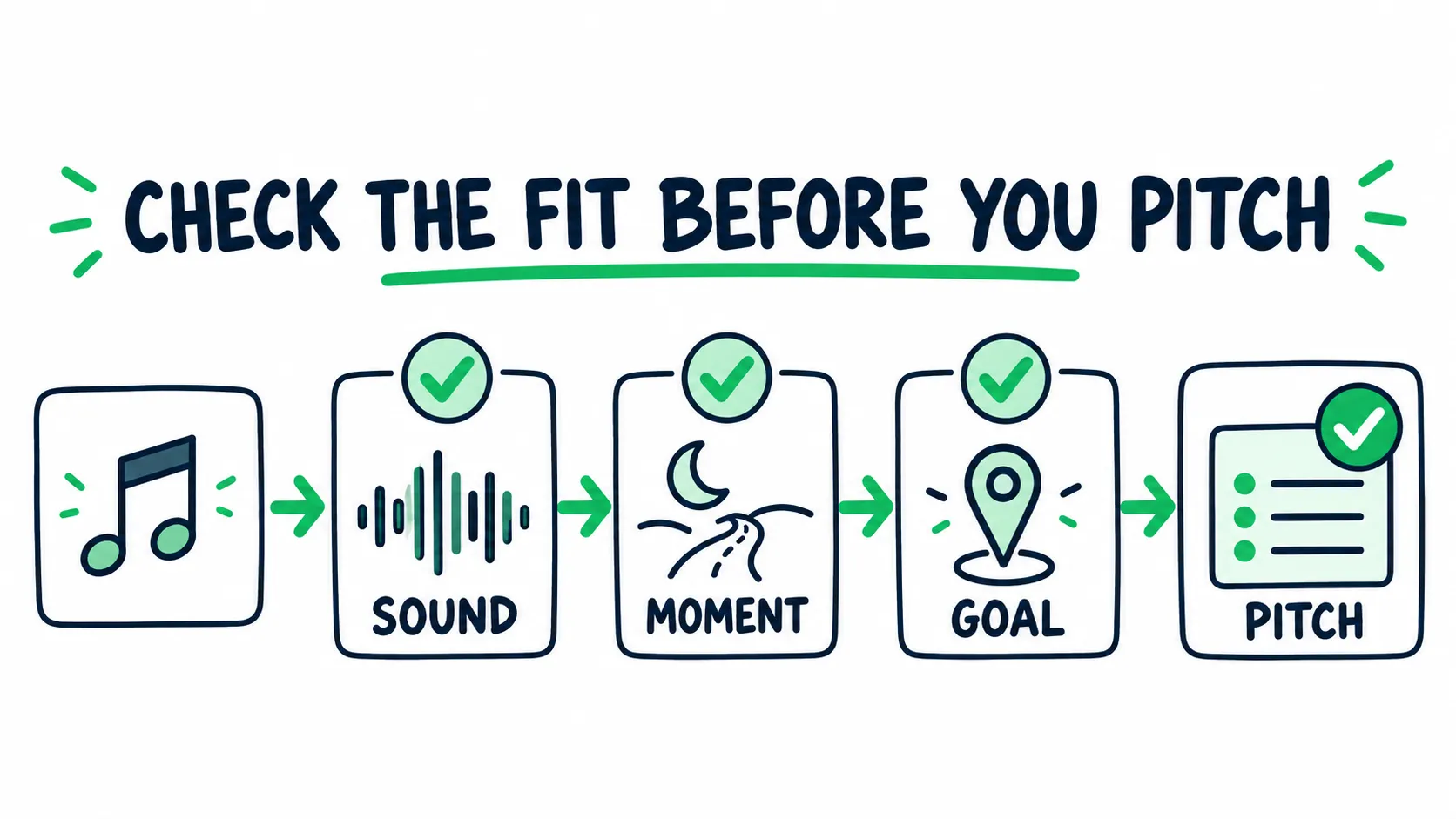
Check the song, the listening moment, and the goal before you pitch the list.
Sort your shortlist into three piles: pitch, test, pass.
| Check | Pitch | Test or pass |
|---|---|---|
| Song fit | Your track could sit beside several recent adds. | If the list jumps between sounds, test one song before making it a regular target. Pass if the mood is wrong. |
| Activity | The curator still adds music, and the list has a clear point of view. | An old list with no recent adds may not be worth a pitch. |
| Audience | The language, place, and mood fit the fans you want to keep. | A huge list in the wrong lane can lift a number without helping your next release or show. |
| Contact | The curator names a public way to submit and keeps control of what gets added. | No public route means you move on. Do not chase a private account. |
| Your history | Similar lists brought saves, repeat plays, or catalog listens. | If you have no history, send a small first batch and learn from it. |
A follower count cannot predict how many people will hear your song. Your own data shows that after the add.
Say your slow R&B track has found listeners in London and you have a show there next month. A London late night soul list could support that plan.
A much larger workout list may add more short term plays, but it gives you little reason to expect those listeners at the show. If that show is the goal, pitch the London list first.
Keep one sheet with track, playlist, link, curator, why it fits, pitch date, reply, add date, and result. On the next release, start with curators who liked your work and lists that sent listeners who stayed.
If a strong list has no public inbox, do not guess an email. Use its stated form, or try a free playlist submission route to get the track in front of curators who accept music. Log any add in the same sheet.
Submission sites and curator databases are other routes. The Daily Playlists review and Playlist Supply review show what each one costs and what artists report.
Know When To Pass
Believe the track list over the genre tags. If a curator claims to take folk, drill, jazz, and hard techno, but their last twenty adds are house, send your folk song elsewhere.
Leave if someone asks for your Spotify password. Check Spotify’s guidance before buying any promise of streams or a guaranteed slot. A large follower count with no recent music is worth a second look. None of these clues proves a list uses bots by itself.
If you choose a paid playlist placement, run these checks on the named list before you select it. Knowing you will get an add does not tell you whether its listeners want your song. The Spotify promotion service check covers what else to verify before you pay.
How To Pitch A Spotify Playlist Curator
A curator needs to know which list you mean, why this track fits it, and where to hear the song. A long artist bio makes them do more work. So does a link that opens a page with six choices instead of the track.
Use the form if the curator asks for one. For a public email, try a note like this. The names and songs below are made up:
Subject: "Halfway Home" for Night Drive Soul

Hi Sam,

I found Night Drive Soul through "Slow Glow."
I like how the last few songs keep the vocals soft and the bass warm.

My new track, "Halfway Home," has that same late drive feel.
Fans kept asking for the studio version after our last two shows.

Spotify: [track link]

If you are taking songs for the list, I would love for you to hear it.
Thanks,
Mira
Replace the show detail with your own proof, or leave it out. Do not invent a story to look bigger.
Send one song. If it is not live yet, check whether the curator accepts a private preview and include the release date. A pre-save link is not a way to hear the track. If there is no answer after a week, send one short follow up, then stop.
If the curator adds the song, save the playlist URL and the date. Check the track in the list yourself. Save the prior week’s numbers from Spotify for Artists, and thank the curator without asking for a longer stay.
If they pass and give a reason, tag it in your sheet: sound, timing, or list rules. One rejection does not mean the song needs a new mix. It may mean this was the wrong list.
Spotify editors work differently. You pitch them through one form, and there is no editor email to chase.
Can You Get On Spotify Playlists After Release?
The normal Spotify editorial form closes once the track goes live. Curator outreach can still work.
First, check the song’s early response. If people are saving it and finding other tracks in your catalog, shortlist curators whose listeners want that sound. If most of its plays came from one broad list and stopped there, tighten the audience before pitching more of the same.
Independent curators can review released music if their rules allow it. Send the live track link and one clear reason it belongs on their list. You can also build a playlist around a real mood or scene and give your fans a reason to follow it. Keep it useful for listeners, with music beyond your own catalog.
Do not take the song down to chase the editorial form. You would give up a live link and the data you have already earned. Use this release’s data when you pitch the next one.
What About Discover Weekly And Release Radar?
There is no direct pitch to Discover Weekly or Radio. Those lists change for each listener. Spotify looks at listening habits, what people save and add to lists, and other signals. It does not publish a number that forces your song in.
While the add is live, give new listeners a second song to hear. Set Artist Pick to the most natural next listen. If a quiet R&B track brought someone in, your loudest single may break the mood. An older song with the same pull could be the better bridge.
Share a clip with a direct link to the song. Then watch for saves, follows, and plays on the track in Artist Pick.
The algorithmic playlists guide explains the listening behavior behind personalized lists. The Release Radar guide covers its follower and pitch rules.
Read A Playlist Add Like A Campaign
A list with 20,000 followers did not give you 20,000 listeners. Check the listeners it sent in Spotify for Artists.
Save A Clean Before And After View
Record the seven days before the add: daily listeners for the track, saves, artist follows, and plays on the rest of your catalog. Note any ads, posts, shows, or other playlist adds on those dates. Without that line in your sheet, a busy release week can make every channel look like the winner.
While the song is on the list, open Music, then Playlists. Record the list URL, add date, and listeners it brought. Spotify shows a list here only after at least three people have heard your song from it. If the list is missing, open the playlist itself before you assume the curator did nothing.
Then use Source of Streams on the song or audience page. Spotify groups plays from editorial lists, personalized lists, and other people’s lists under programmed sources. A play from your artist page or a listener’s own library sits in active sources.
Spotify explains the source groups and audience segments. You can also filter sources by country, which matters if you are building a city for a show.
Check again after the add ends, then once more a few weeks later. Did daily plays fall straight back? Did people save the song, follow, or play another track? The Spotify monthly listeners guide explains why the headline count can stay high for a while even after the list stops sending people.
Decide What To Do With The Result
| What you saw | What it may mean | Next move |
|---|---|---|
| Many playlist listeners, little change in saves or active listening | The list gave exposure, but few people chose more of your music. | Do not scale the same lane yet. Check song fit and the first few tracks on the list. |
| A modest add, followed by saves, follows, or catalog plays | A smaller group may have matched your sound. | Keep that curator and find nearby lists. Test again on the next release. |
| The song appeared on the list but few listeners show in your account | The audience may be small or inactive. | Log it and put your effort into stronger lists. |
| Plays jumped from an unexpected place or source | Something else may be driving the spike. | Check your other activity and the list before you credit the curator. |
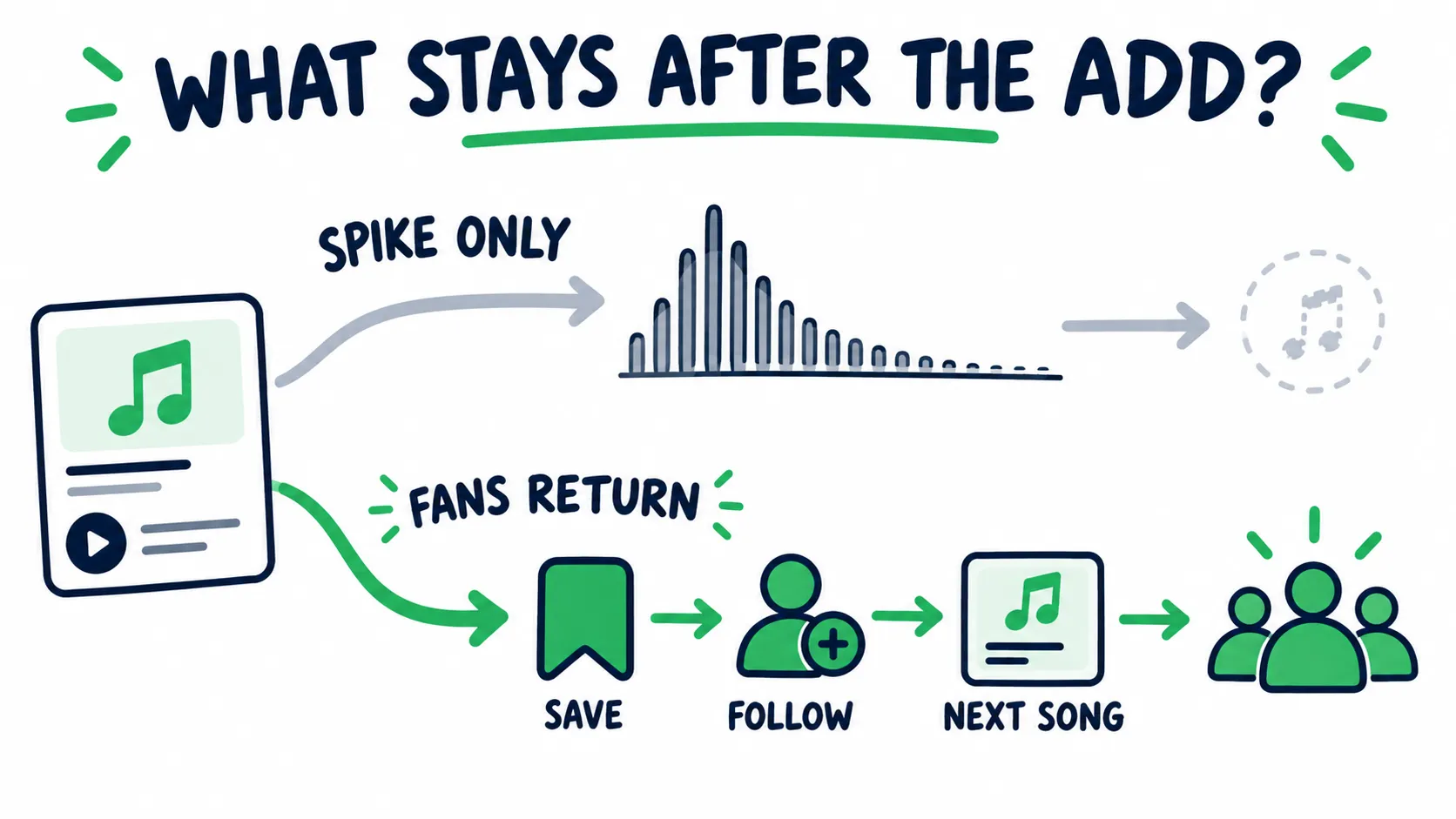
When the add ends, look for saves, follows, and plays on another song.
A busy release week makes attribution messy. If you ran ads and posted a strong clip on the same day, you cannot give every new follow to the playlist. Do not divide all song saves by one list’s listeners and call that its save rate.
Keep the dates and sources together, then look for patterns across releases. The music analytics guide covers the wider problem of measuring channels that run at the same time.
Key takeaway
Wait for saves, follows, or plays on another song before you pitch five more lists like the one that gave you a stream spike.
Turn The Add Into A Listener Brief
Before the song leaves the list, write a four-line brief for your next test:
- Sound: Name two or three artists whose tracks sit beside yours on the lists that worked.
- Place: Note the cities or countries where your audience grew during the test.
- Catalog pair: Name the placed song and the closest next listen in your catalog.
- Proof: Note any saves, follows, active listening, or catalog plays that held after the add.
Use the brief as a lead to test. It cannot prove that one list caused every change. Say two late night R&B lists add your song. Saves rise during those weeks. More London listeners hear your catalog, and an older slow track also gets attention. Pitch nearby late night lists, put the older track in Artist Pick, and watch whether that response holds.
Try another list with the same mood. Post a clip built around that listening moment. Or use mobile ads that open your music in Spotify to reach listeners of similar artists. Keep the two songs in play.
Check the response after the first week and again when the push ends. If only the focus track moves, the song may fit that audience. If followers and a second track rise too, you have a stronger case that the audience fits your music. Repeat that match on the next release.
Run A Small Test Before You Pitch More
From your shortlist, send the first five pitches to the clearest matches. Log replies and the reason for each pass. If the curators say the song is too slow, too heavy, or outside their lane, your shortlist needs work. Sending the same note to fifty more lists will not fix it.
If a curator accepts, record the add date and keep watching while the song is on the list. Check the listener sources before you send the next batch. Keep the lists that sent people who stayed. Drop the lists that gave you a headline number and little else.
Next release, open that sheet before you search for “best Spotify playlists” again. Pull out the five lists you would pitch first, the two songs a new listener should hear, and the result that would make you repeat the lane.
Put the dates in your music release checklist. If you plan to fund another test, set a ceiling with the music promotion budget calculator before a big follower count tempts you to spend more.
FAQ: Getting On Spotify Playlists
We Keep Missing Editorial Playlists. Should We Still Pitch?
Yes. Pitch every eligible release. It is free, and pitching at least seven days before release gets the chosen song into your followers’ Release Radar.
Give editors one useful detail from this release, such as a live response or a local plan. Keep your curator and fan plan moving either way.
How Do I Find Curators With Real Listeners, Not Just Follower Counts?
A public follower count cannot tell you how many people hear the list. Screen each list in three steps:
- Sound: Do recent tracks sit near yours?
- Activity: Is the curator still adding music?
- Proof: Did similar lists send listeners to your past songs?
Pitch a small first batch. If you get an add, check its listeners in Spotify for Artists before sending more.
How Early Should I Pitch If My Distributor Takes Time To Deliver?
Count from the day the track appears in Upcoming, not the day you upload it. You can only pitch once Spotify shows it there.
Leave at least seven days before release for followers’ Release Radar. Spotify recommends two weeks or more for editorial review. Build distributor delivery time into the pre release plan.
Can I Still Pitch A Track That Is Already Out?
Yes, if an independent curator accepts released music. Send the live song link, name the list, and give one clear reason the track belongs there.
Spotify’s normal editorial form closes once the song is live. Use this release’s response to choose a stronger lane for the next pitch.
Why Did A Playlist Raise Monthly Listeners But Not Followers?
One playlist play can raise your monthly listener count. A follow takes another choice. The count uses a rolling 28 day window, which the monthly listeners guide explains.
Check saves, active listening, and plays on other tracks after the add. If those stay flat while playlist plays rise, test a closer song and listener match next time.