
How to Promote Music Without Social Media and Grow on Spotify
You can promote music without social media. You can’t promote it without getting it in front of strangers.
That’s the part the “post three times a day” advice skips. Posting is one way to reach strangers. It’s the way most artists hate, and for a lot of music it isn’t the best one.
The short answer
To promote music without social media, swap posting for three kinds of reach:
- Paid: ads built from music-only clips, and Spotify’s own campaigns.
- Other people’s: playlists, creators who use your song, collabs, radio, and sync.
- Yours: live shows and an email list.
Test the song on strangers first. Then judge every channel in Spotify for Artists.
Promote the music, not your life
Most artists who quit posting don’t hate promotion. They hate being the content: the daily vlogs, the trends, the clips that get 12 views.
You’re also missing less than it feels like. MIDiA’s research on social listening found that discovery “is getting stuck at the song clip”: people hear the hook and never go stream it (MIDiA).
Spotify works differently. More than half of new artist discoveries on Spotify happen in programmed playlists, the editorial and algorithmic playlists Spotify picks for listeners (Spotify for Artists).
What You’ll Learn
- How artists grow on Spotify with little or no posting
- A one-week test that shows whether the song, the clip, or the channel is the problem
- 11 channels compared by time, cost, speed, and what they show in Spotify for Artists
- How to get creators to use your song without becoming one
- A promo week that takes about 2.5 hours and zero posts
Can you grow as a musician without social media?
Yes, as long as the song works on strangers and you replace posting with other ways to reach them. Here’s what artists shared on Reddit:
- One artist with about 60,000 monthly listeners and around a million streams a year hadn’t posted anything of note in three years. Their advice: one single on a decent label, or one solid TV or film sync, does more than two years of posting with no ads.
- In the same thread, a band with 160,000 monthly listeners has about 500 Instagram followers.
- A band reached 111,000 monthly listeners without posting. Someone used a clip of their song in a video, and other people picked it up from there.
- In that thread, another artist reached 7,000 monthly listeners in two months with Meta ads and no content.
Two cautions. Some “mystery” artists posted a lot early on and deleted it later, and others run ads quietly. And skipping social has a cost. The 160,000-listener band said it’s fine for local gigs, but bookers in other cities look at socials.
So keep one basic profile up, with a pinned post that shows your latest release and your next shows. That’s a signpost for people who look you up. It doesn’t need a posting schedule.
Key takeaway
Is the problem your music, your clip, or your channel?
Find out before you pick a channel: send a few hundred targeted strangers to the song and see if they replay and save it. No channel can fix a song that strangers skip.
A small ad test works well for this:
- Pick a song with little playlist or Radio traffic right now, so the test traffic stands out.
- Target fans of two or three artists close to your sound, in one country.
- Send them straight to the song. When you scale up later, send people to your profile instead.
- After 7 days, compare the song with the 7 days before. Divide its streams by its listeners, then its saves by its listeners.
Artists who share their Spotify for Artists data often treat under 1.5 streams per listener as a warning sign, and around 2 or more as healthy. For saves, compare with your best song. Our monthly listeners guide shows how to read the rest of the dashboard.
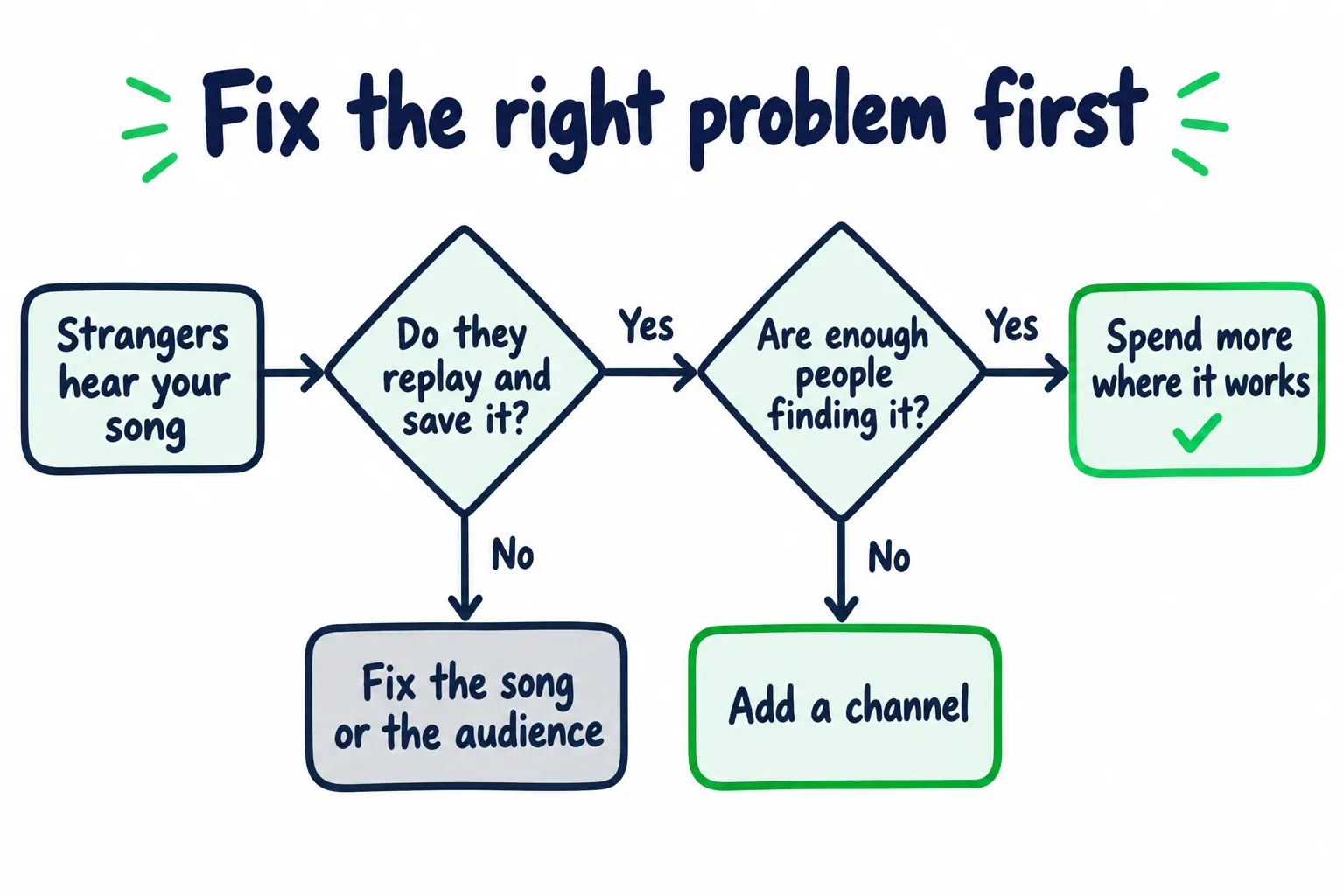
Replays and saves tell you which box you’re in.
| What you see | What’s wrong | What to do |
|---|---|---|
| Strangers play it once and leave | The song, or the audience you picked | Try another song, or a different set of similar artists, before spending more |
| Lots of ad clicks, few Spotify plays | The clip or the path to Spotify | Build the clip around the song’s best 10 seconds, and test the tap-to-play path on your phone |
| People replay and save, but few find it | The channel | Add one of the channels below |
| One channel works, then stops growing | You’ve reached most of that audience | Add a second channel before adding more money to the first |
If you’d like a second opinion on the song and your profile before you spend, get a free Spotify audit.
What are the best ways to promote music without posting?
The best options are music-only ads, Spotify’s own tools, playlists, creators who use your song, collabs, radio, sync, live shows, and email. They fall into three groups, and the strongest plans use at least one from each.
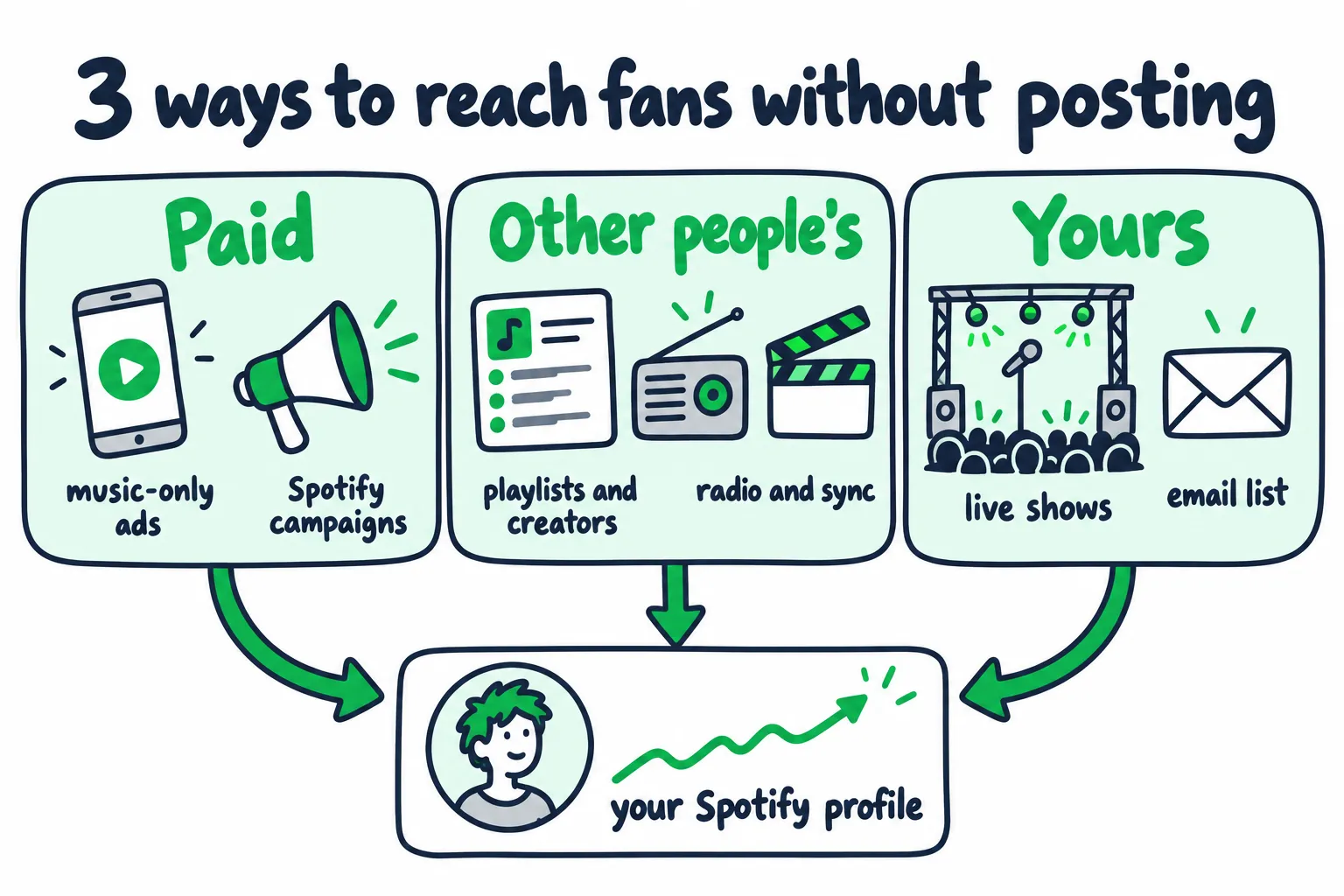
All three routes end at your Spotify profile, so judge them in one place.
| Channel | Your time | Cost | How fast | What shows up in Spotify for Artists |
|---|---|---|---|---|
| Music-only ads | Medium to set up, low after | Low to medium | Days | Profile and playlist plays in the countries you target |
| Spotify pitching | Low | Free | On release day | Editorial plays, plus Release Radar for your followers |
| Showcase, Marquee, Discovery Mode | Low | $100+ budgets, or a 30% commission | Days | More plays in the market or contexts you pick |
| Playlists and curators | Medium | Free to medium | 1 to 3 weeks | Plays from other listeners’ playlists |
| Creators using your song | Medium | Free to medium | Hard to predict | Jumps in search and profile plays |
| Collabs and features | Medium | Free, plus a split | On release | New listeners who found you through the other artist |
| Radio | Medium | Low | Weeks | Search bumps in the places that played you |
| Sync | High | Free to pitch | Months | A spike from search when the scene airs |
| Press and blogs | Medium | Low to high | Weeks | Small, but useful for bookers and sync |
| Live shows | High | Low | Same night | New follows and profile plays from that city |
| Email list | Low | Free to low | Release day | Plays from people you already reached |
Rough planning ranges, not benchmarks. Your genre and budget will move them.
Ads built from the music alone
Ads are the fastest way to reach strangers without posting. Use a clip where the music does the work: a live take, a visualizer, a lyric clip, or your cover art with motion.
Meta ads run from a Facebook Page, so you need one. It doesn’t need daily posts.
Two setup details decide whether clicks turn into plays:
- Use Ads Manager instead of the Boost button. A boost buys reach for a post. An Ads Manager campaign lets you tell Meta to find people who tap through to your music.
- Send people where their plays count. Send the ad to a landing page that records the tap, and have that page open your profile or “This Is” playlist. Our monthly listeners guide explains why that destination matters.
Ads tend to bring listeners before they bring fans, so pair them with something you own, like an email list or your next show. Check the numbers first with our Meta ads for Spotify calculator, and see how ads compare in Meta ads vs playlist pitching.
Let other people post your song
If you don’t want to make videos, get your song into other people’s videos. That’s how the 111,000-listener band grew, without asking anyone.
You can help it along:
- Make sure creators can find it. Ask your distributor to deliver the song to TikTok’s and Instagram’s music libraries. Most distributors offer this.
- Pick the moment. Find the 10 to 15 seconds that work under someone else’s video: a drop, a hook, or a line that fits a mood.
- Find pages that match that moment. Think by niche: car edits, gaming clips, fitness, travel, film edits, or fan pages for artists like you. A page whose videos already fit your sound beats a big general page.
- Make the ask easy. Send the clip, the song name as it shows in the library, and one line on why it fits their videos.
If you pay a creator or give them anything of value, have them turn on the platform’s paid label. TikTok requires it for paid posts (TikTok), and so does Instagram. If the creator talks up the song, FTC rules apply too, and as the one paying, you can be held responsible (FTC). Ask for a link to every video and check the label.
Playlists and collabs
Both put your song in front of listeners who already trust someone else’s taste.
Independent playlists work best when the playlist sounds like you and its listeners save songs. Our guide on how to get on Spotify playlists covers finding and pitching those curators, and you can start with free playlist submission.
A feature with an artist close to your sound reaches their fans on release day, with no posting from you. Plan who promotes what, and when, in your collab release plan.
Spotify’s own tools
Pitch every release to Spotify’s editors at least 7 days before it comes out. When you do, Spotify adds the song to your followers’ Release Radar (Spotify). It’s free and needs no posting.
Editorial and algorithmic playlists do a lot of the discovery work on Spotify. Over a quarter of new artist discoveries come from Mixes, Radio, and Autoplay. Fresh Finds, Spotify’s editorial program for independent artists, drove over 65 million new artist discoveries in a single year (Spotify for Artists). Our guide to Spotify editorial playlists covers how to write the pitch.
Once you’re eligible, Showcase, Marquee, and Discovery Mode add paid reach inside Spotify. Each one unlocks at a different level, so check the full listener ladder and our Marquee vs Showcase guide.
Whatever brings people in, aim for saves. Spotify says that six months after saving a track, a listener streams it about 3 times more than before they saved it (Spotify for Artists).
Radio, sync, and press
These channels move slower, but someone else does the talking for you.
- Radio. AM/FM radio ranked third in Edison Research’s music discovery report: 58% of Americans 12 and older use it to find music (Radio Ink). Pitch college and community stations, the hosts of shows in your genre, and BBC Introducing if you’re in the UK. Then check where people Shazam you in Apple Music for Artists.
- Sync. A placement in a show, film, game, or ad sends people to search for your song. The 60,000-listener artist above ranks one solid sync above years of posting. Before you pitch, have instrumentals and clean versions ready, and make sure you and every co-writer can say yes fast, for both the recording and the song.
- Press and blogs. Most useful when coverage helps something else, like a tour, a booking, or a sync pitch. If you sell on Bandcamp, pitch Bandcamp Daily about 8 weeks before release. Its editors get around 1,000 pitches a week (Bandcamp). Keep an EPK ready for every pitch.
Each of these pays through a different path, so set them up before you pitch:
- The song: join a PRO and register every song. Your PRO collects songwriting royalties when radio and TV play your music.
- The recording: in the US, AM/FM radio pays nothing for the recording itself. SoundExchange collects recording royalties only from digital radio, like satellite and webcasters (SoundExchange).
- Sync: the fee is negotiated in each deal. Agree splits with your co-writers before you pitch.
Our music royalties guide covers the full registration stack.
Shows and email: the reach you own
Shows and an email list reach people who already chose you, and you keep both if a platform changes its rules.
- Get the follow while they’re standing there. One performer who plays over 100 shows a year went from 39 to 254 Spotify followers in four months. On breaks, this performer talks to people who reacted during the set and has them follow from a QR code on the spot.
- Ask local venues and shops to add you to the playlists they play in the room.
- Collect emails at the merch table and on your music website.
- Email on release day. Spotify says artist profiles get 77% more visits when new music drops (Spotify for Artists).
- Turn on Bandcamp follower emails if you sell there. Bandcamp emails your followers when you release, and calls those emails “one of the biggest drivers of artist revenue” on the site (Bandcamp).
How much time does promotion take without social media?
About 2.5 hours a week, plus your shows, once you keep to the channels that work for you. Here’s a sample week.
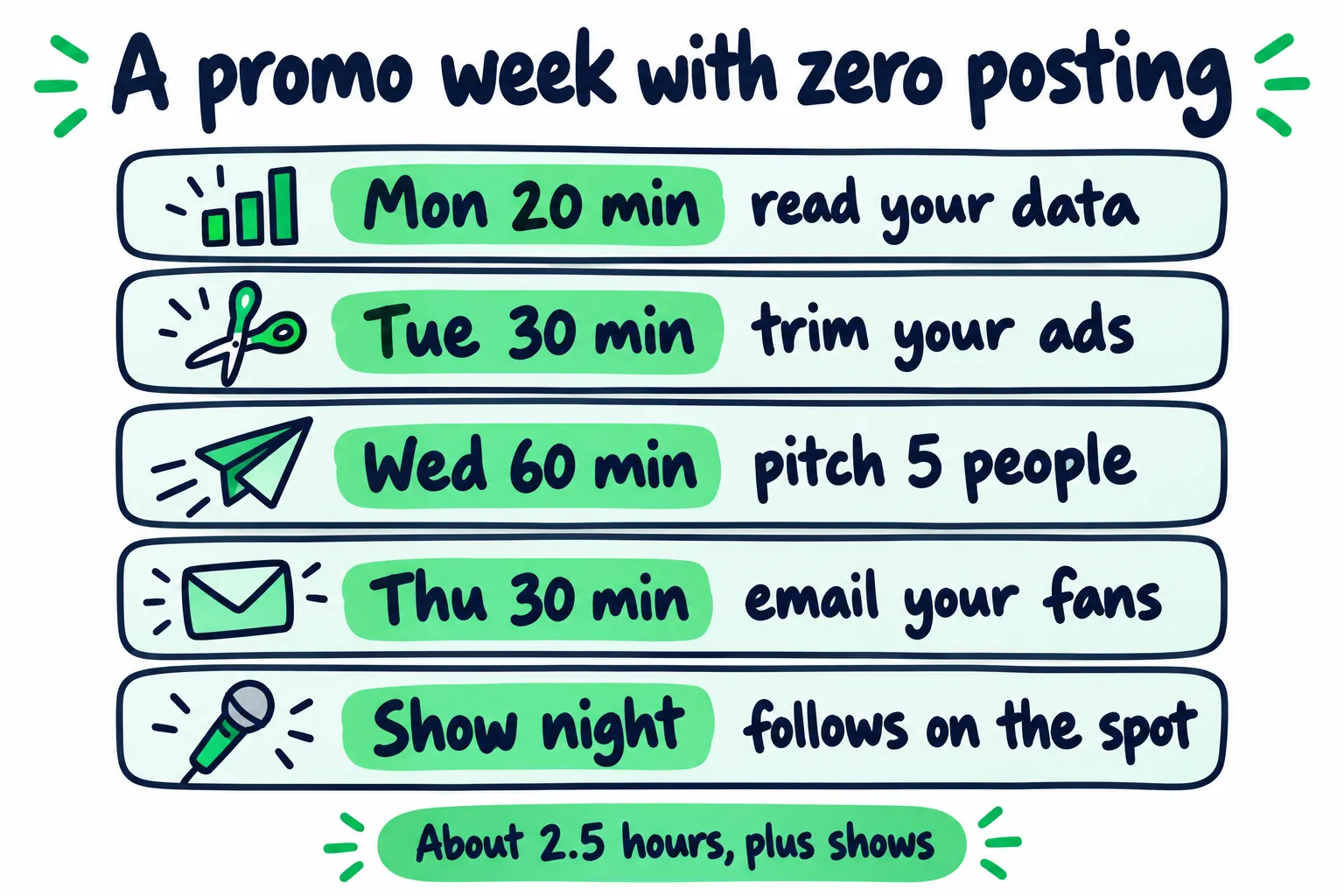
Monday’s 20 minutes decide where the other two hours go.
| When | Time | What to do |
|---|---|---|
| Monday | 20 min | Read your data: streams and saves per listener for the song you’re pushing, plus where its streams come from |
| Tuesday | 30 min | Trim your ads: cut the weakest audience or clip, and leave the rest running |
| Wednesday | 60 min | Pitch 5 people: curators, creators, radio hosts, writers, or sync contacts |
| Thursday | 30 min | Email your fans, or draft the next email around a release or show |
| Show night | Your set | Get follows on the spot with a QR code |
Skip any row that doesn’t fit this release. If you don’t run ads, put those 30 minutes into pitching.
Keep a simple log of who you pitched and what happened. After a month, you’ll know which channel to give more time and which to drop.
How do you vet paid help when you stop posting?
Ask every paid service for proof you can check yourself, and walk away from anyone who promises a number of streams. Once you stop posting, you’ll get pitched by people who want to run the other channels for you. Here’s what to ask each one.
| Who’s pitching you | Ask for this | Walk away if |
|---|---|---|
| Radio pluggers | The station list before you pay, and the play logs after | They won’t name the stations |
| Creator campaigns | A link to every video, each labeled as an ad | They can’t show you the videos |
| Sync libraries and agents | Whether the deal is exclusive, and any upfront fee | You’d sign over your catalog with no proof of recent placements |
| Spotify promotion and ad services | Targeting built around listeners of artists like you, and results you can read in your own Spotify for Artists | They promise a set number of streams |
That last line matters most. Spotify says paid services that guarantee streams aren’t legitimate, and using them can get your music removed (Spotify). Our guide to making money from your music covers sync deals in more depth.
If you’d rather hand off the Spotify side, see how our Spotify promotion works.
FAQ: Promoting Music Without Social Media
Can you be a successful musician without social media?
Yes. Artists grow through syncs, labels, live shows, playlists, ads, and other people’s videos.
You still need some way to reach strangers. And bookers outside your city may still look at your socials, so keep one basic profile up to date.
How do you grow on Spotify without social media?
Pitch every release at least 7 days early, so it reaches your followers’ Release Radar. Run small music-only ad tests, and get on playlists that fit your sound.
Then judge it all by saves and streams per listener in Spotify for Artists.
Do you need TikTok to promote music?
No. TikTok helps when a song catches on there, but plenty of people who hear a song on social never stream it.
You can still reach TikTok’s audience without posting by getting creators to use your song. If you do want to post, our TikTok guide for musicians covers it.
How long does promotion without social media take to work?
Ads and pitching show results within days to a few weeks. Radio and press take weeks. Sync and a live following take months.
Give any new channel at least one full release before you judge it.
What should you do first if you stop posting?
Run the stranger test on your best song. If people replay and save it, add one paid channel and one channel you own, like an email list.
Add more channels only after those two are working.