
Lyric Video vs Music Video: Which Is Better?
A weak $5,000 music video can do less for a song than a sharp $500 lyric video.
The Short Answer
Make a lyric video if the words are the hook, time is tight, or you need to save more of the budget for promotion.
Make a music video if people need to meet you, see you perform, or step into the world of the song.
If both matter, release them at different points and give people a fresh reason to watch each one.
Why This Choice Gets Expensive
The song is done, a few clips are moving, and maybe your monthly listeners are climbing. Now the team must choose between a full shoot and a leaner visual that leaves more cash for the push. With traction, a big shoot can feel like proof that you have reached the next level.
But it can also eat the money needed to get the song heard. Waiting for the perfect idea can leave you with no useful visual on release day.
Before you spend, get clear on the song’s role. Is it the lead single, a supporting track, or a song that has already earned another push? That role decides how much the visual needs to carry.
What You’ll Learn
- Which format fits your current growth problem
- How to set the budget and judge the full value
- When to release one video or both
- What to lock before production starts
- How to measure the result beyond views
Lyric Video vs Music Video At A Glance
Both formats play the full song. They differ in where they point the viewer’s eyes.
| Decision | Lyric video | Music video |
|---|---|---|
| Main job | Make the words easy to follow, remember, and share | Make the artist, performance, story, or visual world stick |
| Best fit | Songs led by the words, album tracks, quick campaigns, smaller budgets | Lead singles, press pushes, artist growth, songs with a strong concept |
| Main risk | Unreadable text, bad timing, or template visuals that feel generic | A weak concept that looks costly but says nothing |
| Useful outputs | Full video, hook clips, quote moments, vertical lyric edits | Full video, performance clips, stills, teasers, behind the scenes footage |
Neither format wins every time. The better choice is the video that does its job at a quality your audience will trust.
Find The Bottleneck Before You Pick The Format
“Which video is better?” is too broad to guide a real budget. Ask what is holding the release back now.
The problem may be song understanding, artist recall, or weak conversion from casual viewers to followers. It may be a lack of good content for the next six weeks. Each of those problems calls for a different video.
| What you see | Likely bottleneck | Better starting point |
|---|---|---|
| Fans quote lines, ask what a word means, or keep replaying a dense verse | The words create demand, but people cannot fully enter the song | Lyric video |
| The song gets reach, but channel follows and profile follows stay soft | People know the track better than they know the artist | Music video |
| Fans know your face, but the campaign runs out of strong clips fast | You need a planned bank of useful content | Performance led music video |
| Most posts get weak clicks and poor watch time, no matter the format | The hook, idea, or packaging is weak | Fix the creative before funding either video |
| The song is ready, but a full shoot would miss the release or kill the media budget | Time and cash are the limits | Lyric video or a focused hybrid |
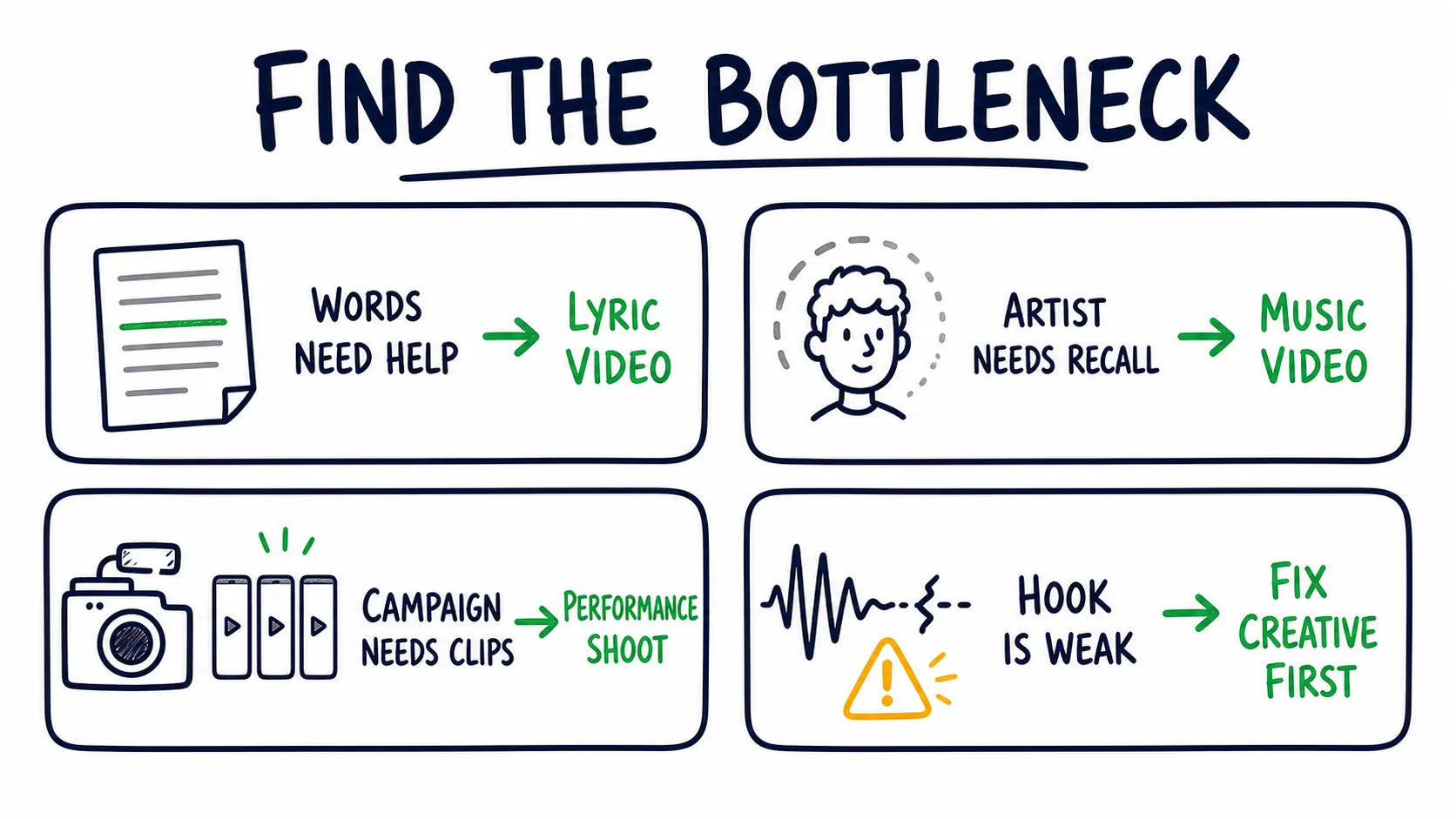
Diagnose the limit first. Then choose the visual built to remove it.
Read your own signals before you copy another artist’s rollout. Look at comments, saves, profile actions, subscribers, returning viewers, and which clips people finish. Compare the song with your last few releases, since a global benchmark tells you little about your audience.
Use this order when the signals disagree:
-
Behavior beats compliments. A save, follow, replay, or second video view tells you more than “this is fire.”
-
Patterns beat one loud comment. Ten people quoting the same line is a clue. One person asking for a lyric video is a request.
-
Conversion beats reach. A clip with fewer views may matter more if it sends people into your catalog.
-
Your data beats habit. “We always make a music video for the lead single” is no reason to make this one.
Then finish this sentence:
After watching this video, the right viewer should __________.A useful answer might be “understand the second verse,” “remember my face,” “watch another song,” or “share one line with a friend.”
“Get more views” is too vague to be a video job. Views are an output, and they do not tell the team what to make or why someone should care.
Your music marketing strategy should define the audience and the proof this release needs to create. The video should solve one part of that plan.
When A Lyric Video Creates More Value
A strong lyric video is a fan tool. It helps people learn, quote, search, share, and return to the song.
The Words Are Already Driving Behavior
Look for proof: fans quoting the same line, clips holding longer with words on screen, or people asking about a name, reference, or fast verse. A lyric video makes that part of the song easier to use.
This often fits rap, singer songwriter music, worship, story songs, direct pop, and tracks with a featured verse that brings in a new fan base.
The Song Needs Depth, Not A New Persona
Some records grow when the listener sits with the words, and a full concept can pull focus from that. For a supporting single, a lyric video also creates a lasting search result without spending lead single money.
Speed Has Real Financial Value
Finishing sooner protects the release date, cuts reshoot risk, and saves cash for media, creators, press, or the next single. Waiting for a larger visual can mean missing a live moment.
One Design Can Cover More Of The Campaign
A good lyric system can produce the full video, vertical hooks, quote cards, language versions, live loops, and clips for several verses.
Plan that system before animation starts. Type that only works in a wide frame will force each vertical edit to be rebuilt.
The main lyric video risk is artist invisibility. The song may grow while the artist stays faceless. If your data already shows weak artist recall, use original photos, short performance shots, or a brief on camera opening.
Every lyric still needs a human check. Names, slang, accents, backing vocals, and ad libs are common failure points. YouTube warns that automatic captions can get the words wrong, so use them as a rough draft and check every line against the master. YouTube automatic caption guidance
Key takeaway
When A Music Video Creates More Value
A music video earns its larger cost when the song has attention but the artist needs stronger recall, meaning, or proof.
The Track Is Outrunning The Artist
This often happens after playlist reach or a strong short clip. People know the hook, but follows and second song views stay soft.
That is an identity gap. A strong performance or concept can link the voice to a face and point of view, which gives the viewer a reason to care about the next release.
The Visual Can Change How The Song Is Understood
The best concepts add tension, reveal a second meaning, or create one image tied to the record instead of acting out each line.
Before you approve the treatment, ask: What does the camera add that the audio and cover do not? If the answer is “production value,” the idea is still weak.
The Release Has Other Buyers To Convince
Press, bookers, managers, service teams, brand partners, and festival buyers may use the video as proof of taste and stage presence. Still, make it for fans first. A strong fan asset also gives your EPK more weight.
The Shoot Can Become A Content System
One planned day can produce the full video, clean takes, vertical hooks, photos, thumbnails, teasers, and behind the scenes clips. Put each asset in the shot list. “We will grab social content on set” is not a plan.
The main music video risk is buying scale without buying a better idea. A warehouse, haze, and a slow camera move are not a point of view. If the treatment could fit twenty artists, it is not yet earning a music video budget.
Do Not Ignore The Useful Middle
You can do more than animated text or a large story shoot. A hybrid can solve a narrow problem with less risk.
| Hybrid format | Best use | Main risk |
|---|---|---|
| Performance with lyric callouts | Connect the face to the song while keeping key lines easy to share | Too much text can fight the performance |
| One location performance film | Show presence and styling without the cost of a full story | A weak performance has nowhere to hide |
| Live session | Prove musicianship and give current fans a new version | Poor live audio can lower trust fast |
| Original visualizer | Give a supporting track a visual world without a full shoot | A short loop can feel empty across a full song |
Pick a hybrid because it matches the bottleneck, not because the team could not agree. A focused middle option can be strong. A watered down compromise rarely is.
The Quality Floor Matters More Than The Format
Every format has a point where it starts to feel finished. Go below that point and fans notice the weak parts before they notice the song.
A lyric video can be simple, but it still needs clean type, exact timing, strong contrast, and one idea that holds the whole thing together.
A small music video can work too, as long as the idea fits the money. One great room and one sure performance will beat five rushed locations and half a story.
Use these ranges to shape the idea, not as price quotes. Crew rates, travel, set needs, and your market can move the total a lot.
| Total visual budget | Credible options | What to avoid |
|---|---|---|
| Below $500 | Well planned DIY performance, clean lyric video, artwork with simple motion | A fake film concept with no crew, time, or lighting plan |
| $500 to $2,000 | Custom lyric video, controlled performance video, edit from footage you have | Too many locations, actors, effects, or story beats |
| $2,000 to $7,500 | Small crew performance or concept video with short campaign edits planned | Spending it all on the main video and leaving nothing to promote it |
| Above $7,500 | Directed story, stronger sets and styling, larger crew, bigger asset package | Adding scale without adding a better idea or a stronger release plan |
Reserve cash for ads, creators, press, artwork, travel, editing, and problems first. What remains is the safe limit for the video.
No fixed split fits every artist. Strong organic reach may lower the need for paid media, and a small owned audience may raise it. Base the split on the bottleneck and your past results.
Run the full release through the music promotion budget calculator and use the music promotion cost guide to check the costs that are easy to miss.
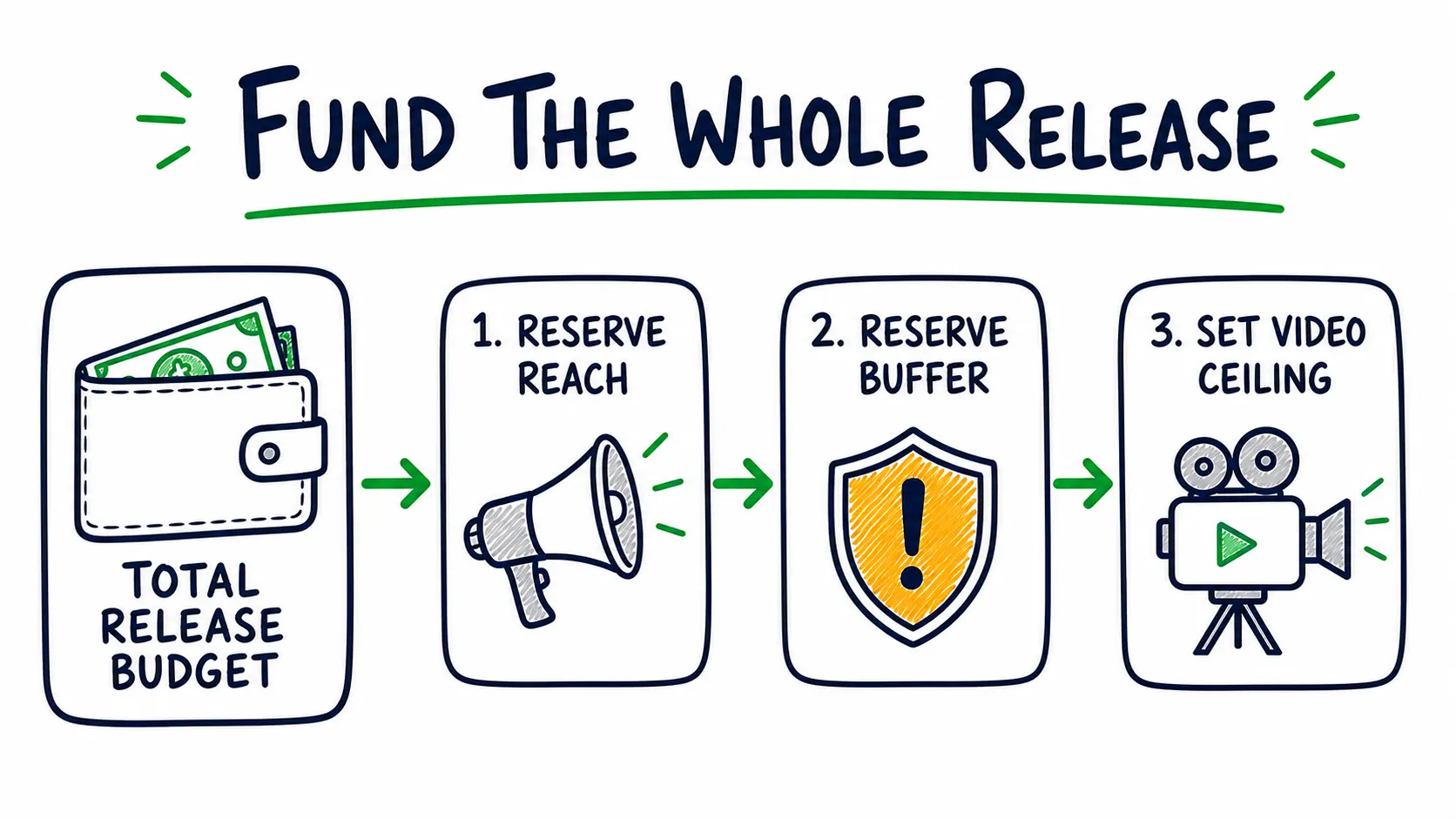
Reserve the money that helps the release travel before deciding how large the video can be.
Judge The Full Economics, Not Just The Quote
The quote is only the visible cost. Add travel, props, talent, locations, revisions, licensed footage, storage, and extra edits. Then count what the job can produce.
Effective visual cost = production + extra costs + required follow up work

Cost per posted asset = effective visual cost / assets you approve and publish
Count only what gets posted: a piece that fits the artist, has its own hook, and has a place in the plan.
A $3,000 shoot with a full video, ten strong clips, four stills, and a thumbnail may beat a $700 edit that gives you one file. The cheaper job may still be the better deal if most of those extra clips would never be posted.
Ask these questions before you sign:
- What part of the campaign gets cut if the quote rises by 20 percent?
- Does the video still make sense if paid reach performs below plan?
- Are we funding proven demand or trying to create proof with production alone?
- Which files will still have value after the release window closes?
- Would a smaller concept leave enough money to test and learn before the next single?
Agree on the files, rights, and revision limits before work starts. Surprise fees show up when you ask after the final edit.
Lyric Video Deliverables
- Full horizontal master
- Two or three vertical hook edits
- Text that stays clear on a phone
- Clean background loop when possible
- Approved lyric or caption file
- Thumbnail image
- Written terms for revisions and source files
Music Video Deliverables
- Full horizontal master
- Vertical performance and story edits
- Clean clips without titles for later ads
- Thumbnail options or sharp frame grabs
- Selected still photographs
- Behind the scenes footage
- Clear rights to use every delivered asset
Plan a Spotify loop as its own edit. A Spotify Canvas has a different shape and job than a full song video, and cropping the main video at the last minute often gives you the weakest part of both formats.
Should You Release The Lyric Video Or Music Video First?
No fixed “lyric video first” rule exists. When the official video is ready, YouTube suggests releasing it with the audio. Its artist guide links that plan with stronger early views and subscriber growth in YouTube’s data. YouTube release day strategy
The guide says not to drop other release videos at the same time. Shorts are fine because they offer a different way to watch. If the full video is not ready, YouTube lists lyric videos, visualizers, live videos, and art tracks as useful options.
In a real campaign, that looks like this:
| Situation | Release plan | Reason |
|---|---|---|
| Official video is ready | Release it with the song. Use Shorts and teasers around it. Only make a lyric video later if it adds something new. | Your strongest visual is there when interest is fresh. |
| Official video is coming later | Put out a lyric video or another useful visual with the song. Bring the official video out around a real second moment. | The song has a good home now, and the later video still has a reason to exist. |
| EP or album rollout | Use the official video for the main song. Give lyric videos or visualizers to the tracks that support it. | Your best money follows the main song while the full project still feels cared for. |
YouTube also suggests spreading different kinds of release content across days or weeks. YouTube audience growth guide
Do not turn that into a content treadmill. Three posts built on the same chorus are one idea. Lead one with the lyric, one with the artist, and one with the story behind the line.
Make The Second Video Pass An Evidence Gate
A second video needs both a new job and a real trigger, such as a tour or a rising save count. “It has been four weeks” does not count.Good triggers include:
- Organic views, searches, saves, or comments are still rising
- A tour, live session, press feature, or major show creates a fresh moment
- A feature, remix, or new audience gives the song another entry point
- Fan questions reveal a story the first video did not tell
- The new video can move a weak metric, such as artist recall or catalog depth
If none are true, the second video may only split attention and add cost.
Two videos compete when they target the same people with the same promise. Using the same song is fine, as long as each video pulls from a different pool of attention.
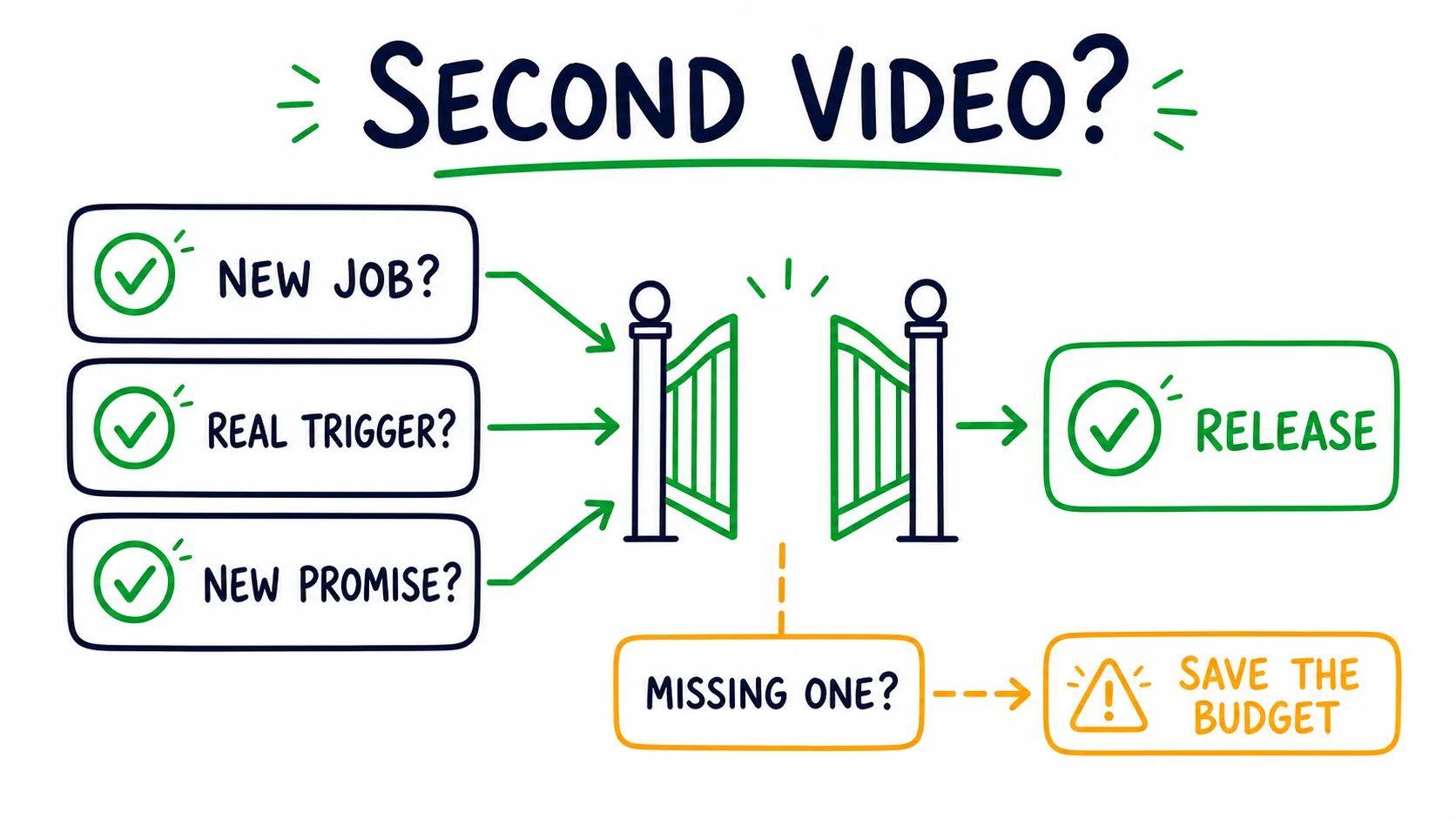
A second upload earns its budget only when all three gates are open.
Map that full run with the pre release strategy guide. Then keep the uploads, rights, and release tasks inside the music release checklist, so a missing thumbnail or caption file does not become the last minute emergency.
How YouTube Treats Each Format
YouTube can count views from official music videos, lyric videos, and fan videos that use the official song in its Top Songs and Top Artists charts. The Top Music Videos chart is for official music videos. YouTube Charts and Insights
On an Official Artist Channel, the automatic Music videos row mainly pulls in official videos and art tracks. Your other uploads can still live in the normal Videos row. YouTube Official Artist Channel sections
YouTube says viewers use the title and thumbnail to decide if a video is worth their time. Most top performing videos use a custom thumbnail. Test yours at phone size. YouTube thumbnail and title tips
Words inside the video do not replace a caption track. Upload one so viewers can control it and you can add languages later. YouTube caption guide
For rights, claims, and payment paths, use the YouTube monetization for musicians guide.
Use This Video Production Brief
“Make it cool” gets you three rounds of edits and a video no one chose.
Fill this out before you ask for quotes. It lets every vendor price the same job and gives the team something clear to approve.
Song role:
Lead single, supporting single, album track, or catalog revival

Video job:
What should the right person know, feel, or do after watching?

Target viewer:
Who already likes music like this, and what makes this song different?

Creative sentence:
Describe the full visual idea in one clear sentence.

Must show:
Artist, performance, lyrics, story, artwork, product, or location

Must avoid:
Visual styles, references, colors, or ideas that do not fit the artist

Deliverables:
Full video, vertical clips, stills, clean clips, captions, and thumbnail

Release date:
Include the final file date and enough time to review it.

Approvals:
Name the person who signs off on lyrics, edit, color, and final export.

Success check:
Choose the viewer action and release result you will review.
Lock The Approval Gates Before Production
Do not wait for a nearly finished video to decide if the idea works. Approve the risky parts in order.
For a lyric video, use these gates:
- Lyric lock: Approve every word, repeat, ad lib, and spelling choice.
- Style frame: Approve the type, colors, contrast, and visual world on a few key frames.
- Timing pass: Watch the full song with rough text timing before detailed motion starts.
- Vertical proof: Test a dense verse and a chorus on a real phone screen.
- Final check: Review the full video at normal speed, with sound, before export.
For a music video, use these gates:
- Treatment lock: Agree on the idea, references, ending, and what the concept adds to the song.
- Production lock: Confirm the shot list, locations, cast, styling, schedule, and asset map.
- Rough cut: Fix story, pace, and performance choices before color and effects.
- Picture lock: Stop changing shot order once finishing work begins.
- Delivery check: Confirm every wide, vertical, clean, captioned, and thumbnail file in the agreement.
Name one final approver. Everyone can give notes, but one person should send a clear response. Conflicting feedback burns edit time.
The contract should say who can use the footage, project files, fonts, stock, locations, artwork, and talent images. Lock edit rounds, extra costs, cancellation terms, and source file storage too.
Use A Weighted Decision Score
A simple vote can hide the factors that matter most. Use a weighted score when the artist, manager, and creative team see the choice differently.
Score each format from 0 to 2 for every row. Zero means it does not solve the need, one means it helps, and two means it directly solves the need. Multiply each score by the weight, then add each column.
| Decision factor | Weight | A lyric video scores high when | A music video scores high when |
|---|---|---|---|
| Proven audience need | 3 | Fans already use, quote, or ask about the words | Reach is not turning into artist recall or follows |
| Creative advantage | 3 | Type and motion can add meaning to the writing | The treatment adds a clear idea the song lacks on its own |
| Budget fit | 3 | It protects the reach, press, and follow up budget | The full shoot fits without weakening the rest of the release |
| Release timing | 2 | It can be finished well while the moment is still live | The crew and edit can finish without rushing key choices |
| Asset yield | 2 | The design can create many distinct lyric led pieces | The shot list maps to a strong bank of performance and story assets |
| Long term use | 2 | The song needs a lasting lyric and search home | The video will support press, booking, live visuals, and artist identity |
| Execution confidence | 3 | The animator has a strong system and clear lyric process | The director, performance, locations, and treatment are all ready |
One fatal risk can cancel out a strong total. A missing location, weak performance, unclear rights deal, or impossible edit date can stop the project from working. If the totals are close, choose the option with less downside now, and keep the second idea for when the song earns another push.
Measure What The Video Changed
Choose one main result before production and keep it, even if another number looks better later.Use a small set of supporting signals to explain why the result moved.
| Video job | Early signals | Deeper result | Warning sign |
|---|---|---|---|
| Build artist recall | Strong click rate, comments about the artist, profile visits | Subscribers, follows, returning viewers, second song views | The song gets praise, but no one mentions or follows the artist |
| Deepen the lyric | Repeat views, lyric comments, saves, shares of several lines | More catalog listening, fan posts, search demand around the song | Views come from one hook, but people leave during the verses |
| Move people into the catalog | End screen clicks, playlist opens, channel page visits | Second and third song plays, returning listeners, follows | The video holds attention but the next step is unclear |
| Create campaign supply | Number of approved assets with distinct hooks | Weeks of useful posts, lower cost per posted asset, stable performance | Many files are delivered, but the team only wants to post two |
| Support press or booking | Embeds, replies, pitch opens, direct feedback | Features, interviews, better booking talks, partner interest | The visual looks polished but gives the pitch no clear story |
Use your last few similar uploads as the baseline. Compare the first week and month. Note any ads, playlist adds, press, shows, or viral clips that could move the same numbers.
Separate packaging from the video itself. A low click rate may point to the title, thumbnail, or audience. A strong click rate followed by an early drop points back to the video or a broken promise.
Fewer views can still win if they lead to more fans, second song views, press, or useful content. Once the video holds attention, judge any paid push by the same standard. Look for targeted YouTube Ads that shift spend toward viewers who watch, subscribe, and return, with every result checked in your own YouTube Analytics.
On streaming, look for lasting reach instead of one spike. The Spotify monthly listeners guide shows how to read that change without treating every listener like a fan.
Bottom Line
Choose the lyric video when the words already drive fan behavior and easier access can deepen that demand.
Choose the music video when the track is outrunning the artist, or when the visual can add meaning and create useful proof beyond the song.
Choose a hybrid when one narrow job matters more than making either format at full scale.
Make both only when each video has its own audience promise, release trigger, and success measure.
Before you request quotes, fill in the production brief above and set the video ceiling from your full release budget.
FAQ
Should I Release A Lyric Video Before The Official Music Video?
Not by default. If the official music video is ready, YouTube recommends putting it out with the song. Do not drop another release video at the same time.
If it is not ready, a lyric video can give the song a strong home. Save the official video for a real second moment, such as a tour start, press win, remix, or clear jump in fan interest.
Are Music Videos Still Worth It For Independent Artists?
Yes, when the video builds artist recall or adds meaning to the song. It can also give press something to share and create useful clips.
It is a poor buy when the idea feels generic and the shoot takes the money needed to reach viewers. Judge every useful file, not only the full video.
Does Every Song Need A Full Music Video?
No. Put the biggest visual budget behind the song that carries the release. Other tracks can use lyric videos, performance videos, visualizers, or strong art tracks. An EP needs a clear look across the project, not a short film for every track.
Can A Lyric Video Get More Views Than A Music Video?
Yes. Fans may come back to learn the words, check a line, or sing along. Lyric videos do not always win, though. The result still depends on the song, thumbnail, timing, audience, promotion, and execution.
Can A Low Budget Lyric Video Still Look Professional?
Yes. Start with the final song and approved lyrics. Keep the words on time, make the type easy to read, use strong contrast, and stick to one visual idea. A clean lyric video will beat a busy one with late words and piles of effects.