
Music Marketing Strategy: The Practical System Independent Artists Can Use Every Release
Most music marketing fails because it sends the wrong people to the right song. If the first people hearing it are a bad fit, the numbers can move and still mean almost nothing. A good music marketing strategy fixes that before you spend.
The short answer
A real music marketing strategy is a simple way to answer five questions:
- Who is this song really for?
- Where can I reach those people?
- What do I want them to do?
- How will I know if they actually care?
- What do I do next if the signal is good or bad?
If your plan cannot answer those questions, you are guessing with extra steps.
Who this is for
This is for independent artists who have a song coming out and do not want to waste the little money, time, and energy they have. Maybe you are stuck between TikTok, Spotify, playlists, YouTube, blogs, ads, and email. Or maybe you already got streams that disappeared.
What You’ll Learn
- How to build a music marketing plan around real fan behavior
- How to find the right listener before spending money
- How to score a song before pushing it
- How to choose channels by what they prove
- How to know when to stop, fix, repeat, or scale
What a music marketing strategy really is
A music marketing strategy is a plan for turning attention into proof.
| Part | What it means | Weak version | Better version |
|---|---|---|---|
| Goal | The thing you want to prove | I need more streams | I need to know if strangers save this song |
| Listener | The person most likely to care | Anyone who likes pop | Fans of sad pop who listen at night |
| Song | The role of the release | My newest song | The easiest song for new listeners to enter through |
| Channel | The place you test | TikTok because everyone says TikTok | TikTok for hooks, Spotify for listener behavior |
| Signal | The behavior that matters | Views and plays | Saves, follows, replays, comments, and active audience |
Most artists jump straight from song to platform. They drop the track, post the link, send it to playlists, maybe run ads, then refresh the numbers all week.
Key takeaway
The biggest mistake artists make
The biggest mistake is trying to reach anyone who will listen. I get why artists do it: when you are small, any attention feels useful. But listeners are not equal.
One person streams once and forgets your name. Another saves the song, follows you, sends it to a friend, and comes back two days later.
Spotify separates listener value inside its own tools, including audience segments and Super Listeners. Even the platform treats listeners who come back as worth more.
The wrong listener can make a good song look weak. If a playlist sends people who skip, never save, and never return, you may still see a stream spike, but the signal is thin. If a broad ad sends clicks from people who do not like your sound, the clicks look cheap and the result is still weak.
Reach people who are likely to behave like fans before you try to reach more people.The Listener Fit Framework
Before picking a channel, write this sentence:
This song is for people who already listen to [artist type] when they want to feel [emotion] during [moment].
Do not skip this. It tells you who to target, what content to make, which playlists make sense, and what campaign is worth testing.
| Artist type | Weak listener idea | Better listener thesis |
|---|---|---|
| Hip hop | People who like rap | Fans of melodic street rap before going out |
| Pop | People who like catchy songs | Fans of breakup pop on the way to work |
| Ambient | People who like chill music | Listeners who need calm music to work or sleep |
| Rock | People who like guitars | Fans of raw indie rock after a long day |
| Electronic | People who like dance music | House listeners who want warm late night energy |
| Country | People who like country | Fans of story driven country pop on long drives |
| Latin | People who like Latin music | Reggaeton fans looking for a new summer party track |
| Gospel | People who like Christian music | Worship listeners who want hope on a hard day |
| Singer songwriter | People who like emotional music | Acoustic pop listeners who want honest lyrics |
If you cannot write the sentence yet, learn who the listener is before you promote. Read your best comments, check playlist adds, and notice which artists people compare you to.
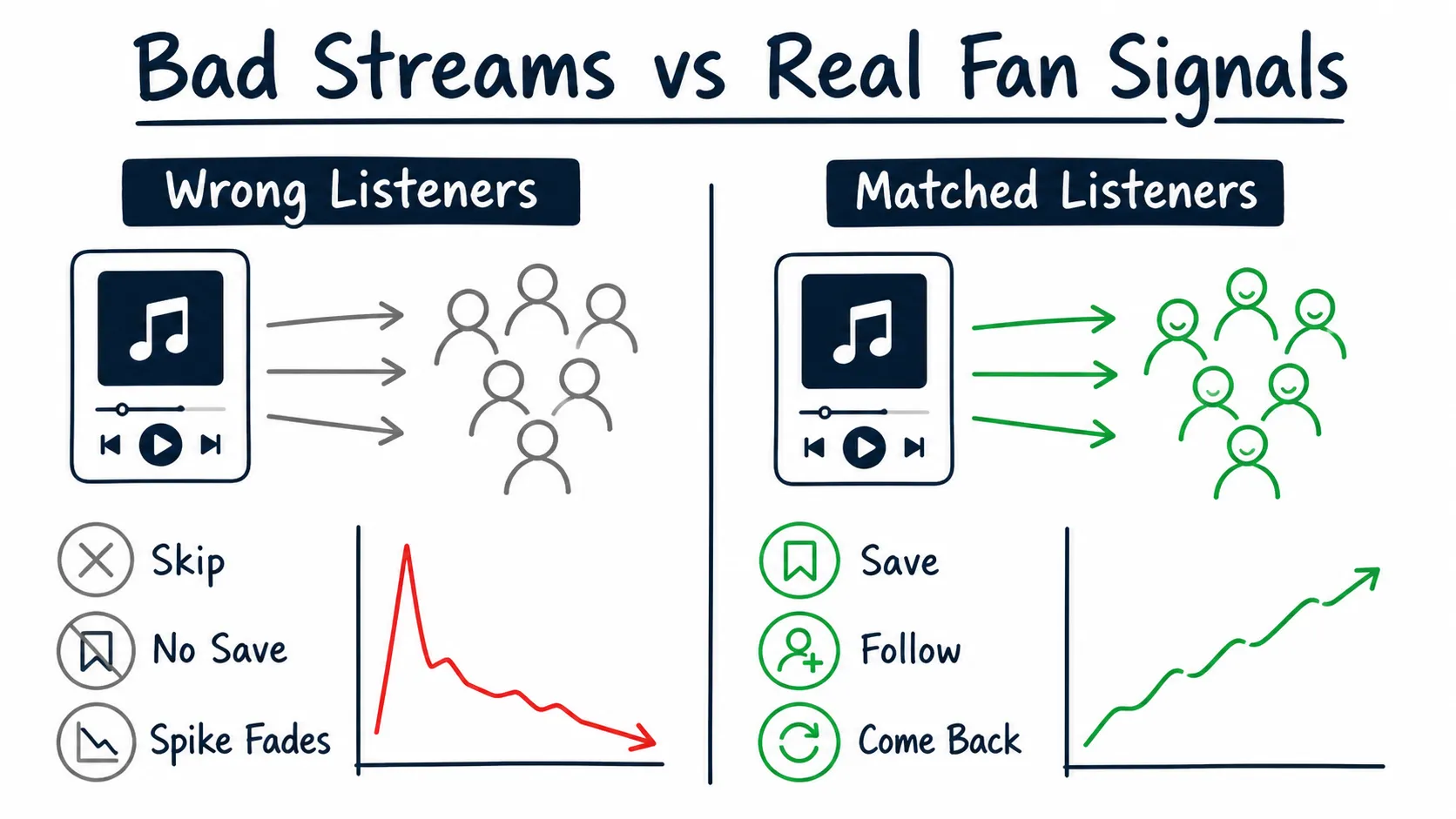
Bad streams can make the graph jump. Matched listeners create signals that last longer.
The Song Signal Scorecard
Some songs are ready for a push. Some need more setup. Some work better as content than as the main release.
The scorecard keeps you from spending real money on a song that is not ready to teach you anything yet. Give yourself one point for each yes.
| Question | Why it matters |
|---|---|
| Is the hook clear fast? | New listeners decide quickly. |
| Can you explain the genre lane in one sentence? | Fuzzy targeting creates fuzzy results. |
| Does your Spotify profile look current? | New listeners often check before following. |
| Do you have at least three content angles? | One post is a guess. Three gives you a test. |
| Does the song fit a clear mood or moment? | People keep songs that fit their life. |
| Do you know what success means? | Saves, follows, views, and email need different plans. |
| Can you check results in Spotify for Artists? | You need your own source of truth. |
| Do you have a plan after release week? | Most songs die because the artist stops too early. |
Score 0 to 3: fix the setup first.
Score 4 to 6: run a small test.
Score 7 to 8: the song is ready for a stronger push.
Choose channels by what they prove
Do not choose a channel because it is popular. Choose it because it answers the next question.
| Channel | What it proves | Best use | Main risk |
|---|---|---|---|
| Spotify promotion | Listener fit and streaming behavior | Saves, follows, repeat plays | Weak targeting |
| TikTok | Fast hook response | Sound moments and story clips | Views without listeners |
| YouTube | Visual attention | Videos, sessions, lyric clips | Views with no next step |
| Playlists | Passive discovery response | Mood fit and listener testing | Low quality lists |
| Blogs | Credibility and search proof | Release story and context | Press with no audience fit |
| Direct fan interest | Releases, merch, shows | Weak signup offer | |
| Live markets | Local demand | Shows, merch, regional ads | Targeting cities you cannot serve |
Treat each channel as a test:
- To test the hook, use short form content.
- To test streaming behavior, send qualified listeners to Spotify and watch what they do.
- For credibility, use reviews, interviews, or blog coverage.
- For money, build email, Bandcamp, merch, or live demand.
That is why a strong Spotify marketing strategy cares about saves, follows, and repeat listening more than monthly listener spikes. It is also why TikTok for musicians works best when the video points to a real song moment instead of random posting.
For visual releases, YouTube Analytics for Artists can show where viewers stay, drop, and return. For paid campaigns, read Meta’s ad objective guide, because the objective shapes what the platform tries to find.
The clean release sprint
Treat the release like a small sprint that starts before release day and keeps going after it.
Before release
Write the listener thesis, clean the profile, and create three content angles. Use the content strategy for musicians to turn those angles into repeatable posts, clear platform roles, and fan signals you can measure.
Pick the first signal you want to prove.
If the song is unreleased, pitch it through Spotify for Artists. Spotify explains the basics in its guide to pitching music to playlist editors.
Release week
Send qualified traffic instead of posting the link and hoping people care.
If the song is built for Spotify discovery, send matched listeners through promotion that moves budget toward listeners who save and follow and shows every result inside your own Spotify for Artists. “Pay for plays” gives you neither.
If playlist discovery fits the song, skip random pitching and use a placement that lets you pick the exact playlist before you pay, so you can check its mood against the track.
If the release has a strong story, music blog promotion can add context before people hear the song.
After release
This is where most artists stop too early. Keep the best content angle alive and send interested people back to the song. Use saves, follows, comments, and repeat plays to decide what deserves more energy.
Key takeaway
The budget gate system
A good music marketing budget starts with one question:
What will this spend prove?
Then use gates.
| Gate | Spend level | What must be true | What to do |
|---|---|---|---|
| No spend yet | $0 | Song, profile, or listener is unclear | Fix basics |
| Small test | $50 to $150 | Song is ready, audience is still a guess | Test one channel |
| Repeat winning angle | $150 to $500 | One angle showed real behavior | Improve and repeat |
| Scale with caution | $500 plus | Fan signals are strong | Raise slowly |
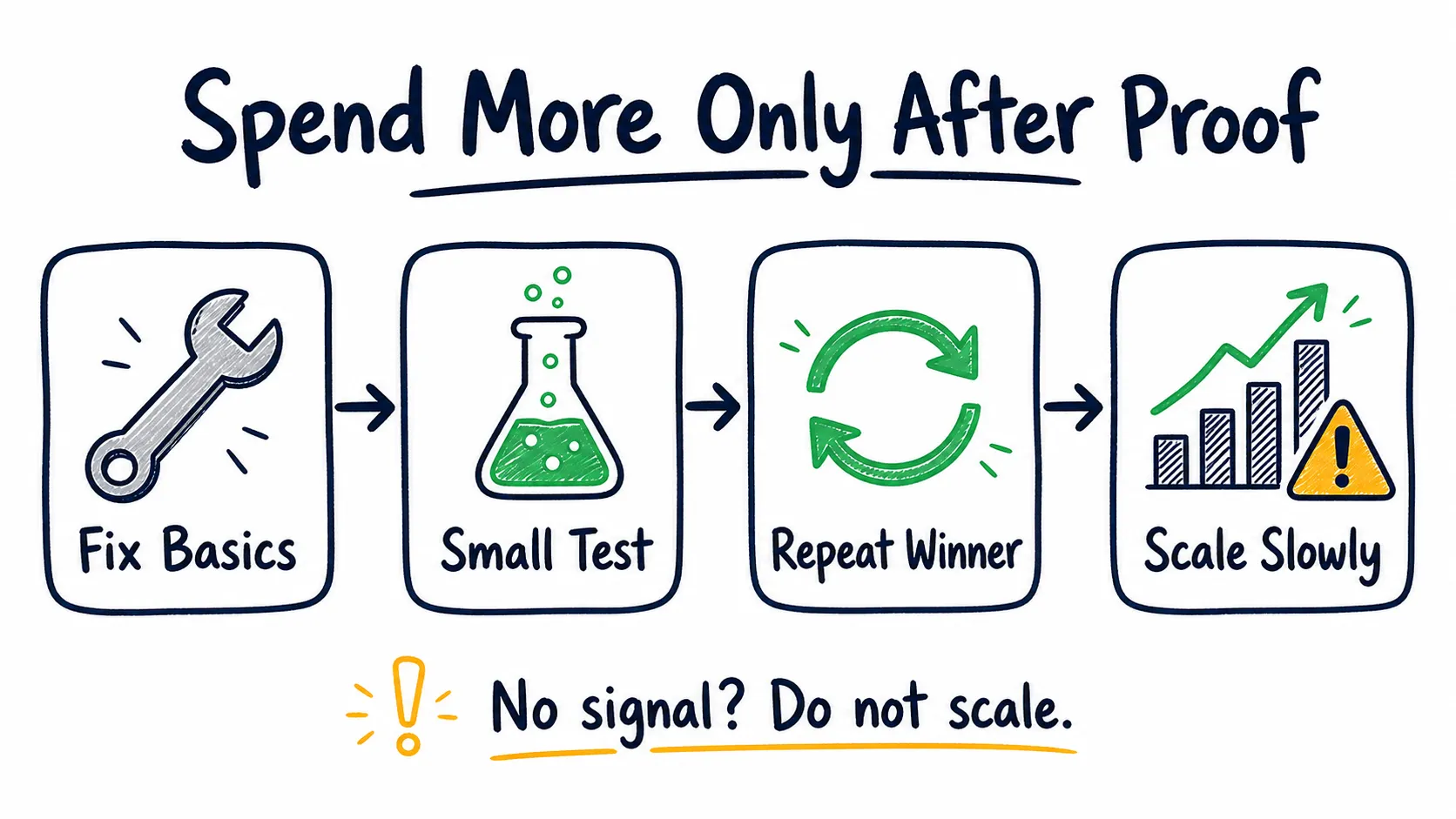
The next budget step should be earned by proof, not hope.
Raise the budget because strangers are proving they care, not because you love the song.
For deeper channel costs, read the music promotion cost guide. A small budget can be useful if it answers a clear question.
Key takeaway
The music marketing metrics that matter
Use your dashboard to make the next decision, not to judge yourself.
| Metric | What it tells you | What to do with it |
|---|---|---|
| Saves | The song mattered enough to keep | Judge song fit |
| Follows | The listener wants more | Judge artist fit |
| Repeat listens | The song has staying power | Keep the best audience |
| Active audience | People come back on purpose | Build around these fans |
| Listener source | Where attention came from | Keep strong sources |
| City and country fit | Growth supports real goals | Match spend to fan plans |
| Comments and shares | The song created social proof | Turn comments into content |
| Email or direct actions | Fans want contact outside platforms | Build owned audience |
Spotify monthly listeners can fool artists. The number tells you how many different people heard you recently. It does not tell you how much they cared.
That gap is why Spotify followers or listeners is a real strategy question. Listeners show reach. Followers show intent.
If your goal is algorithmic growth, go deeper into Spotify algorithmic playlists and Spotify Release Radar.
The fake progress trap
Some numbers feel good and still lead nowhere.
Real progress
- Listeners save, follow, replay, or share
- Growth fits your cities and countries
- One content angle works more than once
- Your own dashboard confirms it
Fake progress
- Streams spike, then disappear
- Plays rise with no saves or follows
- Cheap clicks create weak behavior
- Reports cannot be verified
Playlists, ads, blogs, and content can all work. Every tactic needs a job, and every result needs a source you can check yourself.
The feedback loop most artists are missing
The feedback loop makes music promotion feel less like gambling. Instead of one blast, the best campaign runs a loop:
- Match the song to the most likely listeners
- Send those listeners to the right place
- Read what they do after they arrive
- Move energy toward the audience that responds
- Cut what creates weak behavior
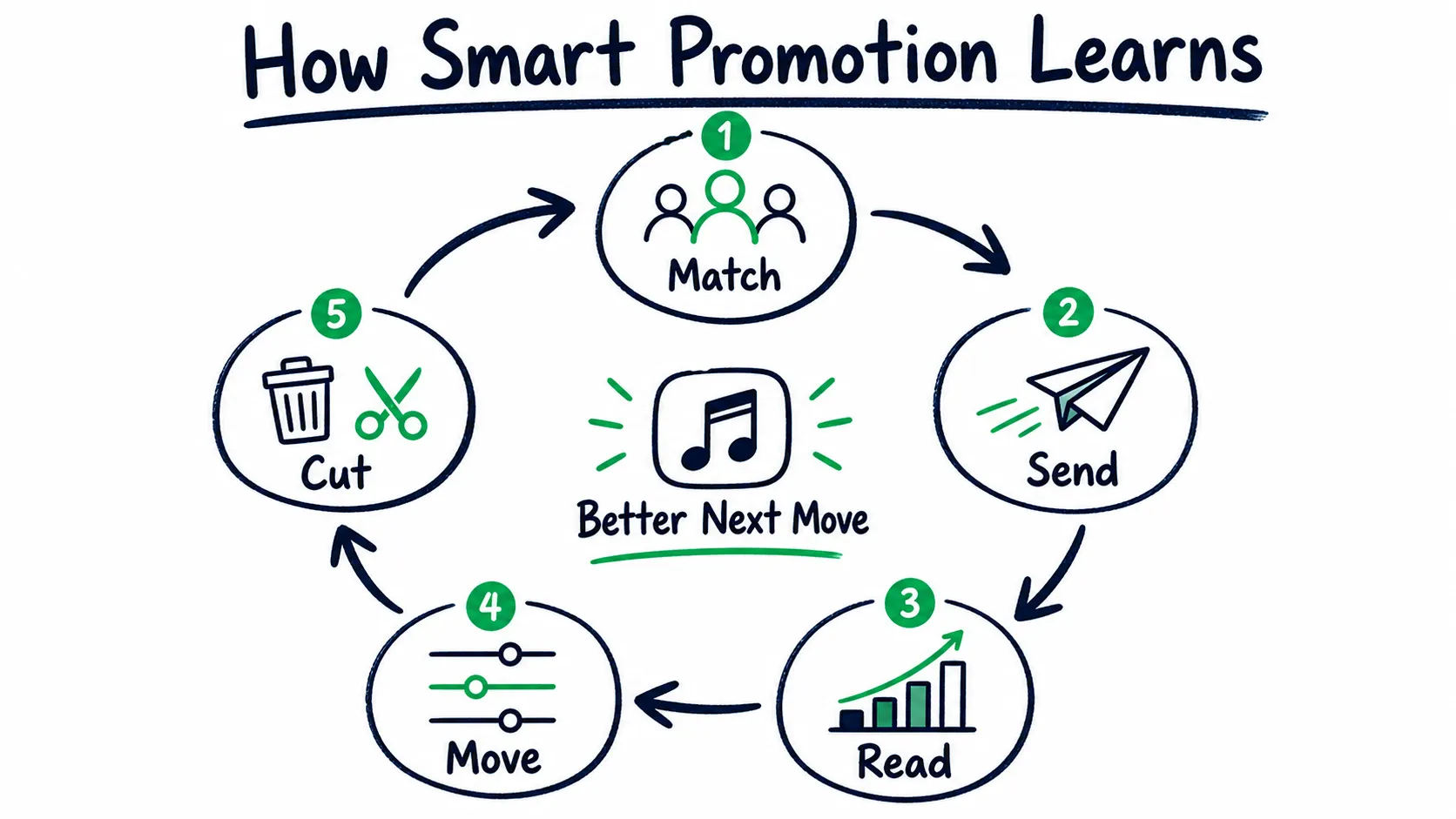
The best campaign keeps learning which listeners deserve the next push.
That sounds basic, but most promotion does not work this way. It is sold like a commodity package: this many streams, this many playlist adds, this many posts, this many views. Those packages count how many people they reach. Before you pay for one, ask, “Can this campaign learn which listeners are worth reaching again?”
| Commodity promotion | Signal based promotion |
|---|---|
| Chases volume | Chases listener fit |
| Treats every stream the same | Watches saves, follows, replays, and source |
| Reports numbers after the campaign | Uses numbers to adjust the campaign |
| Sends broad traffic | Sends matched traffic |
| Feels good when the spike happens | Keeps value after the spike ends |
Two campaigns at the same price can end very differently, because only one of them learns. Signal based promotion runs as an audience intelligence loop. For the alt pop single in the worked example below, it works like this:
- Start from music evidence. Use the profile, full catalog, similar artists, and listener locations, not “people who like pop.”
- Separate audience pockets. Build groups around listeners of two or three similar artists, so you learn which fit worked.
- Send real people to Spotify. Run mobile ads that open Spotify, using the lyric clip that won the short form test. No bots, no stream packages.
- Let the catalog compete. Rotate the single with an older track in the same mood. Your pick is not always the best first song for a stranger.
- Move budget toward chosen behavior. Shift spend to the pockets and tracks that earn saves, follows, and replays.
- Verify and keep the learning. Check results in your own Spotify for Artists, then carry the winning audiences, tracks, and countries into the next release.
You come out knowing your best entry song, which listener groups and countries respond (useful for touring and ads), and with a warmer follower base for the next drop.
Once you think this way, you stop craving “more streams” in the abstract. You start wanting the right streams from the right people, followed by behavior you can verify.
Worked example: one indie release with a small budget
Say an artist has a moody alt pop single and $300 to test.
Listener thesis
This song is for fans of sad but polished alt pop who listen at night when they want to feel understood without feeling dramatic.
With that thesis, the artist skips the general pop audience and looks for people who already respond to emotional, late night, mid tempo songs.
Song readiness score
The song scores 6 out of 8. The weak spots are owned audience and the plan after release week. That puts it in the 4 to 6 range, which calls for a small test.
Channel choice
- Short form content for lyric tests.
- Targeted Spotify traffic for listener behavior.
- Email or Bandcamp for the small group that wants more.
For Bandcamp planning, the official Bandcamp Artist Guide explains direct fan support.
Budget split
- $150 on targeted Spotify traffic, split across two or three pockets built around similar artists, with the single and one older fitting track rotated in each.
- $75 testing two video clips.
- $50 on simple visual assets.
- $25 held back until the first signal appears.
Do not spend the whole budget before the data comes in.
What to measure after seven days
In Spotify for Artists, compare saves for each track. In your ad reports, compare the cost per click to Spotify for each listener group. Then check repeat listening, winning content angle, listener source, city fit, and lyric comments.
If results are weak
Do not scale. Tighten the listener thesis. Ask if the target was too broad, the creative missed the song, or the hook was unclear. Then run one smaller test.
If results are strong
Repeat the winning angle and make two more pieces of content in the same emotional lane. Send more qualified listeners to the song. If the signal keeps improving, raise the budget slowly. Doing this at scale takes many audience pockets running at once, daily budget shifts, and steady track rotation.
What a real campaign should prove
You can run this yourself. Any promotion you pay for should pass the same rules:
- Can it explain the listener it is trying to reach?
- Can it explain how that listener is reached?
- Does it test more than one song from your catalog?
- Does it move budget toward saves and follows instead of cheap clicks?
- Can you verify the result in your own tools, like Spotify for Artists?
If a campaign cannot answer those questions, it is asking you to trust the result. The same standard applies to playlist support, paid ads, creator campaigns, YouTube promotion, blog coverage, and Spotify growth.
For a video that holds attention and has a next step, look for YouTube Ads aimed at viewers who watch, subscribe, and return, with results you check in YouTube Analytics.
Free playlist submission is a low risk way to test curator response before you spend.
Music royalties and making money with your music matter once attention turns into income.
If you are choosing the first song in a bigger rollout, the lead single guide can help.
FAQ
How do I market my music if I do not know my audience yet?
Start small. Write three listener theses and make one short video for each. Watch which one creates comments, saves, shares, and profile visits. Your first goal is learning who responds, not maximum reach.
Should I spend money on every song?
No. Spend money when the song can prove something. If the hook is weak, the profile is messy, the listener is unclear, or there is no plan after release week, fix those first.
Some songs are for content. Some are for fans you already have. Some deserve a real push.
Are playlists good or bad for music marketing?
Playlists are useful when the audience fits the song and risky when they only create passive streams. If streams rise but every other signal stays flat, the placement may not be helping.
How do I know if ads are helping or hurting?
Look past the cost per click. Ads are helping when the listeners they send save, follow, replay, comment, share, or join your audience. They are hurting when they create cheap actions with weak behavior after the click.
What should I do if my content gets views but my streams do not grow?
Your content may be entertaining without making people want the song. Make the song more central: use the best lyric, clearest mood, strongest story, or the moment that made you write it.
If views stay strong but listener behavior stays weak, the content angle may be working for the platform but not for your music marketing strategy.