
Music Release Checklist: The Practical Plan for Independent Artists
A good music release checklist keeps your song from getting rushed, buried, or sent to the wrong people.
Most artists do not flop because they forgot one Instagram post. They lose momentum because the song went up late, the profile was half done, the pitch was rushed, the links were messy, or the promo stopped right when the song needed another push. This checklist is built to catch those problems.
The Short Version
Start planning your release at least 6 weeks before the song drops, or 8 weeks if you can. That gives you time to finish the audio, handle the rights, upload through your distributor, fix your artist profiles, pitch Spotify, make content, and line up real promo.
Treat a release as a small campaign with three parts: setup, launch, and follow through.Who This Is For
This is for independent artists releasing a single, EP, album, first song, collaboration, cover, or video. It is also for you if every drop turns into the same scramble: upload, post, wait, panic, move on.
For the bigger strategy, read our music marketing strategy guide after this.
What You’ll Learn
- What to finish before upload
- How early to upload your release
- What to do if this is your first Spotify release
- How to pitch Spotify without missing the window
- What to post before and after release day
- How to avoid risky promo and playlist mistakes
- What numbers to check after the release
Music Release Checklist At A Glance
Use this as the quick map. The notes below explain what each step protects.
8 to 6 weeks out: Pick the goal, release date, budget, and main audience. Do not skip the final mix, master, artwork plan, or split agreement.
6 to 4 weeks out: Upload through your distributor and clean up song info. Do not skip artist names, credits, ISRC, explicit tag, or cover license.
4 to 2 weeks out: Claim profiles, pitch Spotify, and build the content plan. Do not skip the Spotify for Artists pitch or profile updates.
Release week: Make the song impossible to miss for people who already care. Do not skip your smart link, pinned posts, email, stories, or direct fan asks.
Days 1 to 30: Keep testing angles, content, and audiences. Do not skip save rate, repeat listeners, playlist source, or follower lift.
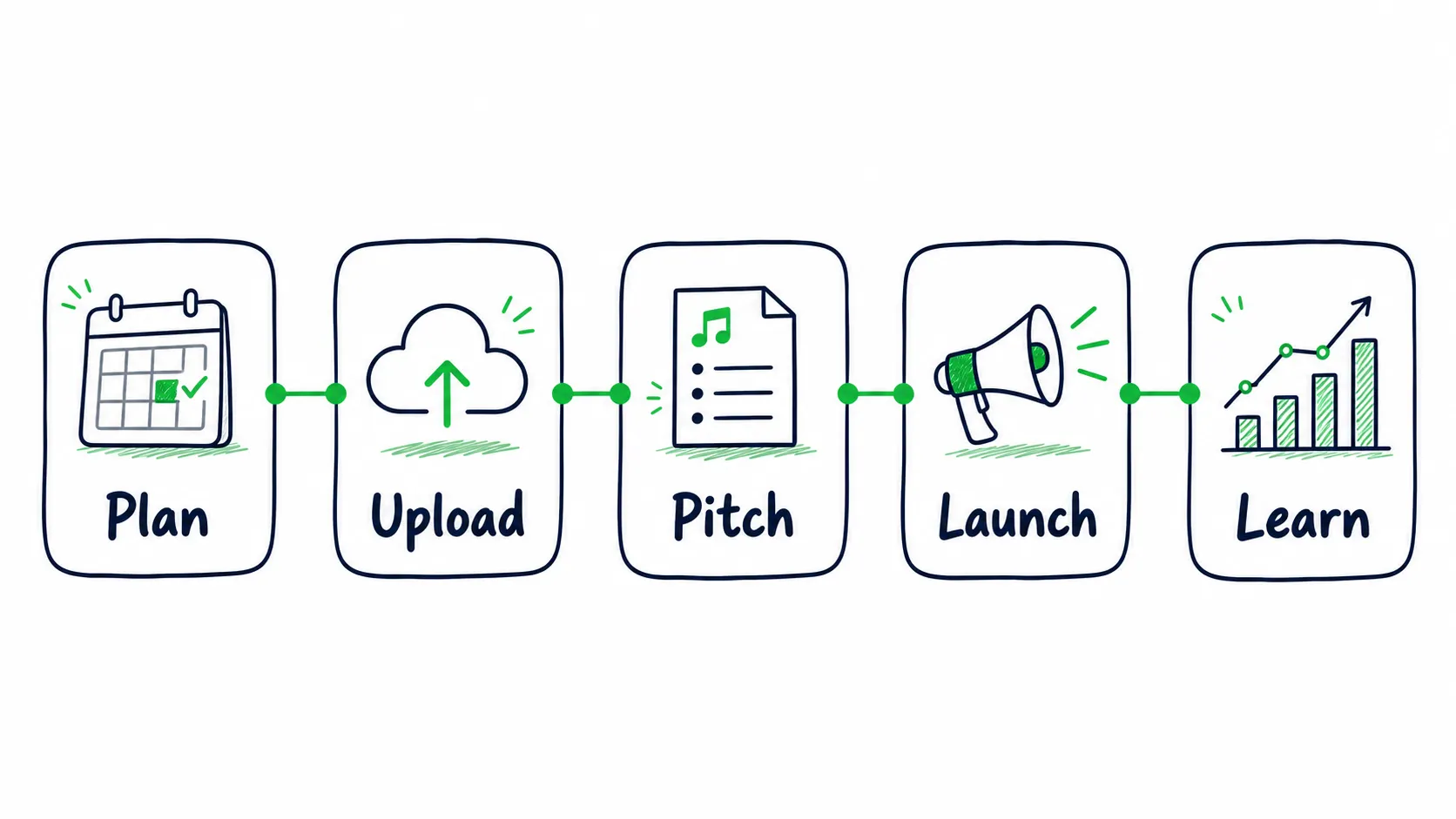
A strong release moves in order: plan, upload, pitch, launch, then learn.
Quick Music Release Checklist
Run through this before you lock the date. If several boxes are still open, the release needs more setup.
Before upload
- Release goal and date are chosen
- Final master and artwork are approved
- Credits, splits, and artist names are correct
- Cover licenses and sample clearances are handled
- Distributor upload is complete
Pitch and content
- Spotify pitch is submitted early
- Artist profiles are claimed or requested
- Smart link is created and tested
- Email and release day captions are written
- Short form content ideas are ready
After release
- Release day links and pinned posts are updated
- Saves, follows, repeats, and sources are checked
- Best audience or content angle is identified
- Risky traffic spikes are reviewed
- Learnings are saved for the next release
For the money side, read music royalties explained. For the Spotify algorithm side, use the Spotify algorithm launch playbook.
Before You Pick A Release Date
Choose the job of the release before you choose the date. A song can have different jobs:
- Build your first real streaming profile
- Warm up an EP or album
- Test a new sound
- Give current fans something new
- Push for playlist discovery
- Support a music video
- Sell tickets, merch, or direct fan offers
Then set the goal with this rule:
Key takeaway
Proof means you are trying to see who actually cares.
Scale means you already have a signal, and now you want more people like that to hear it.
The goal shapes your budget, content, and promo plan. If you are unsure what to spend, our music promotion cost guide breaks down realistic budget ranges.
The 8 Week Music Release Checklist
This timeline is for artists without a big team. If you only have 4 weeks, tighten it. If you have 12 weeks, add warming, press, and testing time.
8 Weeks Out: Lock The Release Strategy
Write one plain sentence for the release:
This release is for [listener type] who likes [similar artists or mood], and the main goal is [save, follow, playlist add, email signup, ticket sale, merch sale, or video view].Bad goal: “Make the song go viral.”
Better goal: “Get 300 real listeners to hear the song, then see if enough of them save it or follow.”
Now choose:
- Release type: single, EP, album, cover, collaboration, video
- Main platform: Spotify, YouTube, TikTok, Apple Music, Bandcamp, live show
- Main call to action: save, follow, share, watch, join email list
- Budget cap
- Promo channels you will actually use
If the release starts an album campaign, our lead single guide will help you pick the right first song.
6 Weeks Out: Finish The Release Package
Check these:
- Final master is done
- Clean version exists if needed
- Instrumental, radio edit, or performance edit is ready if needed
- Artwork is final and follows platform rules
- Song title and artist name are spelled the same everywhere
- Collaborators are credited the right way
- Split agreement is signed
- Cover song license is handled if the song is a cover
- Samples are cleared if you used samples
- Lyrics are final
- Short artist bio is ready
- Press photos are ready
- Private listening link is ready for pitching
For United States artists, know which money your distributor does not collect. The U.S. Copyright Office handles copyright registration. The MLC helps with U.S. digital mechanical royalties. SoundExchange collects some recording performance royalties.
4 To 6 Weeks Out: Upload To Your Distributor
Upload early enough to fix mistakes. You want the song delivered, checked, and visible in artist tools before the pitch window gets tight.
During upload, slow down on the song info. Most release problems come from small details:
- Wrong artist profile
- Wrong featured artist format
- Missing explicit tag
- Artwork rejection
- Bad audio file
- Duplicate release
- Wrong release date
- Wrong songwriter or producer credit
- Cover song uploaded as an original
If this is your first release, build in extra time. The artist profile may not look public yet, so fans may search your name on release day and find nothing, or land on a blank profile.
Once your distributor delivers the song, claim or request access to artist tools as soon as you can. Start with Spotify for Artists. For Apple Music, Apple says your content must be live on Apple Music for at least five business days before you can claim your artist page through Apple Music for Artists.
Spotify Release Checklist
Small setup mistakes hurt fast on Spotify, so give it its own pass.
Claim And Clean Your Profile
Before release day:
- Add a current artist image
- Update the bio
- Add socials if available
- Set Artist Pick once the release is live
- Make sure old links point to the right profile
- Check that similar artists and playlists make sense
- Save screenshots of your starting stats
Before you send traffic, do a quick profile leak check. Make sure the artist photo, bio, Artist Pick, top links, and newest release all point people in the same direction. A messy profile can make good promotion look weak.
Pitch Spotify The Right Way
Spotify lets artists pitch unreleased music through Spotify for Artists. Spotify says a pitch at least 7 days before release helps get the selected song into followers’ Release Radar, and it asks you to deliver music at least 7 days early so editors have time to listen. Its release guide also recommends pitching at least 2 weeks before release when you can.
Seven days is the floor. Two to four weeks is the safer working window.Use the official Spotify playlist pitching guide for the current rules.
In your pitch, answer four things:
- What does the song sound like?
- Who is the listener?
- What is the story behind it?
- What are you doing to help the release?
Use this simple pitch frame:
[Song title] is a [genre and mood] track for fans of [listener reference]. The song is about [plain story]. We are supporting it with [content, email, video, live, ads, press, creator outreach]. The best playlist fit is [specific mood or context].Do not stuff it with hype. Make the editor’s job easy.
For a full breakdown, use our Spotify editorial playlists guide.
Prepare For Release Radar
Spotify Release Radar updates on Fridays and can show new music to followers, listeners, and people Spotify thinks may like your music.
Your job is to make that first test cleaner.
Before release day, ask real fans to follow you on Spotify. After release, ask them to save the song and add it to a personal playlist if they actually like it.
Do not buy guaranteed streams. Spotify says paid services that guarantee streams violate its rules. Read Spotify’s warning on artificial streaming and paid services before you spend money.
For more, read our Spotify Release Radar guide.
If this release is an album or an EP, check whether you can run a Spotify Countdown Page. It collects pre-saves inside the app before release day.
Content And Promotion Checklist
Most artists post the cover art once and call it a rollout. Plan more than that with four content buckets:
Story: Why you wrote it, who it is for, what line matters most.
Sound: Hook clips, chorus clips, live takes, stripped versions.
Proof: Fan reactions, comments, playlist adds, creator uses, early feedback.
Action: Save it, share it, watch the video, join the list, send it to one friend.
For TikTok and Reels, skip the plain “new song out now” post. Try:
- The line that explains the song
- The hook with on screen lyrics
- A story before the hook
- A live one take clip
- A “who this song is for” clip
- A breakdown of one lyric
- A reaction to the first demo
- A fan comment turned into a video
Our TikTok for musicians guide goes deeper without turning your life into a full time content job.
If you have video plans, use the YouTube monetization for musicians guide. In YouTube promotion, the right viewer beats a cheap view.
Release Week Checklist
Release week is for running the plan you already made.
Check this 48 hours before release:
- Smart link works
- Spotify link is ready if available
- Apple Music link is ready if available
- YouTube link is scheduled
- Bio links are updated
- Pinned posts are ready
- Email or text message is written
- Release day captions are written
- Story slides are ready
- Canvas, Clips, or vertical videos are ready if available
- Artist Pick plan is ready
- Press or curator follow ups are ready
On release day:
- Test every link
- Post the strongest hook first
- Send the email
- Reply to every real comment
- Repost fans
- Ask for one clear thing
- Watch for wrong artist profile issues
- Save starting screenshots
Ask for one real thing, and tell fans exactly how to do it.
Weak ask: “Go stream it.”
Better ask: “If the chorus hits you, save it on Spotify so you can find it again.”
Postrelease Checklist: Days 1 To 30
This is where most releases fade out. The song comes out, the artist posts for two days, then everyone waits. Do not let that be the plan.
Days 1 To 7
Look for early signal:
- Are people saving it?
- Are they replaying it?
- Are followers increasing?
- Are comments about the song, or just support?
- Are playlist adds coming from real user libraries?
- Are video viewers clicking through?
If the signal is weak, change the angle before you spend more. If the signal is strong, show it to more people who look like the listeners already responding.
Days 8 To 30
Keep using new angles:
- Acoustic or stripped clip
- Lyric explanation
- Fan reaction
- Studio story
- Live performance
- Playlist thank you
- Behind the artwork
- “If you like this artist, try this song” post
- YouTube short from the strongest moment
- Email follow up with the story behind the song
Check results weekly and look for the pattern.
If monthly listeners jumped but followers did not, read Spotify followers or listeners. If listeners drop after 28 days, read Spotify monthly listeners so the normal drop does not scare you.
The Promotion Loop Most Artists Miss
You are trying to find the people who make Spotify believe the song belongs in their world. Raw stream count is secondary.
Good promotion works like a loop:
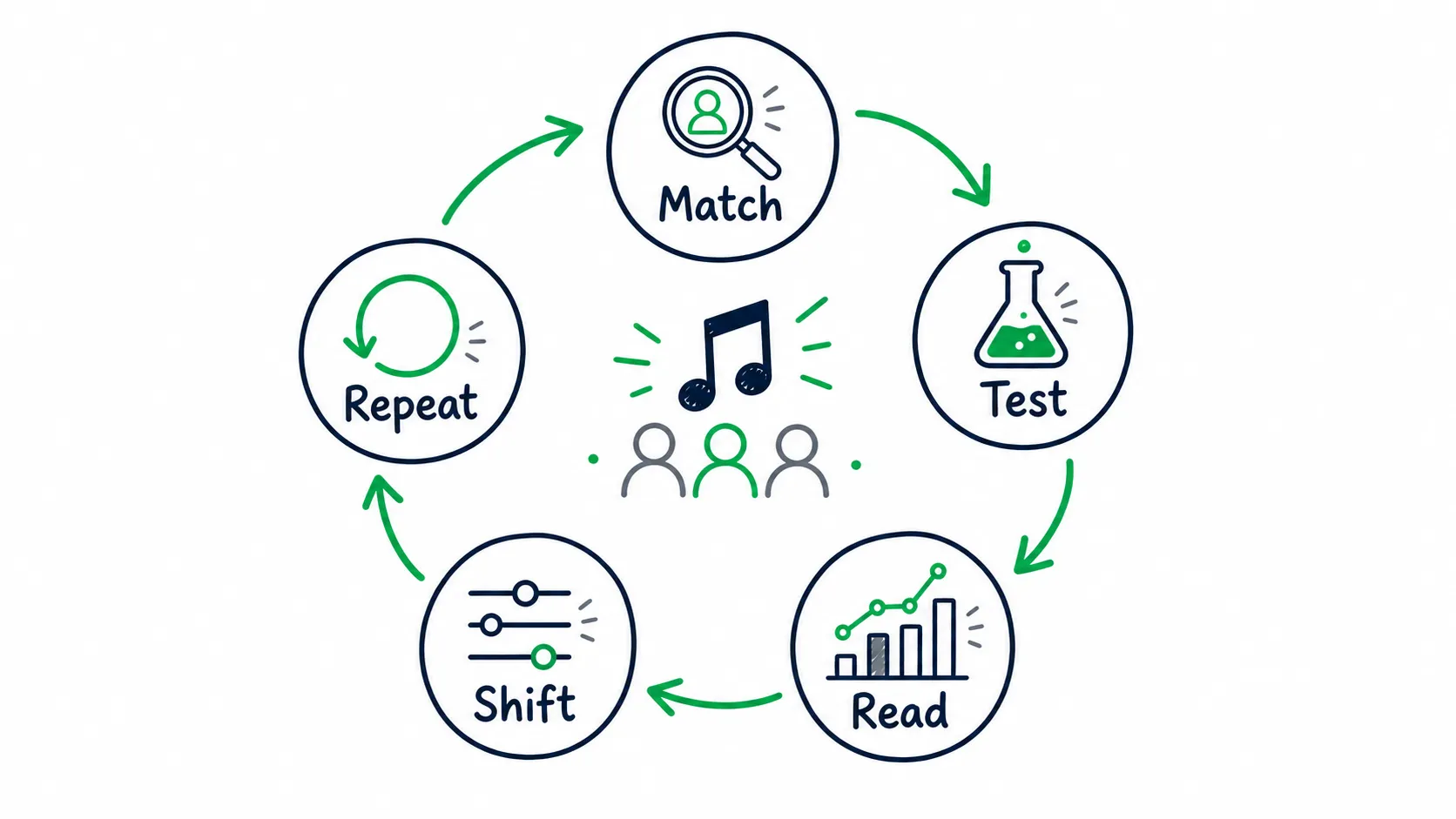
Aim for a release loop that gets smarter over time, not a one day spike.
- Match: start with people who like nearby artists, moods, or scenes.
- Test: send clean traffic before spending more.
- Read: watch saves, follows, repeat plays, source data, and skips.
- Shift: put more energy behind the audience that responds best.
- Repeat: use what you learned on the next song.
What you want from the loop is a listener pattern you can repeat.
That pattern is also how you tell commodity promo from a serious growth system. Commodity promo talks about volume first. A serious process talks about fit, source quality, listener behavior, and what gets learned for the next release.
If a traffic source gives you streams but leaves you guessing, it did not give you much. If it helps you see which listeners stayed, saved, followed, or came back, it gave you something you can build on.
Key takeaway
Promotion Safety Checklist
Artists are right to be nervous about playlist promo. Strange playlist spikes, paid stream problems, and traffic nobody can explain are common.
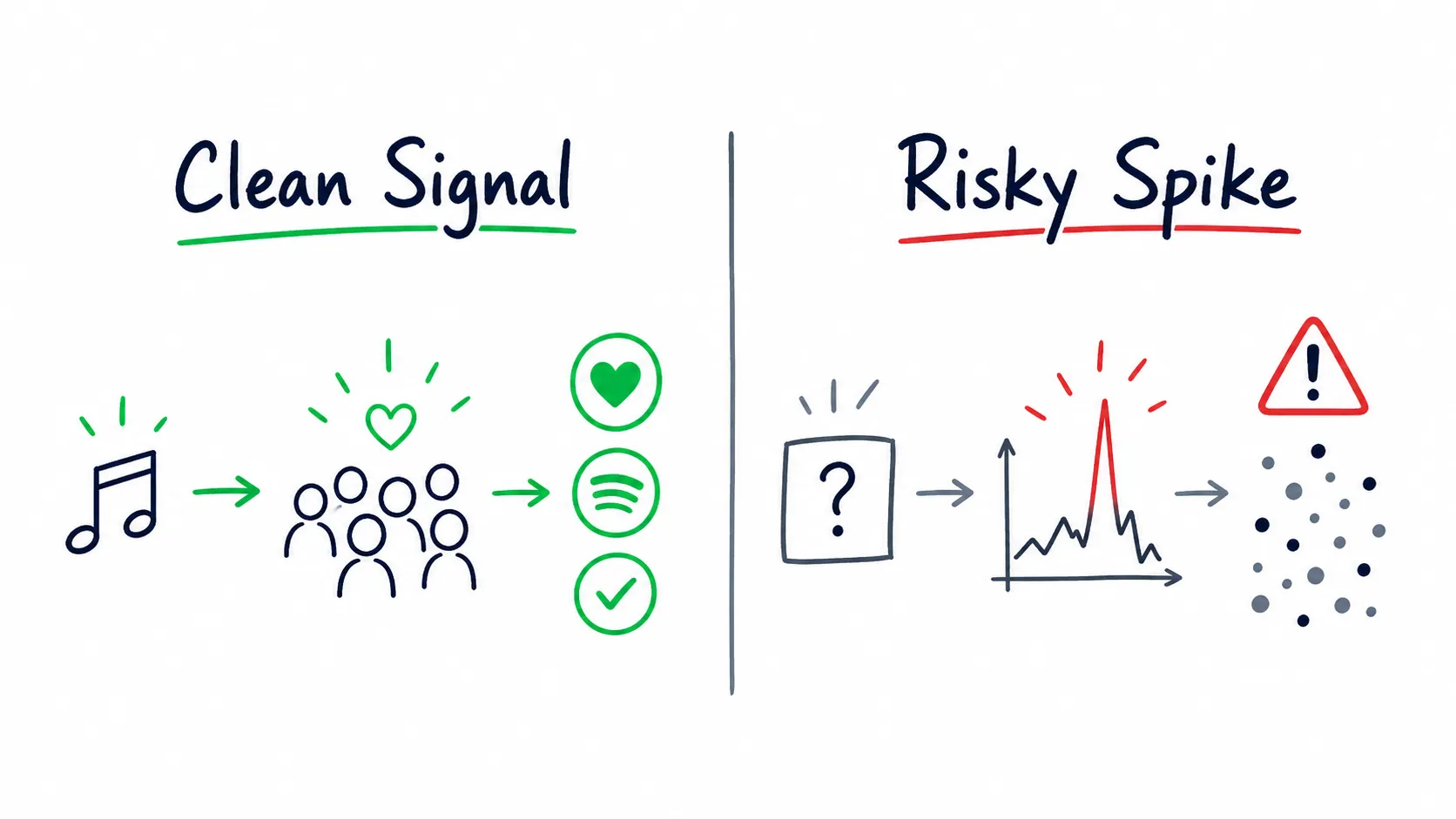
Clean promotion makes the listener path easier to understand.
Use this filter:
- Does the service guarantee streams?
- Can you see where the traffic comes from?
- Can you stop it if the data looks strange?
- Are the playlists public, active, and genre matched?
- Do listeners save or follow after hearing the song?
- Is the growth believable for your current audience size?
If it feels unclear, do not use it.
If you test playlists, treat each one as a way to reach a specific audience. Whether you submit yourself or use a playlist placement path, look for a named playlist, real genre fit, believable followers, and data you can check.
Before you pitch blogs, ask yourself if a stranger would care about this story without knowing you.
Release Readiness Score
Score each line from 0 to 2:
0 means not done. 1 means partly done. 2 means ready.
- Audio, artwork, and song info are final
- Rights, splits, covers, and samples are handled
- Distributor upload is complete
- Artist profiles are claimed or requested
- Spotify pitch and smart link are ready
- Content, fan message, and postrelease plan exist
If you score under 8, delay if you can. If you score 8 to 10, release only if the missing items are small. If you score 11 or 12, you are in good shape.
The score shows you what is missing before the date makes the choice for you.
FAQ
How far in advance should I upload my song?
Upload 4 to 6 weeks before release if you can. Two weeks can work, but it gives you less room to fix song info mistakes, profile issues, artwork problems, and Spotify pitching delays.
If this is your first release, give yourself extra time, because claiming artist profiles can take longer than expected.
Do I need to pitch Spotify if I am a small artist?
Yes. Pitch every eligible unreleased song. Pitching does not guarantee an editorial playlist, but Spotify says pitching at least 7 days before release helps get the chosen song into followers’ Release Radar. It is free, official, and worth doing.
What is the best day to release music?
Friday is common, but it is not always required. Friday makes sense because Release Radar updates on Fridays, the music industry often works around Friday releases, and fans are used to seeing new music then. Still, the best day is the one you can support with real attention, working links, and a clear fan ask.
What should I do if this is my first Spotify release?
Upload earlier than you think. Once your distributor delivers the music, claim Spotify for Artists as soon as you can.
Then check that the artist profile is right, add your image and bio, and use a direct link on release day. Do not make fans search your name if your profile is still new or hard to find.
Should I pay for playlist promotion before release day?
Be careful. Playlist promo can help, but bad traffic can hurt. Do not use anything that guarantees streams, viral growth, or a fixed listener count.
Focus first on your profile, pitch, fans, content, and clean listener fit. If you pay for promo, make sure it is clear, genre matched, and easy to check.
Final Checklist Before You Release
Aim for a clean rollout over a giant one: finish the audio, protect the rights, upload early, pitch it the right way, give fans a clear reason to care, and keep going after release day.
If the song shows real signal, keep the audience intelligence loop running and hold any serious promotion system to the same standard. It should start from matched listeners and clean source traffic, then:
- Test your whole catalog to find the best entry song for new listeners
- Move budget toward the listeners who save and follow
- Show every result in your own Spotify for Artists
- Carry the winning audiences, tracks, and countries into your next release so it starts warmer