
Instagram for Musicians: The Fan Growth System for Serious Artists
A Reel with 50,000 views from the wrong crowd can be worth less than 5,000 views from people who may become fans.
The Views Are Not the Result
Instagram can look busy while the music stays still. Serious artists usually feel one of two gaps:
- Attention without transfer: A Reel moves, but profile visits, music clicks, saves, and repeat plays do not.
- Demand without distribution: Spotify shows real traction, but Instagram struggles to find and hold more of the right people.
Another random list of post ideas fixes neither problem. Instagram for musicians works when every post feeds one path: Reel attention → profile recognition → link intent → song action.
If one step is weak, more posting often creates more noise. If the path works, each post also teaches you something reusable about the listener, promise, song section, or next step.
Who This Guide Is For
You are not starting from zero. This guide assumes you:
- Have released music and have some proof that people care
- Check Spotify for Artists and notice which songs pull ahead
- Can make content, but cannot always explain why one post creates fans and another creates empty reach
- May have a manager, producer, bandmate, or small team helping
We will skip: username basics, profile setup tutorials, and vague advice about being consistent.
We will focus on: finding the weak step, running useful tests, protecting audience quality, and connecting Instagram activity to music results.
What You’ll Learn
- Diagnose the leak: Find the first weak step before making more content
- Protect audience quality: Separate likely fans from peers, promo accounts, and empty reach
- Build message match: Carry one clear promise from the post to the profile, link, and song
- Create useful tests: Turn song moments into premises, series, and controlled comparisons
- Measure fan movement: Read content, profile, streaming, and catalog signals together
- Scale what compounds: Use Instagram learning across releases, creators, and paid reach
Instagram for Musicians Is a Signal System
Treat Instagram as a chain of small decisions. A stranger becomes a fan in steps: they notice a moment, decide whether the artist feels relevant, look for more, and then choose an action. That path has four stages.
| Stage | What Instagram must do | Useful Instagram proof | Useful proof outside Instagram |
|---|---|---|---|
| Attention | Make the right person stop | Watch time, completion, replays, and shares | None yet |
| Recognition | Make the artist worth remembering | Profile visits, follows, repeat viewers, and branded search | Direct searches for the artist or song |
| Intent | Make the next step feel worth taking | Link taps, Story replies, messages, and ticket page visits | Landing page visits and music platform clicks |
| Fan action | Turn interest into chosen behavior | Replies after listening and return visits | Saves, follows, repeat plays, catalog plays, email joins, and tickets |
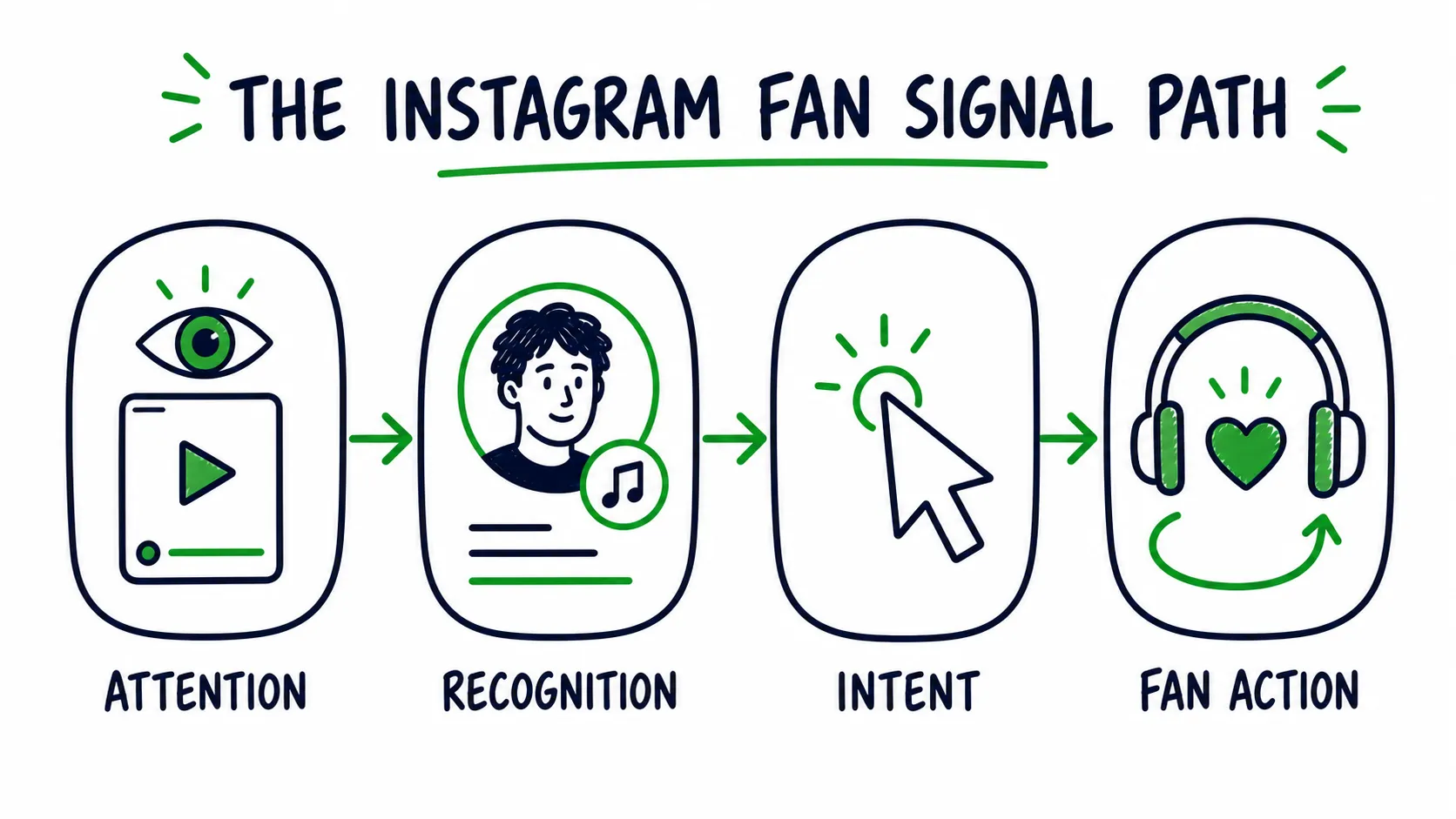
Attention becomes useful when it moves the listener toward recognition, intent, and a chosen fan action.
Each stage can create a false win. High watch time can come from a confusing opening. Profile visits can rise because people do not understand who they are watching. Link taps can rise while saves stay flat. Streams can rise from weak traffic that never returns.
Read every signal with the next signal beside it. A win at one stage means little when the next stage does not move.Your wider music marketing strategy sets the business goal and channel mix. Instagram should solve one part of that plan.
Find the First Weak Step
Before you plan another shoot, find the first place where likely fans stop moving.
If reach is weak, more profile work will not solve it. If profile visits are strong but music clicks are weak, buying more reach will not help either.
| What you see | Likely weak step | What to test next |
|---|---|---|
| Your current fans respond, but few new people see the post | Attention | Stronger openings, clearer listener moments, and better audience pockets |
| Reels get views, but profile visits stay low | Recognition | A clearer face, artist name, point of view, or repeatable series |
| People visit the profile, but few follow or tap the link | Profile promise | Bio, pinned posts, proof, and one clear current action |
| People tap the link, but the song gets few saves or repeat plays | Message or audience fit | A closer match between the post, listener, landing page, and song |
| One song moves, but the catalog stays flat | Fan depth | Catalog bridges, related songs, and reasons to return |
Pick one weak step for the next test cycle. That choice should shape the format, post idea, call to action, and metric. It also stops a team from changing five things at once and learning nothing.
Audit Audience Quality Before You Post More
Follower count measures audience size, not audience quality. A page can grow while becoming less useful.
This often happens after a giveaway, broad trend, cheap boost, viral joke, or run of studio content that attracts mostly musicians. Reach looks healthy while fan demand stays flat.
Run a Fast Fifty Account Audit
Take the last fifty accounts that made a real action. Use commenters, sharers you can see, Story replies, recent followers, and people who sent a message.
This is a quick, rough way to spot drift.
Place each account in one group:
- Likely listener: Their posts, follows, or comments suggest real fit with the music or scene
- Music peer: An artist, producer, engineer, manager, or other industry person
- Promo account: A page built mainly to sell, trade, or farm engagement
- Existing connection: A friend, family member, local contact, or current fan you know
- Unclear: There is not enough public context to make a fair call
Then calculate:
Likely listener share =
likely listeners / accounts you could classify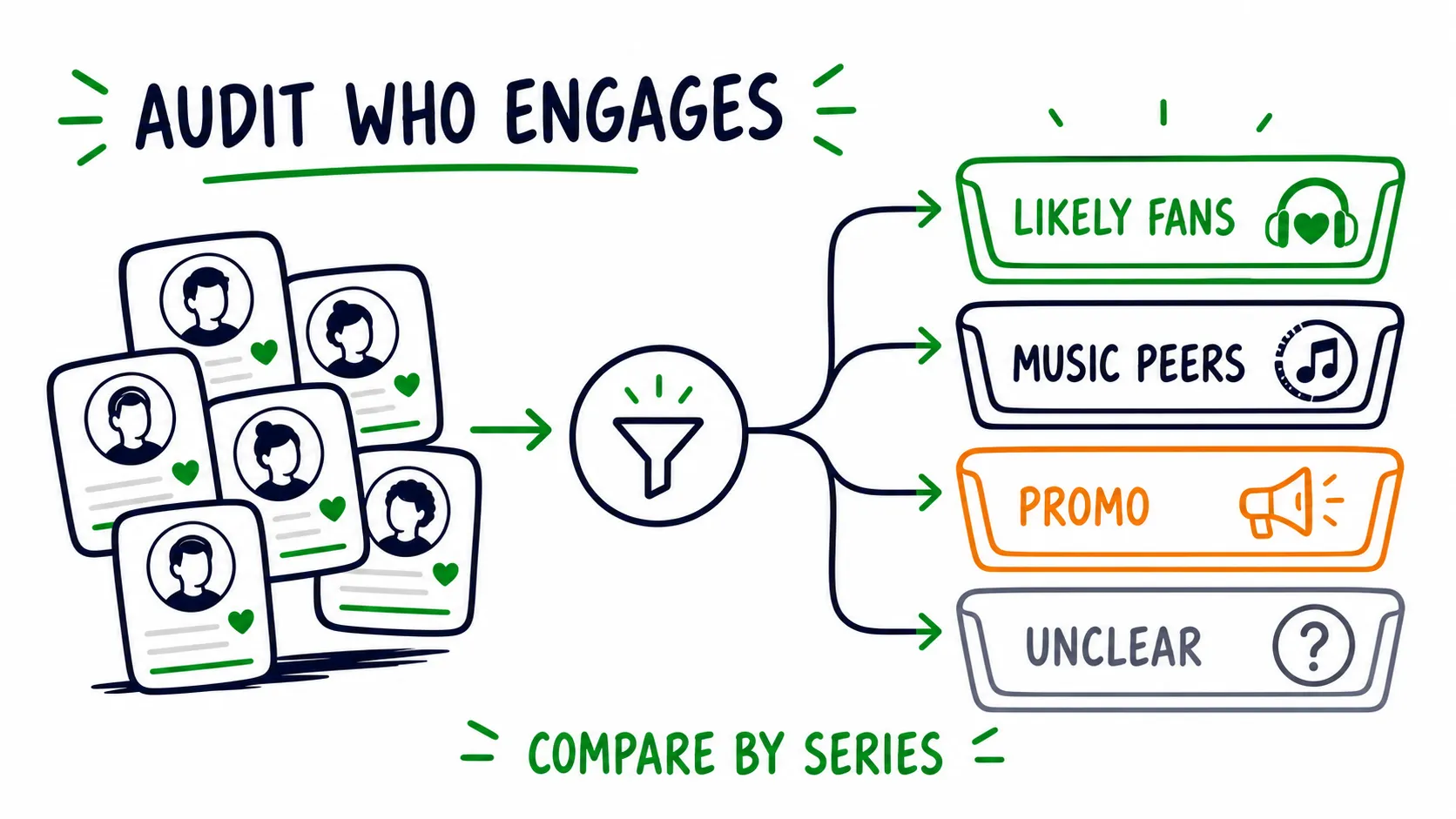
Sort engaged accounts by likely role, then compare the mix by series instead of trusting total reach.
Do not treat the result as a universal score. Compare it by content series and over time. A live performance series may pull likely listeners. A gear breakdown may pull peers. A trend may pull a large unclear crowd.
Key takeaway
Decide Whether to Keep the Current Account
Low reach alone is not a reason to start over.
A new account makes sense when the current audience came for a different topic, the artist needs a separate public identity, or privacy requires a clean split.
Keep the account when the current audience already knows the music and the change feels natural. A quiet but relevant audience is more useful than a fresh page with no history.
If you do start again, use the old account to explain the move. Bring over the people who fit. Do not copy every old follower just to rebuild the same problem.
Make the Profile Finish the Post
Treat your profile as a decision page for someone who has a little interest and almost no context.
Give a teammate or listener five seconds with the profile. Then ask:
- What kind of artist is this?
- Which song or project matters now?
- What proof made the artist feel real?
- What should I do next?
If the answers are fuzzy, the profile is leaking good traffic.
Use the Bio for Fit, Not Biography
The bio should help the right listener place the music fast.
Use this structure:
[Sound, scene, or emotional promise]
[Current song, show, or proof]
[One next step]
Example:
Dark pop for the drive home after a bad decision.
New single "Glass Room" out now.
Hear the full track below.
The line gives the music a place in the listener’s life instead of wasting space on a weak claim such as “genre bending artist.”
Build a Three Post Decision Stack
Pin three posts in this order:
- The anchor: The clearest song and fastest way to understand the artist
- The proof: A live take, crowd moment, strong fan story, press result, or clear career step
- The current route: The release, show, video, email list, or campaign that matters now
Story Highlights should answer the questions visitors arrive with. Start Here, Songs, Live, Tour, and Press can work. Old release folders with no current value can go.
Send the profile link to one focused page. The music website checklist shows how to build that path. The Spotify artist profile guide helps the music page keep the same promise after the click.
Protect Message Match
Message match means each step feels like the same story, so the listener has less to think about.
If the Reel says “the quietest song I have written about losing a friend,” the profile should make that song easy to find. The landing page should not lead with merch. Spotify should not greet the listener with a different release and no Artist Pick.
Pick the Account Type With Care
For most artist led pages, a Creator account is the best starting point. A Business account fits a label, venue, studio, or team page. A Personal account fits someone who values privacy over Insights and promotion tools.
Check music access before changing anything. Meta says its licensed music library can change by account type, post type, and region. Some business accounts get fewer music choices because of rights limits. Do not break a working release setup to gain tools you may never use.
Give Every Instagram Surface One Job
Instagram does not use one master algorithm. Meta’s Feed ranking system card and ranking overview explain that different parts of the app use different signals and predictions.
Treat a Reel, Story, carousel, message, and profile as separate channels, each with its own job.
| Surface | Main job | Best use for a serious artist | Common failure |
|---|---|---|---|
| Reels | Reach and test ideas | Put a strong song moment inside a clear listener promise | The clip gets watched, but the artist is easy to forget |
| Carousels | Build depth | Lyrics, choices, stories, proof, or useful context worth saving | The post teaches peers but gives fans no reason to care |
| Feed posts | Shape public proof | Release art, live proof, strong images, and career moments | The grid looks polished but says nothing clear about the music |
| Stories | Learn from warm fans | Replies, polls, links, show context, fan care, and quick choices | Stories become a second feed full of one way promotion |
| Live | Create a shared event | Listening rooms, rehearsals, writing sessions, and fan questions | Going live with no reason to arrive at a set time |
| Messages | Build direct trust | Useful replies, local show contact, thanks, and fan support | Cold sales messages that treat fans like leads |
| Shared posts | Transfer trust | Featured artists, venues, producers, and creators with real audience overlap | Choosing partners by follower count instead of listener fit |
Instagram keeps current product advice in its Best Practices hub. Use that for feature changes. Do not build a strategy around one magic posting time or a rumor about the algorithm.
Key takeaway
Captions and Hashtags
The first caption line should make the post easier to place. Use words a fan may search for, such as the genre, city, scene, venue, song theme, or artist name. Hashtags can label that context. They cannot make a weak idea useful.
Shared Posts and Creator Fit
Use a shared post when both audiences have a good reason to care.
Before it goes live, agree on the clip, caption, credit, music rights, and next step. A featured artist may want streams. A venue may want ticket visits. A creator may want a strong story for their audience.
If the exchange is not clear, the post often feels borrowed. A shared post is also an audience fit test.
If you expand into a larger creator led campaign, keep the song promise and route stable across partners. Give each creator a separate tracking link. Compare qualified profile visits, music clicks, and later fan actions, not creator reach alone.
Build Creative Premises, Not Random Post Ideas
A format tells you what file to make. A premise tells the viewer why the file matters.“Studio Reel” is a format. “I removed the drums because the lyric sounded more scared without them” is a premise. The second one makes the viewer want to hear the difference.
Use this formula:
For [specific listener or moment],
this song carries [tension, claim, or feeling],
shown through [one clear song moment].| Artist context | Weak setup | Stronger premise |
|---|---|---|
| Alternative pop | New song out now | I wrote this for people who rehearse an argument after it is already over |
| Rapper | Rate this verse | Eight bars for the friend who only calls when they need something |
| Electronic producer | Making a beat | The drop started with a train door recorded at midnight |
| Live band | Show clip | The crowd thought the song was over. Then the drummer did this |
The premise must match the song. If the setup promises grief and the clip feels carefree, people may watch but the handoff breaks. The best premise names something the music already proves.
Build Five Series With a Clear Hypothesis
A series saves time, but its bigger job is to test the same belief more than once.
| Series | What it tests | Useful proof | Warning sign |
|---|---|---|---|
| The decision room | Fans want to hear how a real choice changes the song | Replies with reasons, repeat viewers, and later interest in the result | Votes come mainly from producers or the choice was never real |
| Proof under pressure | The artist becomes more memorable when the skill is seen live | Shares, profile visits, show interest, and comments about the performance | People praise the skill but cannot name the song or artist |
| The song in its world | A clear place, scene, or feeling improves listener fit | Fan shares, personal comments, and stronger music clicks | The lifestyle frame gets attention but the song does not |
| Fan evidence with context | Real response lowers doubt for new listeners | Profile visits, ticket interest, and replies from similar fans | Numbers feel like boasting or private messages are used without consent |
| The catalog bridge | Interest in one song can lead to a second chosen listen | Older song activity, playlist adds, and repeat profile visits | Every post sends people back to the same single |
Write the hypothesis before you film. For example:
We believe live vocal proof will bring more likely fans
to the profile than polished lyric clips.

We will compare profile visit rate, fan comments,
and music link activity across three posts from each series.
Run Cleaner Instagram Content Tests
Instagram results are noisy. The same post can perform differently because of timing, audience mix, current events, or plain chance. One winner is a clue, not a law.
Use paired tests when the decision matters.
Key takeaway
| Variable | Keep stable | What the test can teach |
|---|---|---|
| Opening | Song moment, length, and edit | Which first line or frame earns attention |
| Song section | Premise, visual, and caption | Which part of the song carries the promise best |
| Listener frame | Song section and basic edit | Which audience or moment creates better fan fit |
| Proof type | Song and premise | Whether live, fan, press, or data proof creates more trust |
| Next step | Post and audience | Which call to action gets more useful movement |
Do not compare a live vocal posted on a quiet week with a joke posted during a major event and call the difference an opening test. The two posts can differ in small ways, but they need to be comparable.
Use Four Decision Rules
After a few clean attempts, choose one action:
- Repeat: The series keeps moving likely fans to the next step
- Fix: Reach is healthy, but one clear step keeps breaking
- Hold: The signal looks good, but the sample is still too small
- Stop: The series keeps attracting the wrong crowd or fails at the same step
The full content strategies for musicians guide covers the wider content portfolio. Use this Instagram test loop inside that larger plan.
Turn One Shoot Into a Useful Asset Bank
Plan a capture session around tests, not a posting calendar.
Before the session, write down:
- The song and section you are testing
- The listener or moment in the premise
- The one variable that will change
- The profile action you want
- The music or business result you will check later
Then capture five asset groups.
1. Performance
Record three full takes. Use one wide frame, one close frame, and one frame built around the strongest physical detail. That may be the hands, mouth, drummer, pedal, crowd, or instrument.
2. Premise
Record three short spoken setups. Change the first line, not the whole story. Keep each version clear enough to understand without the caption.
3. Process
Capture the choice that changed the result. Show the before and after. A plugin screen alone is weak fan content. The sound difference and the reason behind it make the choice useful.
4. World
Collect the room, street, trip, clothes, weather, people, and objects that belong around the song. These clips help the music live inside a scene instead of floating in a blank studio.
5. Route
Record one direct line for each real next step. The next step may be the full song, a ticket, an email list, a video, or another track. Do not record five offers for the same post.
Name the files so the team can find them:
song_series_premise_take
glassroom_world_nightdrive_02
glassroom_live_quietchorus_01
Consistent names make it easier to compare clips by series and premise later.
You can reuse raw footage for other channels. The TikTok for musicians guide covers that platform. Change the opening, crop, caption, and next step before you reuse the edit.
Use Instagram Across the Full Release
A release has different fan states. Early on, people need a reason to care. Near release, they need a clear route. Later, they need a reason to return.
| Release stage | Fan question | Best Instagram work | Useful proof |
|---|---|---|---|
| Early testing | Why should this song matter to me? | Test listener frames, song sections, live proof, and story angles | Shares, fan comments, profile visits, and warm replies |
| Warm up | What is coming, and why now? | Repeat the winning premise, show progress, and involve current fans | Return viewers, Story actions, direct questions, and link interest |
| Release window | Where can I hear or support it? | Use the strongest creative, clear pins, one link, fan proof, and direct answers | Music clicks, chosen streams, saves, follows, tickets, and email joins |
| Depth | Why should I stay with this song or artist? | Second verses, live versions, lyric details, fan stories, and catalog links | Repeat plays, older song activity, and returning listeners |
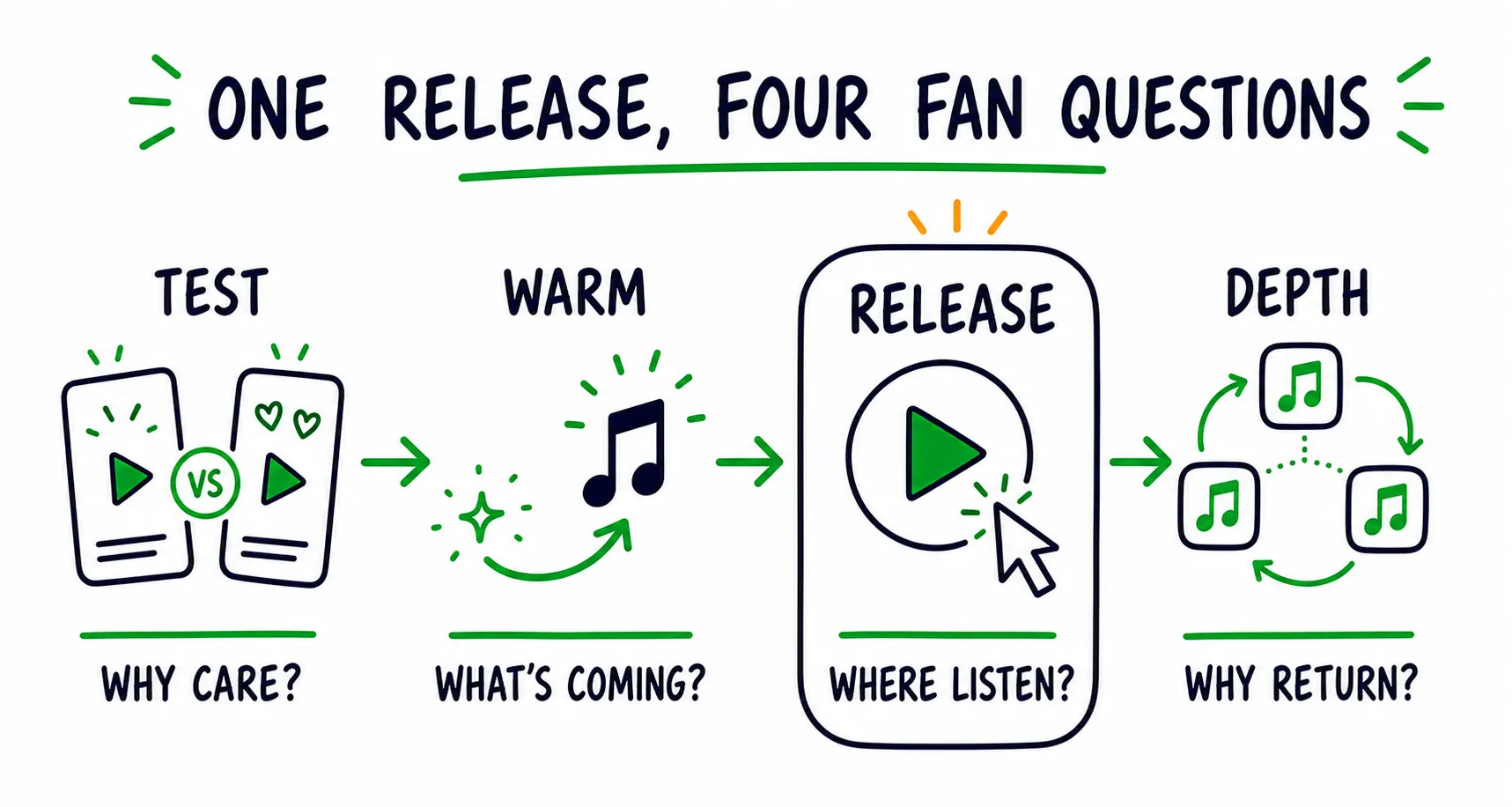
The fan question changes across the release, so the content job must change with it.
Use the early posts to find the winning promise. Carry that promise through the bio, landing page, release post, and music profile.
Artists often stop posting a song when the useful learning finally starts. Fan comments, saves, show response, and repeat plays can reveal a stronger angle after release.
The music release checklist covers the full operation. The pre release strategy goes deeper on timing, pitching, assets, and clean demand.
Measure the Fan Path, Not the Loudest Post
Instagram Insights gives professional accounts reach, interactions, profile activity, and other data. The exact view can change by account and format.
Start with rates that show movement between steps.
Watch depth =
average watch time / Reel length

Profile visit rate =
profile visits / reached accounts

Follow rate from profile =
new follows / profile visits

Music click rate =
music link taps / profile visits
Watch depth can move above 100 percent when people replay or loop a short clip. Treat that as a reason to inspect the post, not a final score.
No single rate proves fan growth. Read them in order:
- Did likely people see and watch?
- Did enough of them care who the artist was?
- Did the profile make the next step clear?
- Did the song or offer earn a real action?
Score the Series, Not Only the Post
One post can get lucky. Group posts by series and premise. Compare their average and middle result. The middle result matters because one large winner can hide several weak posts.
Track:
- Reach from people who do not follow you
- Watch depth and shares
- Profile visit rate
- Follows from profile visits
- Music link activity
- Likely listener share from the audience audit
- Time and money used to make the series
Add one simple cost check:
Useful actions per creation hour =
fan actions you care about / hours used to create the series
This stops a beautiful series from consuming the whole week while a simpler one creates more fan movement.
Connect Instagram to Music Data Carefully
Use a campaign link with tracking tags for each serious series. A tracking tag is a small label added to a URL so your site can show where visits came from.
Compare the campaign period with your normal music activity. Then check Spotify’s Source of Streams and audience segments.
Look for chosen behavior:
- Artist profile streams
- Saves
- Spotify follows
- Repeat listening
- More songs played from the catalog
You usually cannot prove that one named Instagram viewer became one Spotify listener. The platforms do not give you a full person by person path.
You can still compare timing, location, landing page visits, clicks, active streams, and series results. Use the pattern as strong direction, not perfect proof.
Our music analytics guide explains this in depth. The Spotify saves guide helps you judge whether new listeners wanted to keep the track. The comparison of Spotify followers and listeners helps separate broad reach from a deeper audience.
Key takeaway
Use a Failure Map Before Changing the Plan
When a result looks weak, find the first broken step.
| Pattern | What it may mean | Best next test |
|---|---|---|
| Low watch depth and low profile visits | The premise or first frame is weak | Keep the song section and test a sharper opening |
| Strong watch depth and weak profile visits | The clip works, but the artist does not stick | Add a clearer face, name, series cue, or point of view |
| Strong profile visits and weak follows | The profile does not promise enough future value | Fix the bio, pins, proof, and current focus |
| Strong follows and weak music clicks | The next step is hidden or arrives too soon | Use one clear link and a closer match to the post |
| Strong clicks and weak saves or repeat plays | The audience, promise, or song fit is weak | Change the listener frame before sending more traffic |
| Strong saves but weak catalog movement | The listener liked one song but found no bridge | Connect the track to one clear next song or artist story |
Do not respond to every weak post with a new format.
The failure map tells you whether the issue lives in the creative, profile, route, audience, or music.Know When Instagram Learning Is Ready for Paid Reach
Organic Instagram tests the promise, paid distribution tests the audience, and Spotify shows whether both were right.
Ads amplify what is already there. More spend will not repair a weak premise, unclear profile, slow landing page, or poor song fit.
Paid reach is ready when:
- One premise has worked more than once without ads
- The audience audit shows the right people are responding
- The profile and landing page pass the same message forward
- Music clicks lead to saves, follows, repeat plays, or other healthy actions
- The team knows the cost limit and the signal that will stop the test
Do Not Buy Reach That Forgets Everything
For most artists, activity from paid reach rises while the money flows and fades as soon as it stops. The campaign leaves behind a report, but no better way to find the next listener.
A stronger campaign buys learning and listener access at the same time. Each cycle should leave you with a clearer answer to four questions:
- Which audience is most likely to care about this sound?
- Which promise earns attention from that audience?
- Which track earns the strongest chosen behavior?
- Which listeners come back after the first visit?
What lasts is a better map of audience fit, creative fit, and catalog fit that can guide the next cycle.
Build an Audience Intelligence Loop
A useful audience intelligence loop has six connected parts. Build them yourself, or use them to judge anyone managing promotion for you.
- Start from music evidence. Use the artist profile, full catalog, similar artists, genre relationships, and listener locations. “People who like music” is not an audience model.
- Separate audience pockets. Test distinct groups built around real listeners of similar artists and scenes. If every audience is mixed together, you cannot learn which listener fit produced the result.
- Send real people to Spotify. Use targeted ads that open the song in Spotify, and make the premise that worked on Instagram the opening idea. Do not replace proven language with a generic “listen now” ad, and never pad the numbers with bots or stream packages.
- Let the catalog compete. Rotate several fitting tracks so each can earn response. The song the team picks is not always the best first song for a new listener.
- Move budget toward chosen behavior. Shift spend away from cheap taps and raw streams, toward the audience, creative, and track combinations that earn saves, follows, repeat listening, and catalog depth. When direct attribution is limited, read timing, source traffic, location, and Spotify for Artists movement together.
- Verify and keep the learning. Every result should show in your own Spotify for Artists. Carry the winning audiences, premises, tracks, and countries into the next release so it starts warmer. Starting from zero every month turns a learning system back into a traffic purchase.
Key takeaway
Use the Seven Question Promotion Test
Before you scale a campaign or hand it to someone else, ask:
- What artist and catalog data seeds the audience model?
- What makes an audience matched instead of merely broad?
- Does the listener reach the promised song with little friction?
- Can the process discover that another track converts better?
- Which listener behaviors cause targeting or budget to change?
- What learning survives into the next campaign?
- Can the result be checked inside Spotify for Artists?
If the only answers are “we target music fans” and “you get streams,” the process is a commodity. It creates activity with no way to improve listener fit. A process worth trusting tests the whole catalog, moves budget toward listeners who save and follow, and shows every result in your own Spotify for Artists.
If a campaign cannot explain what it learns, how it changes, and where you can verify the result, it is buying traffic.Use the Meta Ads for Spotify calculator to model clicks and listeners before you spend. The music promotion cost guide helps you place that test inside the full budget.
If the full music video keeps the promise better than an audio first route, judge a video first promotion path by completion, subscribers, repeat views, and later catalog interest. Do not send every strong idea to Spotify by default.
Meta’s Reels ads guide has current placement guidance. Check rights before using music in an ad. Instagram’s copyright guide explains the basic duty.
Run a Four Week Instagram Operating Cycle
Use a short cycle so the team can learn without changing direction every day.
Week 1: Audit and Set the Test
Choose the weak step. Run the audience audit. Check the profile path. Write one hypothesis and choose the main metric.
Week 2: Test Two Premises
Use the same song section with two clear listener frames. Keep the edit and next step close enough to compare.
Week 3: Repeat the Better Pattern
Make two or three new versions of the stronger premise. Change one variable at a time. Watch whether the next signal also improves.
Week 4: Test the Handoff
Keep the winning post idea and improve the profile, link, landing page, or song route. Check whether music actions move with Instagram activity.
Key takeaway
Put this in the team’s notes:
Weak step:
Listener we want:
Song and section:
Premise:
Series:
Variable we will test:
Instagram signal:
Music or business signal:
Time and budget limit:
Repeat, fix, hold, or stop rule:
This keeps the team honest and gives Instagram a clear place in the career without letting it run the whole week.
Instagram for Musicians FAQ
Is Instagram Still Worth It for Musicians?
Yes, if Instagram has a defined job in your fan path.
Use it to:
- Reach likely listeners
- Make the artist easier to recognize
- Show live, fan, and career proof
- Learn from replies and repeat viewers
- Move warm interest toward a song, show, or owned channel
Do not ask Instagram to own the whole relationship. Keep your website, email list, music profiles, and live plan active.
How Often Should Musicians Post on Instagram?
Post at the lowest pace that still gives you enough clean tests.
A practical starting rhythm each week is:
- Two Reels: Test reach, openings, and listener premises
- One depth post: Build context, proof, or catalog interest
- Stories when useful: Gather replies, choices, and link activity from warmer fans
Review a series after at least three clean attempts. Change the pace if content quality drops or Instagram starts taking time away from the music.
Why Does My Instagram Attract Musicians Instead of Fans?
Your content may reward production knowledge instead of listener identity.
Check three things:
- The hook: Does someone need studio knowledge to understand why the post matters?
- The frame: Is the story about a plugin, technique, or career task instead of a feeling, scene, or listener moment?
- The audience mix: Does the fifty account audit show that peer heavy posts keep producing peer heavy engagement?
You do not need to remove production detail. Translate the choice into what it changes for the listener.
Why Do My Reels Get Views but No Spotify Streams?
Find the first rate that breaks.
- Low profile visits: The clip works, but the artist or song is easy to forget
- Strong profile visits and weak music clicks: The profile, pinned posts, or link route does not keep the post’s promise
- Strong clicks and weak saves: The audience or song promise does not match the listening experience
- Strong saves and weak repeat plays: The song connected once, but the catalog offers no clear reason to return
Fix that step before sending more traffic into the same path.
Should I Start a Separate Instagram Account for My Music?
Usually, no. Low reach alone is not a reason to restart.
Start a separate account when:
- The current audience followed for a different topic
- Personal privacy requires a clean split
- The artist needs a distinct public identity
Keep the current account when followers already know the music and fit the direction. A quiet but relevant audience is more useful than a new page with no history.