

Content Strategies for Musicians: Turn Posts Into Fans
If your music already has traction, “post more” is an expensive way to avoid the harder decisions that real content strategies for musicians depend on.
You already know how to film a clip, write a hook, and read views, shares, and saves. At this stage, the hard questions are strategic:
- Audience: Which listener are you trying to move?
- Constraint: Where are they getting stuck?
- Creative: Which idea deserves another ten posts?
- Signal: Did the last series attract fans, peers, or cheap attention?
- Path: Is the problem the content, the audience, or the route from post to song?
The Real Job
Your content should move a specific group of people from one stage to the next.
For every campaign, name three things:
- The listener: The specific group you want to reach
- The move: The next action or change you want from them
- The proof: The signal that would show the move happened
A stranger may become an interested viewer. A new listener may save the song. A casual listener may return, join your email list, buy a ticket, or share the track.
Each move needs different content and different proof. The strategy is choosing which move matters now, then building a repeatable way to test it.
Who This Is For
This is for a serious emerging artist with music out, some audience data, and enough momentum to make the next choice matter. At this stage, generic advice starts to cost you. The problem usually looks like one of these:
Weak reach: The song converts, but too few qualified listeners see it.
Weak bridge: The content numbers rise, but Spotify stays flat.
Promotion drop: The format works until you mention the release.
Audience drift: The page grows while the audience becomes less useful.
What You’ll Learn
- Find the constraint before planning content
- Map each post to discovery, activation, or retention
- Write a content thesis that filters weak ideas
- Build and score repeatable creative series
- Run cleaner tests without chasing one lucky post
- Connect signals to listener and business results
- Choose the next move: scale, fix, hold, or stop
Find the Growth Constraint Before You Build the Calendar
Most content plans start with formats: three Reels, two TikToks, one live clip, a story every day. That looks organized, but it may solve the wrong problem.
Start with the constraint, the first weak step in the path from attention to a useful fan action.
| What you see | The likely constraint | What content should test |
|---|---|---|
| Your current listeners respond, but few new people see the posts | Qualified reach | Sharper premises, stronger openings, and new audience pockets |
| Posts get watched, but profile visits and follows stay weak | Recognition | A clearer artist point of view and more repeatable series |
| People visit the profile, but few reach the full song | Activation | Better message match, stronger pinned paths, and clearer next steps |
| Content sends listeners, but saves and repeat plays stay weak | Listener fit | A different audience, song entry point, or creative promise |
| One song gets played, but the catalog and active audience stay flat | Depth | Catalog bridges, song connections, and reasons to return |
| Active fans grow, but email, tickets, merch, or direct support do not | Fan value | Owned relationships, local offers, and better timing |
The constraint decides the brief. If qualified reach is weak, make better discovery tests. If people already watch but do not remember the artist, more reach may waste the attention you have. If content sends streams but the listeners do not save or return, the next test belongs in audience fit, not posting volume.
This is where content strategy connects to your wider music marketing strategy. The marketing plan sets the business goal. The content plan attacks the next weak step.
Key takeaway
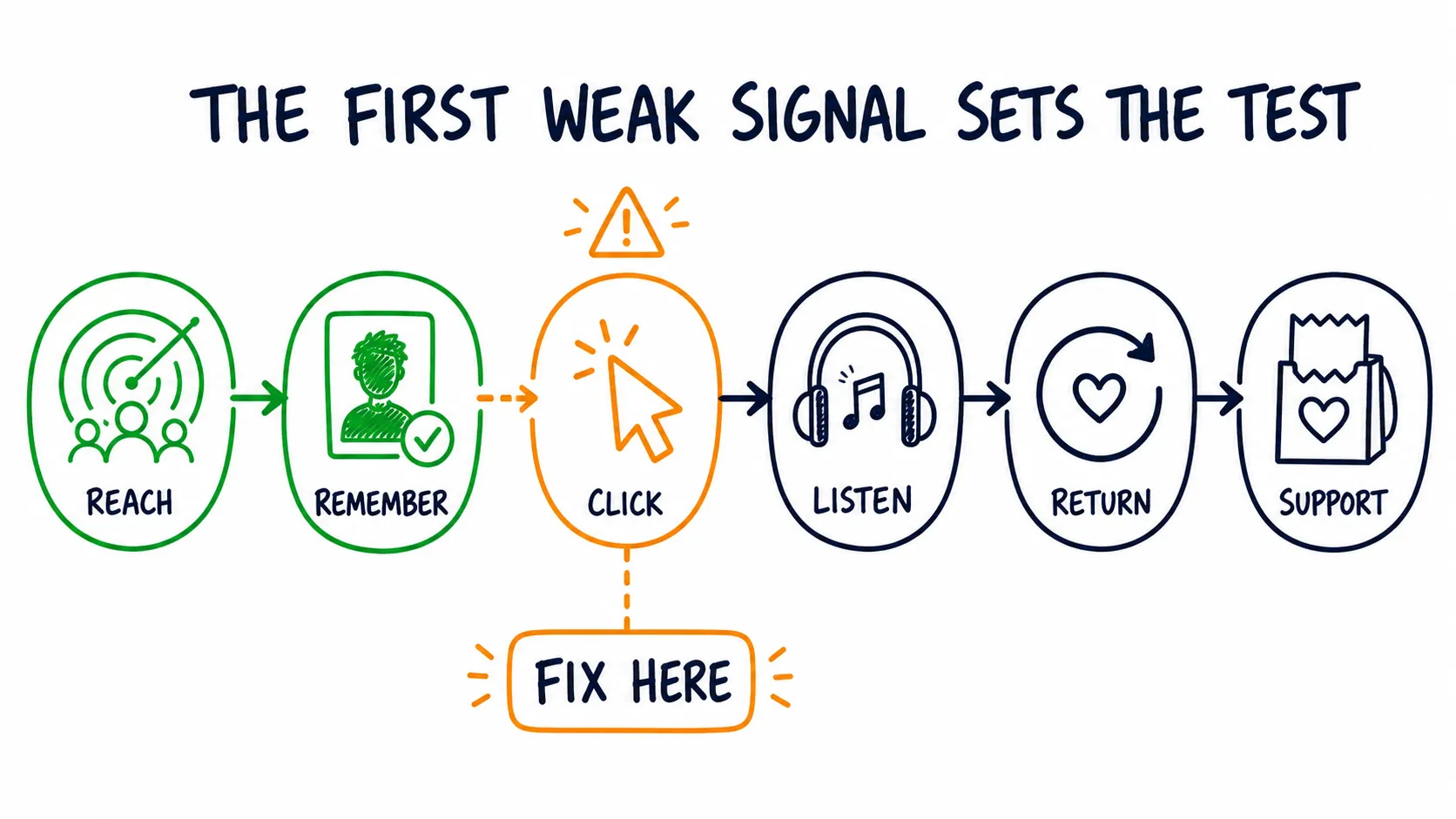
The first weak signal sets the next test. Downstream numbers cannot fix a break that happened earlier.
Map Each Post to a Fan Stage
One post rarely turns a stranger into a committed fan, and it does not need to. Treat the fan path as a set of smaller moves.
| Fan stage | The content job | Useful proof |
|---|---|---|
| Stranger | Make the right person stop and understand the music fast | Qualified reach, hold time, completion, and shares |
| Interested viewer | Make the artist easy to remember and worth checking | Profile visits, follows, repeat views, and comments with context |
| New listener | Make the full song and next song easy to choose | Song clicks, saves, follows, repeat plays, and catalog movement |
| Returning listener | Deepen the link to the catalog, story, and artist world | Active audience, returning viewers, email, and repeat visits |
| Committed fan | Give them a useful way to join, share, attend, or support | Replies, referrals, tickets, merch, direct sales, and fan content |
A common mistake is asking discovery content to prove retention. Mapping each post to a stage prevents it.
A short hook clip may earn attention but say little about the artist. A long studio breakdown may build belief with current fans but reach few strangers. A direct release post may convert warm followers and fail with everyone else.
Judge each post by the move it was built to make. Then judge the full content mix by whether people have a clear next step after that move.
Write a Content Thesis That Can Reject Ideas
A useful strategy needs a point of view. Without one, every trend can look relevant and every format gets tested. The feed grows busy while the artist gets harder to understand.
Write one sentence:
For [specific listener], we use [repeatable creative formats] to connect [what is true about the artist] with [a feeling, tension, or scene in the listener’s life], then lead them toward [the next fan action].
For example:
For late night alternative pop listeners, we use close live takes and short story setups to connect tense, honest songs with the thoughts people avoid during the day, then lead them into the full song and related catalog.
Keep this sentence internal and use it to reject ideas.
A broad studio tutorial may be useful, but it does not fit that thesis unless the production choice makes the listener feel the song more. A random trend may bring reach, but it does not belong if the artist disappears inside it. A beautiful performance may still need a stronger setup if strangers cannot place the feeling.
Use the thesis to choose your content territories. Content pillars for musicians are often treated as topic buckets: behind the scenes, personal life, education, promotion. Those buckets are too broad to guide a strong creative choice, so build territories around a listener tension instead:
- The music promise: What experience does this artist deliver again and again?
- The identity tension: What does the artist believe, resist, want, or struggle with?
- The proof: What can the artist show that makes the work more credible?
- The scene: Where does this music fit in a listener’s life, culture, or routine?
- The fan role: How can people respond, choose, share, or see themselves in it?
For a touring rock band, the proof may be live control and room energy. For a producer artist, it may be the way one sound changes the whole emotion. For a rapper, it may be the detail inside a bar and the life behind it.
The same subject can mean different things in a different territory. “How I recorded this guitar” teaches a peer. “The guitar had to sound like the amp might break” gives a listener a feeling and still shows the craft.
Build a Portfolio, Not a Feed Full of Clones
A content portfolio is a group of posts with different jobs. It protects you from two bad extremes:
- Pure discovery: The page gets broad reach but gives people little reason to care about the artist.
- Pure depth: Current fans enjoy every post, but few new people enter.
Use the next ten posts as a test block. Change the mix based on the constraint.
| Main constraint | A useful ten post test | What you are trying to learn |
|---|---|---|
| Qualified reach | Six discovery, two proof, one bridge, one experiment | Which premise brings the right strangers into the artist world |
| Recognition | Three discovery, four identity or proof, two bridges, one experiment | Which repeatable series makes the artist easier to remember |
| Activation | Three discovery, two identity, four bridges, one experiment | Which path moves warm viewers into the full music |
| Depth or retention | Two discovery, three catalog depth, four community or return, one experiment | Which content brings listeners back and opens more of the catalog |
Treat this as a starting split, not a benchmark. It forces a choice, because every stage cannot be the top goal for the same ten posts.
A bridge post links the content to the next action without feeling like a loose sales pitch.
Examples:
- A pinned performance that names the song and shows where to hear it
- A story that ends on the lyric, then opens the full track
- A catalog pair that connects the new song to an older one
- A live clip tied to a city where tickets are on sale
- A fan comment answered with the part of the song they asked about
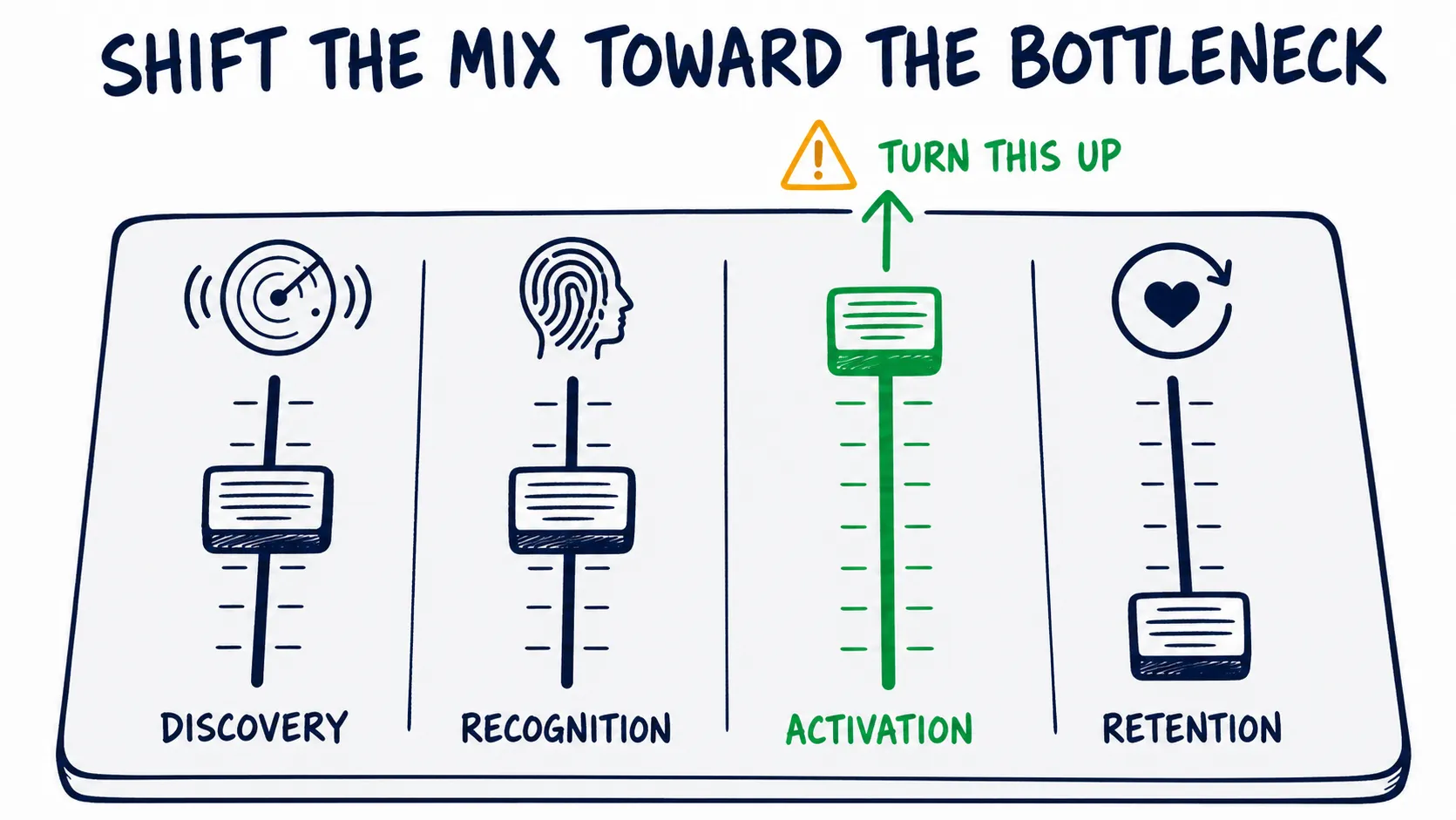
The content mix should change with the constraint. This example turns activation up because the path from interest to music is weak.
Score a Repeatable Series Before You Scale It
One good post can be luck. Before you give a format more time or budget, score it from one to five on six questions.
| Question | What a high score means |
|---|---|
| Does it attract the listener we want? | The comments, follows, and clicks come from likely fans, not only peers |
| Is the music central? | People can link the idea, sound, and artist together |
| Could another artist copy it without changing much? | A high score means the format depends on your voice, taste, or story |
| Can we make ten strong versions? | The format has range without needing ten new songs or locations |
| Does it create a clear next step? | Interest can move toward the song, catalog, show, email, or fan action |
| Is the production cost worth the learning? | The time, money, and team load fit the value of the signal |
Do not chase a perfect total. Compare series against each other.
A detailed production breakdown may be cheap and repeatable. If it brings only producers and no useful business result, it is weak for a fan growth goal.
A close live performance with a sharp story setup may cost more. If it brings qualified profile visits, song clicks, and repeat listeners across several versions, it may deserve the larger share of the calendar.
The series score protects you from scaling whatever happened to get the largest view count.
Design the Capture Day Around Modules
Content repurposing often means posting the same edit in three places. That saves export time but adds little strategic range.
Build modular source material instead. A module is a piece you can combine with different premises, song sections, and next steps.
For one song or campaign, capture four layers:
- Master proof: A full performance, full conversation, rehearsal run, or studio session
- Openings: Several clean first lines built around different listener tensions
- Music moments: Short sections with clear starts and endings, plus clean audio
- Bridges: Endings that point to the full song, another post, a show, or a fan action
Add flexible material such as room shots, hands, crowd footage, lyric pages, travel, stems, and still photos.
With modules, the editor can test a new opening without rebuilding the whole post. The team can change the bridge without changing the proof. A song section can move from a story setup to a fan reply while the source stays clean.
Keep a simple naming system. Mark the song, premise, stage, take, and result. When a format works, you should be able to find the source and build the next version fast.
If the campaign needs one larger visual asset, use the lyric video versus music video guide to choose based on the actual bottleneck.
Test One Variable at a Time
Artists often call three unrelated posts a test. One is a live take at night, one is a studio joke, one is a lyric card. The song section, opening, length, setting, caption, and next step all change, so the results cannot tell you why one worked.
Write a test like this:
We think framing the chorus around late night regret will bring more qualified profile visits than explaining the production, because the listener can enter through a feeling instead of a technical detail.
Then keep as much else steady as you can: the same song section, a similar length, and the same channel. Test several openings, and compare rates, not only totals, since reach will vary.
For this test, useful numbers may include:
- Shares per view
- Profile visits per view
- Follows per profile visit
- Song clicks per profile visit
- Saves or active listeners during the matched window
Use your own recent baseline for that format and audience. A generic benchmark hides genre, market, account size, traffic source, and fan stage.
Treat one strong result as a clue, and wait for a repeated lift before you call it a pattern. If one post goes viral and the next four versions fall below your normal result, you found an event, not a proven series.
Keep a small decision log:
| Field | What to record |
|---|---|
| Hypothesis | Who should respond, what should change, and why |
| Constant | The song, section, format, or audience you kept steady |
| Variable | The one main thing you changed |
| Leading signal | The early content result that fits the post job |
| Bridge signal | The profile, link, song, or return action after the post |
| Decision | Scale, hold, fix, stop, or test again |
This keeps the strategy from becoming a folder of screenshots with no next move.
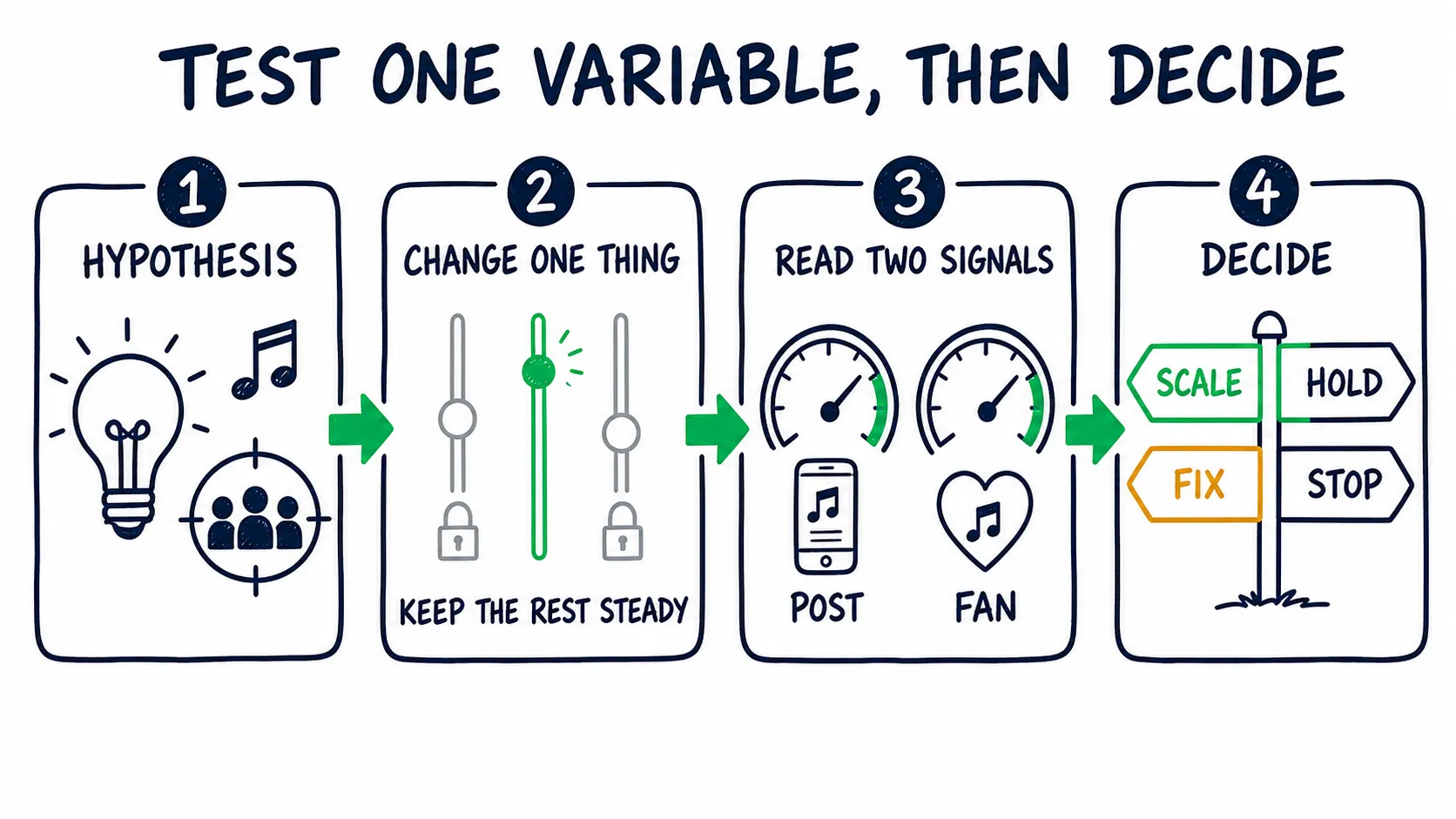
A clean test changes one main variable, reads both the post signal and the fan signal, then ends with a decision.
Give Each Platform a Research Role
The same audience may behave differently on each platform, so use each one to answer a different question.
TikTok can test premises and audience language fast. Its recommendation guide explains how viewer actions and content information shape recommendations. TikTok for Artists adds post, song, and follower data. Our guide to TikTok for musicians covers the execution layer.
Instagram can show whether an idea creates recognition inside a warmer artist world. Instagram Insights includes reach, shares, saves, follows, and other actions.
YouTube can test whether a short premise earns deeper time. YouTube Analytics for Artists joins song and video activity across the platform.
Spotify shows whether outside interest becomes chosen listening. It is a weak content attribution tool but a stronger source for saves, followers, source mix, active audience, and catalog behavior.
Your site and email show whether the relationship can live outside a feed.
Do not force every channel to publish at the same volume. Give each platform a research job, and let a winning premise move from fast testing into deeper proof, then into a bridge toward music or an owned fan action.
Fix the Peer Audience Problem at the Source
Showing the process is rarely what pulls in other musicians. How you frame it decides whether a producer or a listener gets the payoff.
“How I sidechained this bass” promises a lesson. A producer stays for the answer.
“I needed the drop to feel weightless without losing impact” promises an experience. A listener can care before the method appears.
If peer reach is becoming a problem:
- Open with the listener tension, not the tool
- Put the music before the full explanation
- Remove teaching language from fan focused series
- Check who follows, clicks, and returns, not only who comments
- Keep peer series separate when they support production work, education, or industry goals
Do not use a peer heavy post as proof that a fan campaign is working. It may be a strong asset for a different business goal, so label it correctly.
Build an Evidence Chain From the Post to the Fan
Perfect attribution is rare. TikTok, Instagram, YouTube, your link tool, Spotify, email, and ticketing do not share one clean user path. Privacy rules and platform walls leave gaps.
Do not fill attribution gaps with certainty you do not have.Build an evidence chain instead.
| Evidence level | What you can see | What you can claim |
|---|---|---|
| Weak | Views rose | The platform distributed the post |
| Useful | Qualified engagement, profile visits, and link traffic rose | The post created interest and some movement |
| Strong | Target market listeners, saves, follows, or active audience rose in the same window | The campaign likely helped music behavior in that market |
| Stronger | The same pattern repeats across several posts, windows, or markets | The creative and audience fit may be repeatable |
Start with a baseline before the series. Match the dates and the markets. Separate paid from organic traffic when you can. Use tagged links for click paths. Compare the target countries in the artist dashboard.
If you have enough scale, stagger support by market or time. A listener lift that follows exposure in one market and appears again in another is stronger evidence than a worldwide graph that moved during five campaigns.
Do not call it a controlled test unless it was one. Call it evidence and state the limits.
Spotify separates programmed and chosen listening in its audience segments. Its super listener guide also shows why deeper listener groups matter more than a broad total.
Use Spotify saves, follows, active audience, and catalog movement as downstream checks. The Spotify for Artists guide explains where to find them. For the full measurement method, use the music analytics guide.
If people reach the artist page but the listener signals stay weak, use the free Spotify audit to check the profile, audience quality, geography, and likely conversion leaks.
Set Decision Rules Before the Result Arrives
It is easy to move the goal after a post underperforms, so set the next move in advance.
- Scale: The content signal, bridge signal, and music signal all hold across several versions. Production cost is still healthy.
- Hold: The direction looks good, but the sample is too small or the downstream data is late.
- Fix: The opening works, but the next step breaks. Keep the premise and repair the profile, bridge, audience, or offer.
- Stop: The series stays below your baseline, attracts the wrong people, or costs more than the learning is worth.
- Retest: The idea is still sound, but the test changed too many things or ran in a noisy window.
Set these rules before you add paid reach. Money can spread a premise that has already proven itself, but it will not rescue a weak one.
For TikTok, automatic video promotion from TokPromo can place managed mobile ad reach behind each included new public post and report the results by video. Use it after the creative premise and audience have earned more distribution.
Before paying, look for a series that already brings the right people and a bridge that already works. Use the music promotion budget calculator to size the test.
Then carry the winning premise into the ads unchanged. Keep the same opening, song section, and listener tension, and run it as mobile ads that open the song in Spotify for listeners of similar artists. Real people who already like that sound hear the idea that earned attention organically.
Once the ads run, judge each audience group by saves, follows, and repeat plays in the matched window. Cheap taps and raw streams will flatter the wrong groups. Move budget toward the groups and songs where chosen listening rises, and cut the rest. When you compare outside help, look for promotion that moves budget toward listeners who save and follow, with results you can check in your own Spotify for Artists.
A clear music website also gives serious fans one stable place for music, shows, email, merch, and the next release.
Track the Economics of the Content System
A content strategy can perform well and still be too expensive to keep.
Track four operating numbers:
- Capture yield: How many usable modules come from one session?
- Edit load: How much team time does one published post take?
- Useful hit rate: How many posts beat the chosen baseline on the signal that matters?
- Series life: How many strong versions can the format produce before the signal fades?
These numbers expose hidden waste.
A polished video that takes two days and answers no new question may be less useful than a repeatable series that produces six clean tests in one session.
A cheap post is not automatically efficient. If it brings the wrong audience every time, it creates noise and teaches the team very little.
Hire or outsource when the creative format is proven and production has become the constraint. An editor can speed up a clear system. They cannot define an artist voice that the team has not found yet.
Protect the work that creates the music. Cut steps that do not improve the premise, proof, bridge, or learning.
Put the Strategy on One Page
Your working document needs eleven lines:
- Business goal
- Current growth constraint
- Listener and fan stage
- Content thesis
- Three creative territories
- Two or three series to test
- Mix for the next ten posts
- Main variable and baseline
- Platform role
- Bridge to music or an owned fan action
- Scale, hold, fix, and stop rules
Review it once a week. Ask what changed in the audience, what changed in the music data, what the team learned, and which decision follows.
Do not rewrite the whole strategy because one post missed. Do not protect a weak series because one version went viral.
Frequently Asked Questions
How Often Should a Musician With Momentum Post?
Use test speed, not a universal posting quota.
For many independent teams, three or four strong posts a week can create a useful pattern. Your own production load and test design matter more than the number.
- Too slow: It takes two months to test one opening or premise
- Too noisy: Daily output changes the idea, quality, and audience every time
Choose the fastest pace that still gives you clean, comparable tests.
How Do I Stop Content From Attracting Only Other Musicians?
Separate peer goals from fan goals.
For a fan focused series:
- Open with a listener tension, not a tool
- Put the music before the full explanation
- Remove tutorial language from the opening
- Judge follows, profile visits, and song clicks by who created them
Comments alone are weak proof. Musicians are often more likely to explain why they liked a post.
Will Repeating One Song Create Fatigue?
Song fatigue and creative fatigue are different problems.
- The creative may be tired when the same opening, visual, and pitch keep losing hold time and shares
- The song may still have room when new premises earn interest and the track keeps getting saves or repeat plays
Rotate the entry point, song section, proof, audience frame, and bridge. Let several posts show the pattern before you rest the song.
How Can I Prove Content Is Creating Fans When Attribution Is Weak?
Build matched evidence instead of claiming certainty.
Record four things:
- Baseline: What normal results looked like before the series
- Window: The exact dates and target markets
- Bridge: Profile actions and tagged link traffic
- Downstream: Listeners, saves, follows, active audience, and catalog movement
Look for the lift to follow the content window and repeat across posts or markets.
You may not prove that one viewer became one listener, but you can still prove that a series keeps creating qualified movement.
When Should I Put Paid Reach Behind an Organic Post?
Boost proof, not the post with the largest view count.
Put paid reach behind a post only when:
- The creative premise works across more than one result
- The audience looks like the listener you want
- The bridge from content to music holds
- The budget, success rule, and stop rule are set before launch
Use qualified profile visits, song clicks, saves, active listeners, or another signal tied to the goal. Then shift budget in steps toward the audiences that save and follow, as long as listener quality holds.