
Spotify Artist Profile Guide: Advanced Signal Strategy for Real Fan Growth
Your Spotify artist profile is where borrowed attention either turns into fan signal or disappears.
If you already release music, you know Spotify for Artists and you know streams, saves, followers, playlists, and source data all matter. The hard part is reading what those numbers mean after strangers show up.
Treat your Spotify artist profile as a signal router. It catches traffic from ads, playlists, Radio, social content, search, editorial, algorithmic feeds, and direct links, then shows what those people do next. Do they save, follow, play a second song, add the track to a playlist, or come back?
The profile is where you find out whether attention has listener fit. Bigger screenshots and random streams don’t prove it, and neither does traffic that spikes for three days and leaves your profile colder than before.
The goal is to help the right people find the right song, then collect enough signal to know what deserves more budget.
Profile Basics, But Only The Parts That Cost You
A few basic profile issues can still wreck a serious campaign.
Spotify says an artist profile is created automatically when your music is delivered to Spotify. You do not create the public page by hand. Your distributor sends the music, Spotify creates or matches the artist page, then you claim access through Spotify for Artists.
Claim access early
If your first release is unreleased, ask your distributor for the artist link or artist URI after delivery. Spotify says you can use the artist link or URI plus release details to request access before release day. Do this early so you catch mapping issues before traffic starts.
Check the artist URI
Artist names are not unique, so the artist URI is the cleaner identifier. Before every release, save:
Artist name:
Spotify artist URL:
Spotify artist URI:
Upcoming release UPC:
Release date:
Distributor ticket link:
Team members with access:
This is boring until it saves a rollout.
Fix wrong mapping before promotion
If your song lands on another artist’s profile, stop. A wrong profile sends your signal to someone else’s artist page. Don’t run ads, pitch curators, or post the Spotify link anywhere until it is fixed.
Spotify has a support path for music mixed up with another artist. Your distributor is usually the first place to start because they control delivery metadata.
Also check for duplicate profiles, especially after distributor changes, older releases, feature credits, or metadata updates.
Protect the profile
Use Artist Profile Protection if you have access to it.
Keep team access tight. Give people the lowest access level that lets them do the job, then remove access when the job ends.
Key takeaway
Bad setup poisons the signal. Before promotion, make sure artist URI, profile mapping, duplicate profiles, and team access are clean.
The Spotify Artist Profile Is A Signal Router
Most profile advice stops at looking complete: add a bio, a photo, and an Artist Pick. That is too shallow. A serious Spotify artist profile should answer one question: when the right listener lands here, what should they do next?
It won’t always be “stream the new single.” The right next step might be a save, a follow, a second song play, or an artist playlist that gives a cold listener a cleaner first ten minutes.
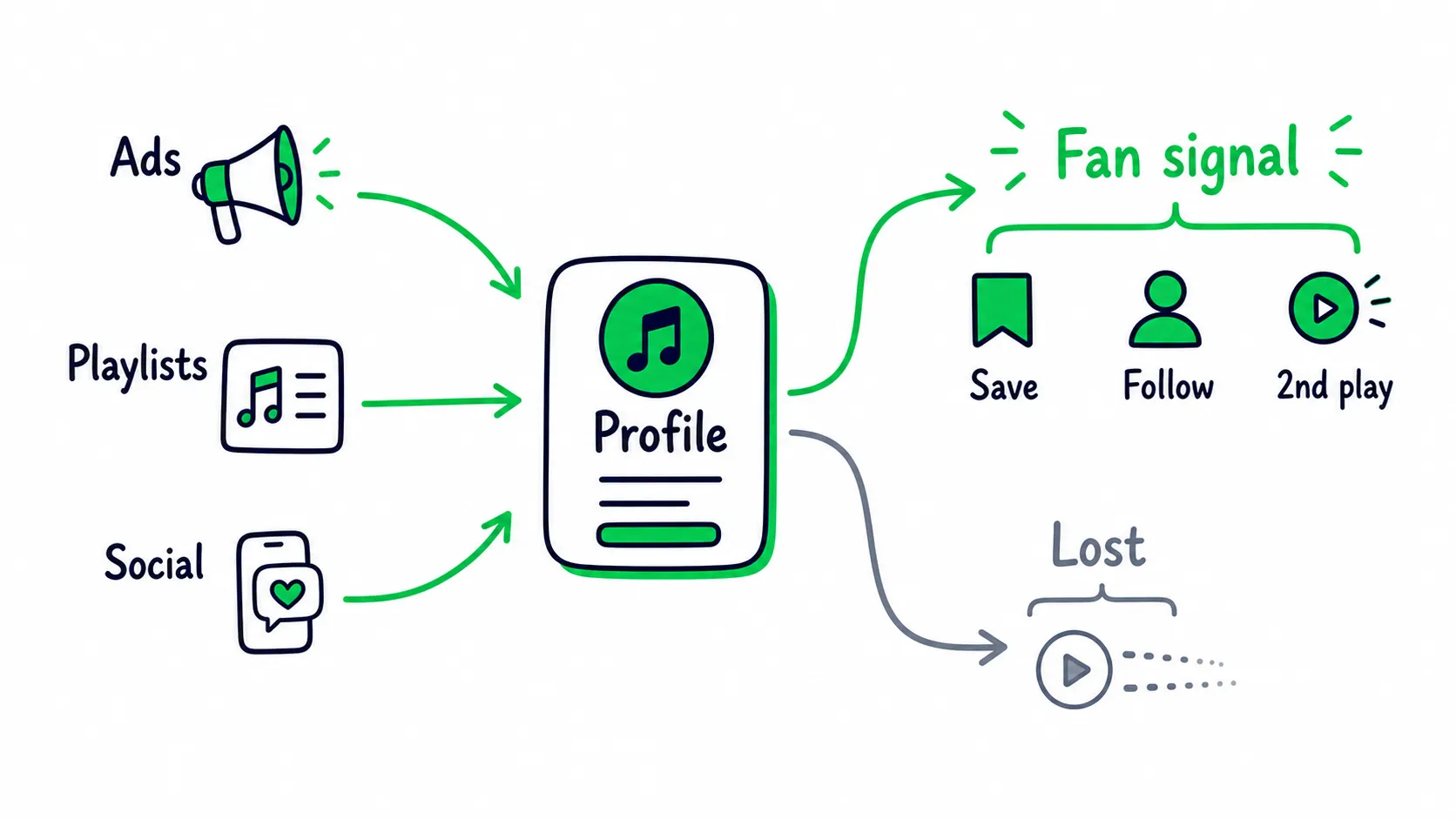
The profile is the router. The same traffic can create fan signal or disappear.
The actions that matter
| Action | What it usually means | Why it matters |
|---|---|---|
| Save | The song earned a place in the listener’s library. | Saves show song level intent. |
| Follow | The listener wants a connection to you, not only one song. | Follows suggest artist level interest. |
| Second song play | The listener got curious enough to leave the first track path. | This shows the profile is routing people into the catalog. |
| Playlist add | The song fits a listener’s mood or use case. | User playlist adds can create return plays. |
| Return listen | The listener came back after the first touch. | Return behavior separates curiosity from real demand. |
Spotify for Artists gives you pieces: sources of streams, audience data, saves, followers, active audience, playlists, cities, countries, and song level movement.
Spotify explains source data in its guide to source of streams, and breaks audience behavior into segments in its guide to audience segments.
Your job is to connect those pieces. Instead of only asking “Did streams go up?”, ask:
- Did the right source grow?
- Did saves rise with streams?
- Did profile visits turn into follows?
- Did people play more than one song?
- Did countries match the audience we meant to reach?
- Did the catalog get healthier, or did only one surface number move?
The Profile Signal Diagnostic Matrix
When a campaign moves numbers, artists often react too fast. Use this table before you scale, stop, or change direction.
| Pattern | Likely meaning | What to inspect | What to do next |
|---|---|---|---|
| Saves rising, follows flat | The song is working harder than the profile. | Profile visits, bio clarity, Artist Pick, top songs, next song path. | Improve the route from song interest to artist interest. |
| Streams rising, saves flat | People are hearing it, but not wanting it again. | Source mix, playlist context, ad targeting, passive streams. | Hold spend. Test a tighter audience or stronger entry song. |
| High streams per listener | Could be catalog bingeing, or low quality repeat behavior. | Saves, followers, country fit, user playlists, second song movement. | Scale only if repeats come with healthy signals. |
| Profile visits without follows | People are curious, but the profile is not closing the loop. | First screen, Artist Pick, profile image, top songs, bio promise. | Make the next step obvious for cold listeners. |
| Playlist streams without catalog movement | The playlist is creating exposure, not discovery. | Playlist theme, country fit, saves, profile visits, second song plays. | Judge the playlist by downstream behavior, not follower count. |
| Ad clicks without Spotify behavior | The ad may be attracting clickers, not listeners. | Ad data against Spotify streams, saves, follows, countries, timing. | Change the creative promise, audience, or destination. |
| Country mismatch | The traffic does not match your intended market. | Top countries, city clusters, ad delivery, playlist locations. | Stop scaling until the source is clear. |
| Fans Also Like drift | Spotify may be associating you with the wrong listener group. | Recent sources, playlist context, collabs, country mix, genre mismatch. | Clean up traffic and aim future tests at better fit listeners. |
How to read the weird patterns
Saves without follows usually means the song won, but the profile did not finish the job. The listener liked the track, but did not yet understand why they should care about you beyond that song. Fix the path from saved song to second song to follow.
High streams per listener can be great when saves, followers, user playlist adds, and country fit also look healthy. It becomes suspicious when repeat plays come from odd sources with no signs of real choice.
Fans Also Like drift doesn’t need daily checking, but if the whole section moves into a lane that makes no sense, treat it as a smoke alarm. Look back at the traffic source that started before the drift.
For listener count context, pair this with the Spotify monthly listeners guide. Monthly listeners alone do not tell you whether the profile is getting stronger.
Build The Profile Around Listener Paths
A good profile gives listeners a path instead of making them work.
Send traffic to one song when the song is the test
This works when:
- The release is new
- The track has the clearest hook
- The creative is built around one moment
- You need clean reads on saves, repeats, and source quality
- The rest of the catalog is not the right first step yet
One song can also become a dead end. If the track gets saves but no profile movement, the song is doing its job while the profile fails to catch the listener. Use the Spotify saves guide to decide whether song level intent is strong enough to justify more push.
Send traffic to the profile when artist discovery matters
This works when:
- You have several strong entry songs
- Your catalog has a clear sound or story
- The audience is already warm
- You want follows and second song plays
- The profile is strong enough to route people
Profile traffic gets messy when top songs, Artist Pick, and bio all point in different directions.
Use an artist playlist when cold listeners need a guided path
An artist playlist helps when one song does not explain you well enough. Give it a job, like walking a cold listener through your sound in five tracks, instead of dumping in every track you like.
Playlist name: Start Here
Track 1: Strongest hook or clearest current single
Track 2: Closest older song
Track 3: Different texture, same world
Track 4: Best proof of depth
Track 5: Current release again, if the flow supports it
If you are using outside playlists, study context before follower count. Use these as quality checks, not shortcuts around listener fit:
Connect new releases to older catalog
A new release should wake up the catalog. Before release week, choose the older tracks that should benefit if the new song works.
New release:
Closest older song:
Best deeper cut:
Best mood match:
Best artist playlist route:
Then watch whether listeners move that way. If the new song gets attention but no older track moves, the profile may not be showing the next right song at the right time.
For release planning, pair this with a music release checklist and a Spotify release engagement read.
The Listener Fit Loop
You can buy attention, pitch for attention, post for attention, or earn attention. Once attention reaches Spotify, the profile tells you whether those people were a good match. Get that fit right before you add more traffic.
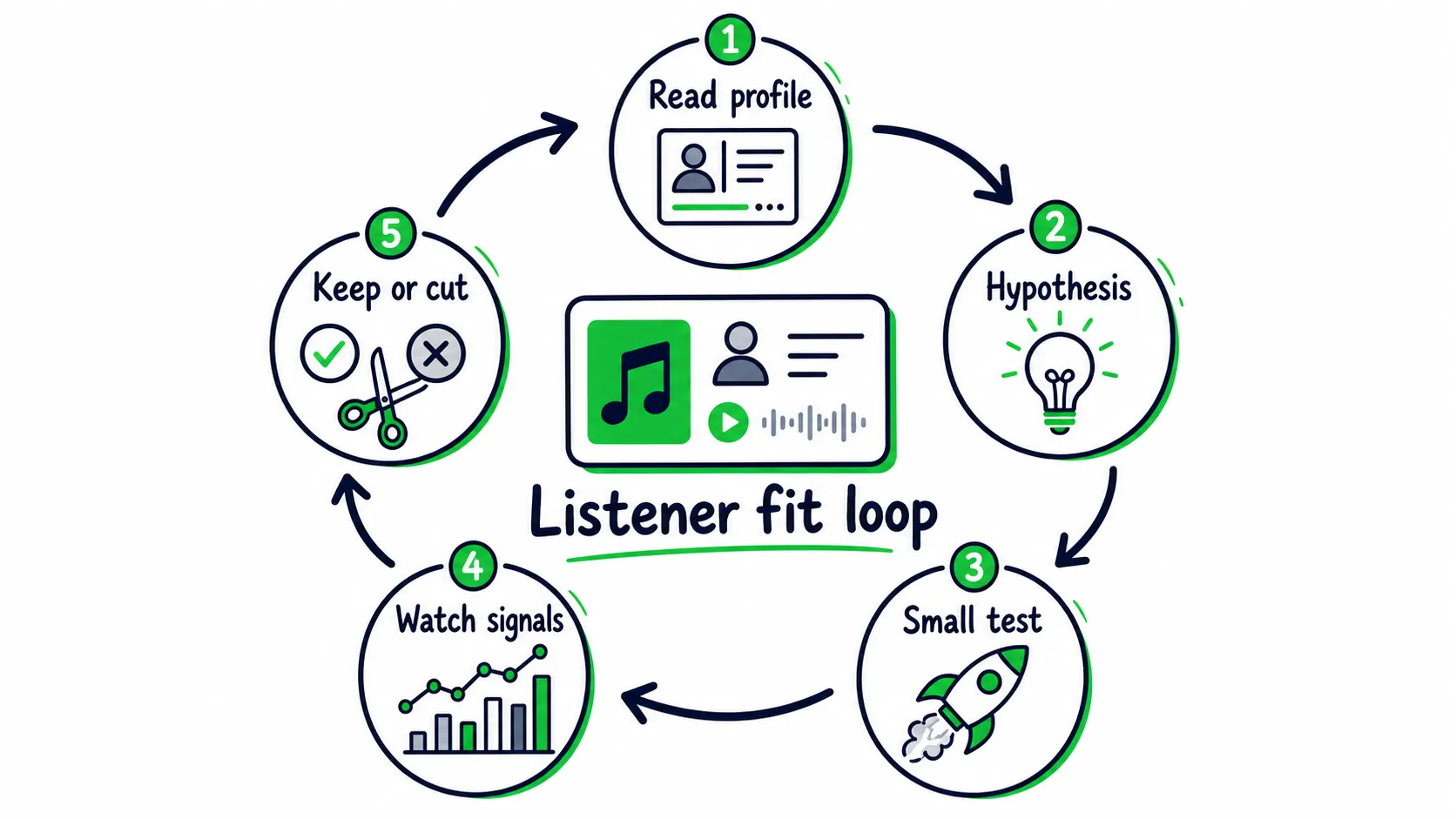
Read the profile, test a listener hypothesis, watch behavior, then keep or cut the source.
Step 1: Read the profile and catalog
Start with where the profile stands today. Read:
- Top songs
- Recent releases
- Saves by song
- Follower movement
- Source mix
- Cities and countries
- Playlist adds
- Active audience movement
- Fans Also Like
- Songs that cause second song behavior
A proper Spotify audit is a good starting point here. It shows where the signal is clean, where it is polluted, and what should be tested next.
Step 2: Form listener hypotheses
Skip “people who like my genre” and start with a sharper guess:
Audience:
Entry song:
Likely reason they care:
Expected action:
Risk:
Example:
Listeners who like moody late night alt pop may save the single, but may need the artist playlist to play a second song.Each guess should connect an audience, a song, and a behavior.
Different listener groups often enter through different songs. The single your team picked may win with fans of one similar artist, while an older track gets more saves from a second group. Pair each audience with two or three fitting tracks, then let saves and follows pick the entry song for that group.
Step 3: Run small tests
Small tests protect the profile because they let you learn before you scale. The channel can be ads, creator content, playlist pitching, short form content, email, direct fan posts, or press.
For each test, write down:
Audience:
Entry song:
Route:
Creative promise:
Source:
Countries:
Budget or effort:
Expected signal:
Stop rule:If you are sending cold ad traffic to one song, saves may be the first signal. If you are sending warm fans to the profile, follows and second song plays matter more. If you are testing a playlist, catalog movement and source quality matter more than playlist follower count.
Step 4: Watch the right signals
For a song test, watch saves, save rate, repeat plays, source of streams, country fit, and streams per listener.
For a profile test, watch profile visits, follower lift, second song plays, top song movement, artist playlist movement, and return listeners.
For a playlist test, watch streams from that playlist, saves, profile visits, follows, other songs moving, and country fit.
For a release system, watch release day source mix, first week saves, follower lift, algorithmic movement, catalog movement, and active audience growth.
Our Spotify algorithm launch playbook goes deeper on the release side.
Step 5: Keep what improves profile health
Judge a source by whether it makes the profile healthier, not by the streams it creates. Healthy signals look like:
- Saves rising with streams
- Follows rising after profile visits
- Listeners playing more than one song
- Top countries matching your real market
- User playlist adds growing
- Fans Also Like staying close to your lane
- Active audience growing, not only total reach
If a source creates surface numbers but weak behavior, it should not get more budget yet.
Read these signals in your own Spotify for Artists, where saves, follows, sources, and countries sit next to each other. Then write down the audience, entry song, and countries that passed. The next release starts from that list instead of from zero.
Step 6: Cut what only creates surface numbers
Sometimes the campaign with the best screenshot is the one you should stop. Watch for no saves, no follows, no second song plays, no market fit, and strange source data.
Before spending more, read how much music promotion costs and decide what proof you need first.
Key takeaway
The best promotion process learns which listeners make the profile stronger, then scales that behavior cleanly. Traffic volume comes second.
Use that standard when judging any Spotify promotion process. The strongest ones run an audience intelligence loop. They test separate listener groups, let several fitting tracks compete for each one, move budget toward listeners who save and follow, and cut sources that only create streams. Every result should show in your own Spotify for Artists, and the winning audiences, songs, and countries should carry into your next release. If a process cannot show you that, it is traffic with a receipt.
Ads, Playlists, And Profile Health
Artists argue about channels too much. No channel is good or bad by default: ads are not magic, playlists are not evil, and content is not always enough. Judge each channel by the behavior it creates on the Spotify artist profile.
| Channel | What it can do well | Where it can fool you | Best profile signal to watch |
|---|---|---|---|
| Ads | Test audiences, creative angles, songs, and countries with control. | Clicks can look strong while Spotify behavior stays weak. | Saves, follow lift, second song plays, country fit, source timing. |
| Playlists | Place a song inside a real listening context. | Streams can rise without profile visits or catalog movement. | Saves, user playlist adds, source quality, movement beyond one track. |
| Short form content | Warm listeners before they search or tap through. | Views can stay on the platform and never become Spotify behavior. | Search lift, profile visits, direct streams, follows, repeat plays. |
| Owned fans | Send warmer traffic that already knows the artist. | Small numbers may look weak if you only compare raw reach. | Follows, saves, second song plays, return listens. |
Scale, hold, or stop
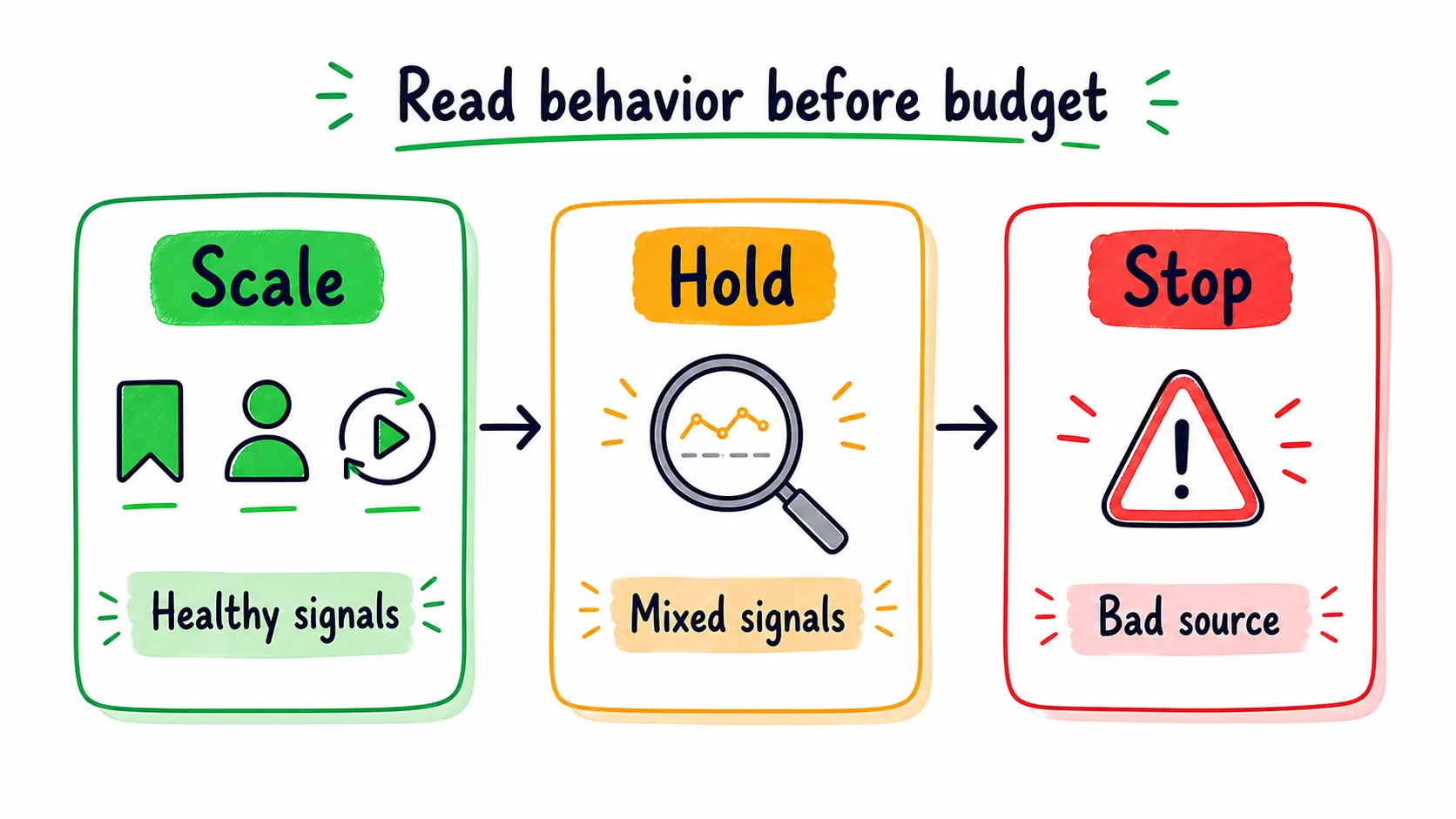
Spend only after behavior gives you a reason. Good signal scales, mixed signal waits, bad sources stop.
Scale when saves rise with streams, follows rise after profile visits, countries match the intended market, source data is clean, and listeners play more than one song.
Hold when streams rise but saves lag, follows are flat, one country takes too much delivery, or the song works but the profile route is weak.
Stop when streams rise with no saves or follows, source data looks strange, countries do not match the plan, Fans Also Like drifts away from your lane, or playlist streams create no catalog movement.
Profile Defense
Sometimes the best growth move is protecting the profile from bad data, bad access, or bad mapping.
If a release lands on the wrong Spotify artist profile, fix it before sending traffic. Spotify’s official article on music mixed up with another artist explains the issue, but your distributor will often need to correct delivery metadata.
If your catalog is split across duplicate profiles, listeners may not see the full world. That can hurt second song behavior, follower growth, and future release reads.
For access, Spotify’s guide to managing your artist profile covers the official tools. Spotify also explains how verified profiles work once you have access through Spotify for Artists.
Don’t share logins, and don’t give long term access to short term helpers. A designer, ad buyer, or casual collaborator should hold only the access the job needs.
Spotify also warns against third party services that guarantee streams. Bad traffic wastes money and makes good data harder to see.
If you suspect profile pollution, stop new promotion and audit:
- Which source changed first?
- Which country or city looks out of pattern?
- Which playlist or campaign started before the spike?
- Did saves, follows, and profile visits rise with streams?
- Did Fans Also Like shift?
- Did older songs move in a normal way?
You may not be able to clean every past signal, but you can stop feeding bad sources and rebuild around cleaner listener fit.
The 30 Minute Advanced Spotify Artist Profile Audit
Use this before a release, before scaling, or once a month.
1. Cold listener test, 5 minutes
Open the profile like someone who has never heard of you. Ask:
- What do I understand in five seconds?
- What song would I play first?
- Does the image match the sound?
- Is the Artist Pick helping?
- Would I follow, or only play one song?
Fix the first obvious friction point.
2. Catalog path test, 5 minutes
Pick the priority song, then the second song listeners should play. If you cannot name it fast, listeners probably cannot find it fast.
Check top songs, Artist Pick, latest release, artist playlist, and older tracks.
3. Source quality test, 5 minutes
Review recent source movement. For each source, ask what it did to saves, follows, countries, and catalog movement.
4. Follow gap test, 5 minutes
If visits are growing but follows are flat, the profile is leaking artist level interest.
Check Artist Pick, first line of bio, top song order, release to catalog connection, image, and whether the profile feels alive.
5. Profile pollution test, 5 minutes
Look for one country suddenly dominating, streams rising while saves stay dead, high streams per listener with no other healthy signal, Fans Also Like drift, or one playlist controlling the whole spike. If you see this, pause scaling and find the source.
6. Scale readiness test, 5 minutes
Before spending more, answer:
What source worked?
What audience did it reach?
What song did they enter through?
What did they do after the first play?
Did saves rise?
Did follows rise?
Did a second song move?
Did country fit stay clean?
What would make us stop?
If you cannot answer those questions, you are not ready to scale. Run another test.
Key takeaway
A good Spotify artist profile audit ends with a decision about traffic, audience, catalog routing, and whether to spend the next dollar, not only a note to fix the bio.
FAQ
Why do I get saves but not followers?
Usually, the song is creating intent but the profile is not turning that intent into artist interest. The listener liked the track, but the next song path, Artist Pick, bio, or catalog route did not make the artist worth following yet.
Is high streams per listener good or suspicious?
It depends on what comes with it. High streams per listener can be great when saves, followers, user playlist adds, second song plays, and country fit also look healthy. It becomes suspicious when repeat plays come from odd sources with no other signs of real choice.
Should I send ads to a song, profile, or artist playlist?
Send ads to a song when you need a clean read on one track, to the profile when you want follows or catalog movement, and to an artist playlist when cold listeners need a guided first path. Pick the destination based on the behavior you want to measure.
What should I do if Fans Also Like is wrong?
Don’t panic over one odd artist; look for a pattern. If the section drifts into a lane that makes no sense, review recent traffic sources, playlists, countries, collabs, and ad audiences. Then stop feeding the strange source.
How do I know if profile traffic is worth scaling?
Profile traffic is worth scaling when it improves profile health, not only total streams. Look for saves, follows, second song plays, clean country fit, real source quality, user playlist adds, and catalog movement.
If traffic creates profile visits but no follows, streams but no saves, or playlist plays with no catalog movement, hold the budget and test a better route.