
Are Spotify Promotion Services Legit? Buy the Work, Not the Number
Are Spotify promotion services legit? Some are. The bad ones sell you a number. The good ones can explain how a stranger reaches your music.
You released the music, built some traction, and learned that a stream spike can mean almost nothing. Now you want more of the right listeners without handing your catalog to a black box. So start with the listener path, not the badge, review count, or word “organic.”
Spotify is blunt about artificial streaming. A service that guarantees streams is promising a result it cannot honestly control. Spotify also tells artists to ask how a company promotes the music.
Read Spotify’s artificial streaming guidance and its warning about paid services that guarantee streams before you pay.
What You’ll Learn
- How to trace the full path from your payment to the listener
- What a provider controls and what it can only estimate
- The 12 questions to ask before you pay
- How to rank proof instead of trusting one screenshot
- How to separate bad traffic from bad targeting
- What listener fit adds after a provider passes the audit
You already have music out, a real baseline to protect, and enough Spotify for Artists data to care about saves, follows, repeat plays, and who comes back. You’re willing to invest, but you want to know exactly what you’re buying first.
Are Spotify Promotion Services Legit? Use Three Tests
To count as legit, a service has to pass three tests.
| Test | What you need to see | The decision it supports |
|---|---|---|
| Listener path | Every handoff from the provider to the channel, the listener, and Spotify | You can spot the hidden step before it becomes your risk |
| Work versus results | A clear split between work the provider promises and results listeners decide | You can tell a deliverable from a sales promise |
| Proof trail | Dates, sources, terms, and listener behavior you can inspect outside a private sales report | You can judge the campaign without taking the seller’s word for it |
Trace the listener path
Write the path in one line:
Your payment → campaign channel → listener action → Spotify page → Spotify for Artists
Now ask who controls each handoff.
In a real ad campaign, the provider sets up the ads and chooses the audience. A person sees the ad and decides whether to tap. Spotify opens. The listener decides whether to play, save, follow, or leave.
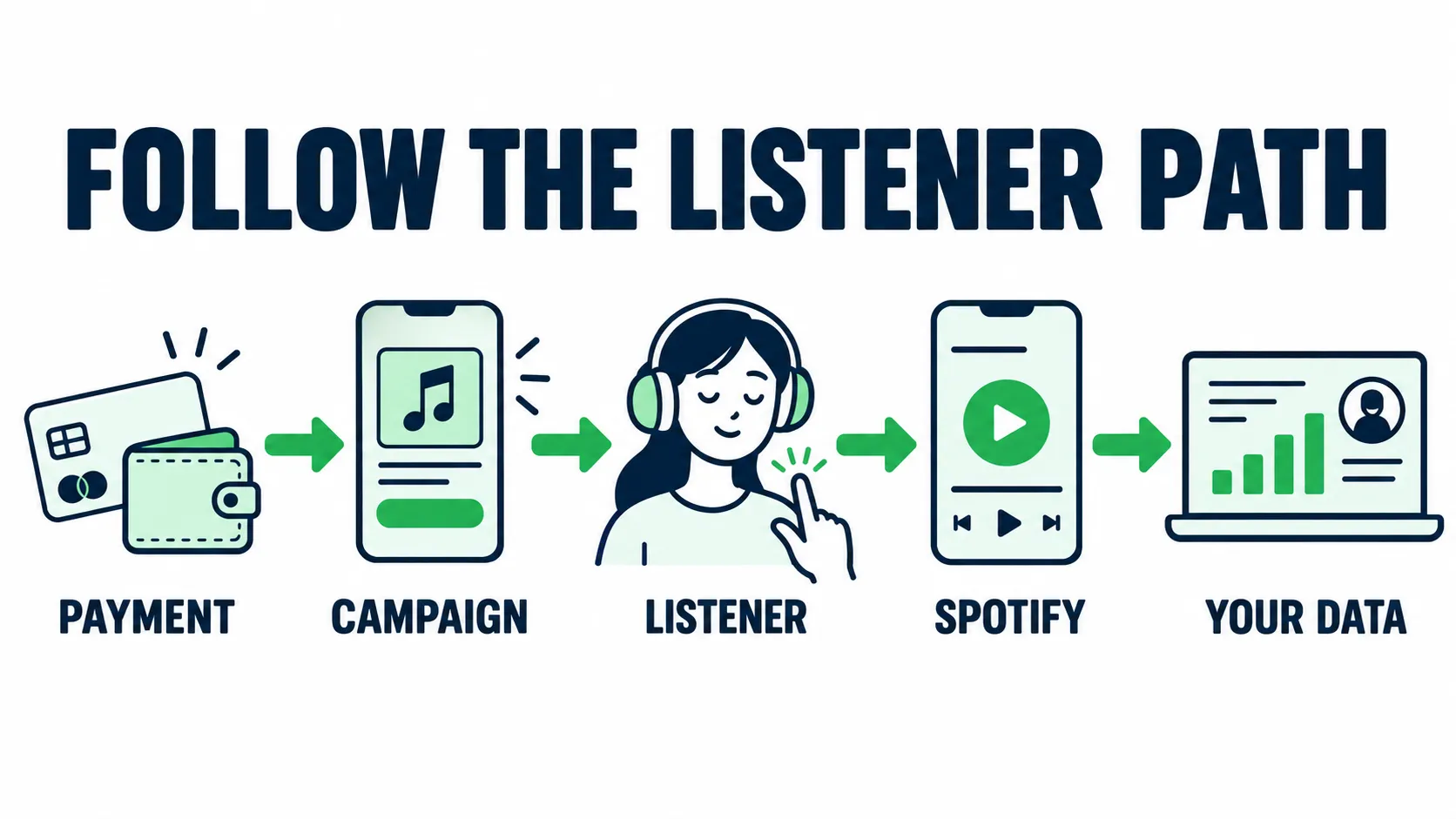
A visible campaign path shows every handoff while leaving the listening decision with the listener.
If the provider jumps from “you pay us” to “you get 10,000 streams,” the middle of the path is missing, and that hidden middle is your risk.
The company may control ad setup, targeting, campaign budget, creative, outreach, or reporting, and that work is what it can promise. It cannot order a real listener to play, save, follow, or return. Those choices stay with the listener.
Know Which Type of Spotify Promotion You Are Buying
Six different products get sold as “Spotify promotion,” and each needs a different test. First, work out which one is in front of you.
| Promotion method | What the provider controls | Good evidence | Main failure mode |
|---|---|---|---|
| Targeted advertising | Audience, creative, delivery, and campaign management | Launch dates, named channel, target markets, and movement in your own data | Real clicks reach the wrong listeners or land on the wrong page |
| Curator outreach | Research, pitches, follow up, and reporting | Named outreach, curator replies, feedback, and any live placements | Passive playlist listeners create streams but little artist interest |
| Creator promotion | Creator choice, brief, content, and posting window | Live posts, reach, audience fit, and the route from content to Spotify | Views stay on the social platform and never become listeners |
| Press outreach | Media research, pitches, follow up, and coverage support | Sent pitches, replies, live coverage, and publication fit | Coverage looks good but has no clear route to the music |
| Spotify’s own tools | The pitch or campaign entered inside Spotify | Delivery and reporting inside Spotify for Artists | Eligibility, reach, and platform choices stay outside your control |
| Stream package | A fixed output sold as the product | A stream counter and little else | The seller must manufacture the number instead of earning attention |
Spotify’s editorial pitch is free inside Spotify for Artists, and pitching does not guarantee placement. No outside seller controls Spotify’s editors. A seller controls the pitch, and Spotify makes the decision.
To size the budget, read the music promotion cost guide and use the music promotion budget calculator.
The 12-Question Audit Before You Pay
Before you pay, paste these questions into an email or chat.
| Ask this | A strong answer sounds like | Walk away when |
|---|---|---|
| 1. What exact channel will bring people to my music? | “We run mobile ads,” “we pitch human curators,” or another named method | The answer is “our network,” “organic reach,” or “secret traffic” |
| 2. What does the listener see before Spotify opens? | An ad, creator post, article, email, or curator playlist the provider can describe | The listener seems to appear from nowhere |
| 3. What does the total charge include? | A clear list of included work, campaign reach, timing, and any costs billed separately | The answer never gets more specific than a package name |
| 4. Which parts are firm deliverables and which are estimates? | The company names what it will do, then labels listener results as estimates | Exact streams, saves, followers, or algorithmic reach are sold as certain |
| 5. What can change the result? | Song fit, audience size, market, creative, catalog, and listener response | The provider claims every genre and artist gets the same result |
| 6. What do you need from me? | A public song or artist link and the details required for the stated method | Your Spotify password, recovery code, or personal login |
| 7. How do you choose the audience, market, and music to promote? | The answer connects your sound, catalog, or goal to a clear choice | The same target and plan are used for every artist |
| 8. When does the work start and what else could blur the result? | A written campaign window plus a request to disclose other active promotion | The timing stays vague or the provider does not care what else is running |
| 9. Where will I see the work and the listener response? | Your Spotify for Artists account, live content, placed coverage, or another source tied to the method | You only receive a total inside the seller’s private dashboard |
| 10. Can I see one complete example? | Starting point, method, dates, target, and more than one result from the same campaign | A cropped graph with no source, baseline, or context |
| 11. What happens if the traffic looks wrong? | A clear support path, review process, cancellation terms, and refund terms | Support disappears once delivery starts |
| 12. Who is not a fit for this service? | A direct answer based on catalog, goal, timing, or campaign type | The provider accepts every song and promises every artist a win |
Or send this shorter version:
Before I book, please tell me the campaign channel and listener path. What work and reach does the total charge cover? Which parts are firm deliverables, and which are estimates? How do you choose the audience? What access do you need? Where will I see the work? What happens if the traffic looks wrong?
Most solid companies can answer that in a few lines. If the reply keeps sliding back to big stream numbers, you have your answer.
Questions 1, 2, 4, and 6 are pass or fail. A hidden channel, a missing listener path, a fixed outcome, or a password request ends the audit.
Turn the Audit Into One Buying Decision
Skip the complicated score out of 100. The audit ends in one of three decisions.
| Decision | What you found | What happens next |
|---|---|---|
| Reject | The method is hidden, the outcome is fixed, account access is unsafe, or the terms change under pressure | Leave the offer |
| Hold | The method makes sense, but proof, timing, costs, or terms are still vague | Get the missing answer in writing before payment |
| Controlled test | The listener path is clear, the work and estimated results are separated, the proof trail exists, and the terms are readable | Test one provider in a clean window you can audit |
A controlled test means one known method, one set of dates, one starting point, and no mystery traffic mixed into the result.
How Musicvertising Answers the Same Audit
Musicvertising has served over 33,986 artists, bands, and labels, and its Spotify campaigns run on the audience intelligence loop. The table shows how a campaign that moves budget toward listeners who save answers the same audit.
| Audit question | Direct answer |
|---|---|
| What brings people to Spotify? | Targeted ads across mobile apps. A person sees an ad, taps, Spotify opens, and the listener chooses whether to play. |
| What do you provide? | One public Spotify artist link. The system maps your artist profile, catalog, similar artists, and listener locations from that link. |
| How is the audience chosen? | Separate audience pockets built around real listeners of similar artists and scenes, tested side by side. |
| What work is included? | Campaign setup and automatic management, multi-track catalog rotation so the strongest first song can win, plus monthly adjustments that move targeting and budget toward the audiences and tracks earning saves, follows, and replays. |
| Where do you see results? | In your own Spotify for Artists account. The winning audiences, tracks, and countries carry into your next release. |
| What are the monthly terms? | You can cancel a monthly plan anytime. If you are dissatisfied within 30 days of your first purchase, you can request a full refund. |
Check the Company Before You Check Out
Once the method holds up, check whether there is a real business behind it. A roundup can help you find names, but it is not proof, so find out who gets paid if you buy through the page.
Run this quick check:
-
Read the service page and terms side by side.
-
Confirm the company has a working contact path.
-
Search the company name with “artificial streaming,” “refund,” and “review.”
-
Open the Spotify profiles behind any testimonial you plan to trust.
-
Save the offer, receipt, terms, campaign dates, and support messages.
-
Use a payment method with a normal record. Do not send money through a method designed to leave no paper trail.
To see this check on real companies, read the reviews of Chartlex, PlaylistGrow, Playlist-Promotion.com, and Dynamoi. Each one lays out pricing, terms, refunds, and what users report.
DistroKid gives artists the same warning: research a service before you hire it, because a company can use fake methods without you knowing. Read DistroKid’s message about deceptive promotion services.
Use a Proof Ladder, Not One Screenshot
Proof gets more useful the closer it sits to the real work and listener behavior.
| Proof | What it can show | What it cannot show by itself |
|---|---|---|
| Your Spotify for Artists data matched to campaign dates | What changed on your profile, where streams came from, and what listeners did | Which outside touch caused every stream |
| A live ad, post, article, or placement | That the claimed campaign work exists | Whether the audience cared after seeing it |
| A complete case study | How one method performed from a known starting point | What your song will do |
| A named artist review | That one customer had an experience you can check | Whether the same method fits your music |
| A private total or cropped graph | That the seller can show a number | The source, quality, cause, or lasting value of that number |
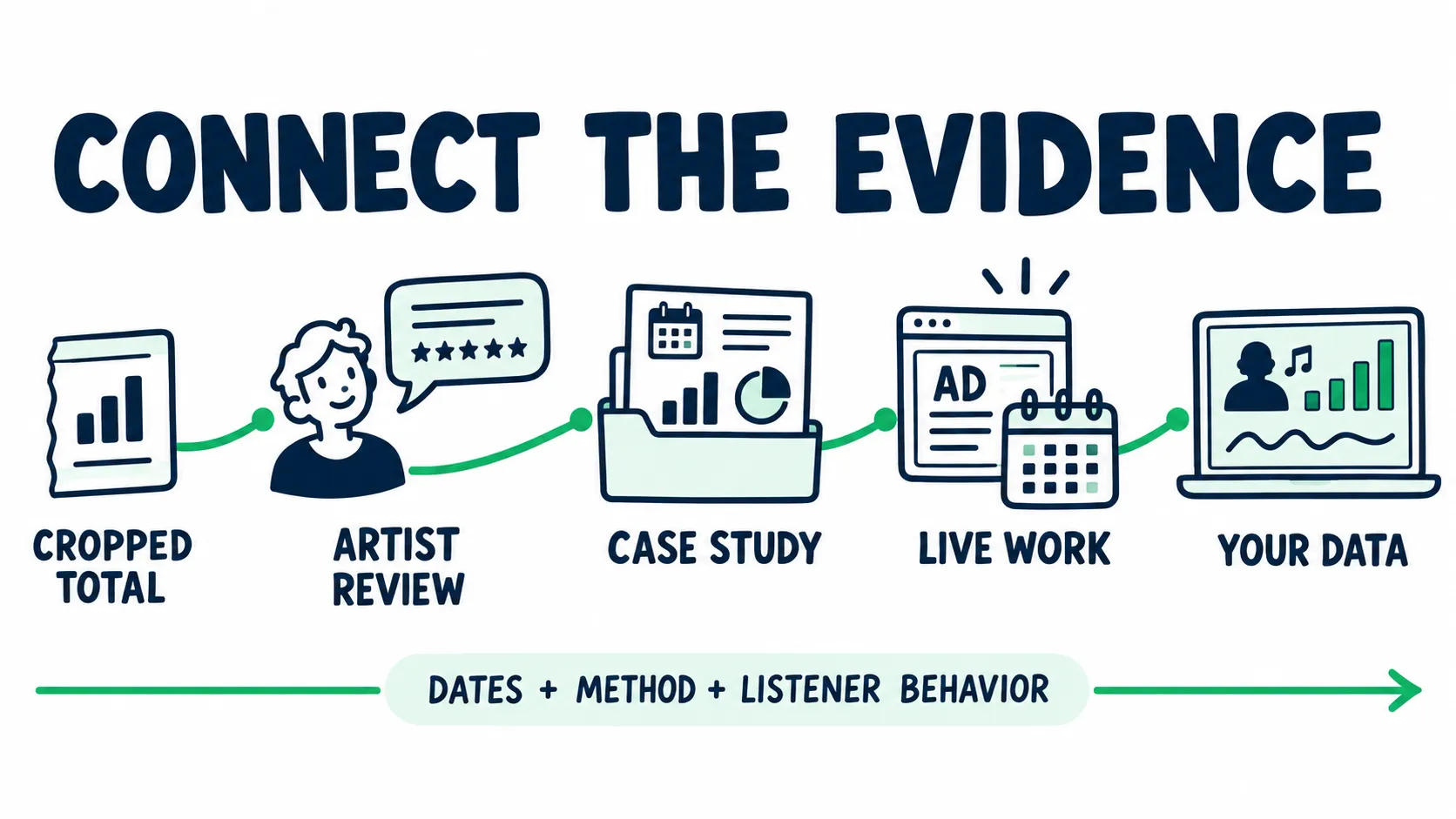
Evidence gets stronger when the dates, method, campaign work, and listener behavior connect. One number is not a verdict.
A large testimonial count should not beat a clear method. Reviews can support the decision, but they cannot replace the listener path.
A useful case study keeps the starting point, campaign method, dates, target, and several outcomes together. If those pieces are split across five screenshots, the result is harder to audit.
How to Check the Campaign After It Starts
The audit doesn’t end at checkout.
Keep the test window clean
Do not test two unknown providers on the same track at the same time.
If streams jump, you will not know which service caused it. If bad traffic appears, each provider can blame the other one.
Write down every active push: ads, playlist outreach, creator posts, PR, your own content, and any older campaign still running. You can’t build a perfect lab, but you can remove enough noise to see what caused the result.
You need a before picture. Open Spotify for Artists before the campaign starts and save these numbers:
- Daily streams and listeners
- Followers
- Top countries and cities
- Source of streams
- Streams per listener
- Saves and playlist adds for the promoted music
Spotify splits stream sources into two groups. Active sources mean the listener chose your music. Programmed sources mean Spotify or another listener chose it for them. See Spotify’s Source of Streams guide for the full list.
Separate source risk from weak listener fit
One weak metric does not prove bots, and one strong metric does not prove a campaign is clean. A real but poorly matched audience can create streams with few saves. A playlist can bring passive listeners who never visit your profile. An ad can reach real people who do not like the song.
Bad targeting misses the right listener, while fake traffic breaks the listener path.
Read the metrics together before you judge a spike.
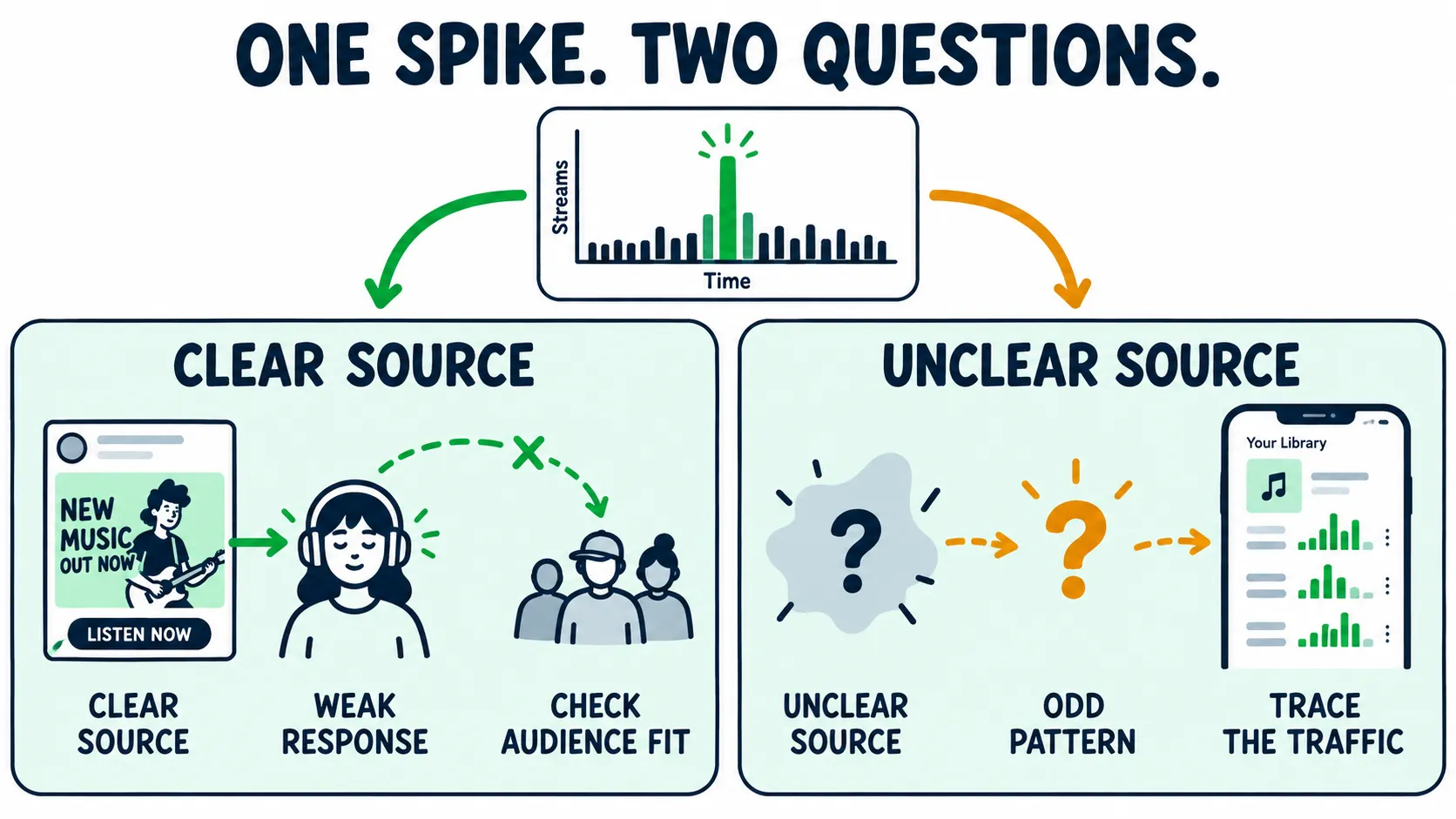
A clear source with weak response points to audience fit. An unclear source with odd delivery patterns calls for a traceable traffic explanation.
| Pattern | What it may mean | The next question |
|---|---|---|
| The source and countries match the plan, but saves and follows stay weak | The traffic may be real but poorly matched | How was the audience picked, and where did the listener land? |
| The source is unclear, the location makes no sense, and streams arrive in fixed bursts | The delivery path may be unsafe or hidden | Can the provider trace the traffic from its source to the listener? |
| Listeners, saves, follows, and catalog plays move together | The campaign is showing stronger signs of listener fit | Which audience and song created that movement? |
| Streams rise while listener count barely moves | A small group is creating many plays | Does that match real repeat listening, or is the pattern unexplained? |
Do not call one odd number fraud. Use it to choose the next question.
Use Spotify for Artists to read the dashboard. Use Spotify audience segments to see who chose you on purpose. Open music analytics when you need a deeper review.
If your monthly listener count falls later, that alone does not prove the campaign was fake, because the count uses a rolling 28-day window. The Spotify monthly listeners guide explains why.
A Legit Method Still Needs Listener Fit
A visible listener path tells you the traffic can be traced, not whether the audience will care.
Fit comes from a process that learns. The audience intelligence loop does that in six steps:
- Start from music evidence. Read the artist profile, full catalog, similar artists, and listener locations, not “people who like music.”
- Separate audience pockets. Test distinct groups built around real listeners of similar artists and scenes, so you learn which fit worked.
- Send real people to Spotify. Use targeted mobile ads that open Spotify and carry the creative premise that already proved itself, with no bots or stream packages.
- Let the catalog compete. Rotate several fitting tracks. The song you picked is not always the best first song for a new listener.
- Move budget toward chosen behavior. Shift spend to the audience and track pairs that earn saves, follows, and replays, not cheap taps or raw streams.
- Verify and keep the learning. Check every result in your own Spotify for Artists, then carry the winning audiences, tracks, and countries into the next release so it starts warmer.
Besides a stream lift, those steps teach you the best first song for new fans and the listener groups and countries that respond (useful for touring and ads). The next release starts with a warmer follower base.
Use the same steps to judge any provider. One worth testing rotates your whole catalog, moves budget by saves and follows, shows results in your own Spotify for Artists, and lets you pick the exact playlist before you pay for playlist placement. A fixed package pushes one song to everyone, sends a screenshot report, and starts from zero every month.
If you are not sure what your profile is already signaling, use the Spotify growth audit before adding traffic. If you are deciding whether the result justified the spend or another month, use the Spotify promotion worth-it guide.
If Something Looks Wrong, Save the Paper Trail
Don’t waste time arguing with the graph. Pause the campaign and save the receipt, offer, messages, campaign dates, and screenshots. Ask the provider to explain the source. Contact your distributor if the activity stays unexplained.
Spotify tells artists to check sudden spikes, strange locations, odd sources, and short bursts of follower growth. See its artificial streaming guide.
If you already have a warning or takedown, you need a recovery plan, not another promotion audit.
The Bottom Line
Buy the work, not the number. Before you pay, ask what happens between your card and the listener. Get the method, included work, terms, and place you will see results in writing.
If the answer is still “trust our network,” keep your money.
FAQ
Are any Spotify promotion services legit?
Yes. Ads, creator posts, press outreach, and human pitching can all be legit. Look for three things: a visible listener path, a clear split between work and estimated results, and proof you can inspect outside the seller’s private report.
Can my Spotify account be flagged if a promotion company lies to me?
Yes. Spotify and distributors can act on fake streams even when the provider lied to you. Keep the offer, receipt, campaign dates, and support messages. Share the provider details with your distributor if odd traffic appears.
Does “100% organic Spotify promotion” mean the traffic is safe?
No. “Organic” is not a channel or a method.
Ask four questions:
- What does the listener see before Spotify opens?
- How is the audience chosen?
- When does the work run?
- Where does the result appear?
How can I tell if Spotify promotion brought real listeners?
Match four parts of the story:
- The campaign channel to the stream source.
- The target market to listener locations.
- The campaign dates to the movement.
- The stream lift to saves, follows, repeat plays, and catalog movement.
If several parts fail to match and the provider cannot trace the traffic, treat the listener path as broken.
Should a Spotify promotion service need my login?
No. Do not share your Spotify password or recovery code.
Many campaigns only need a public artist or track link. If a method needs account access, the provider should explain why and use proper team access instead of asking for your personal login.