
Is Spotify Promotion Worth It? Measure What Stays After the Campaign
Spotify promotion is worth it when it brings you real listeners who save, follow, return, and make your next release easier to grow.
The Short Answer
If you need one campaign to repay itself through Spotify royalties: usually not.
If you need matched listeners, better catalog data, and a stronger base for the next release: yes, when those listeners choose to stay.
Pay for a clear path from the right listener to your music, then watch whether they save, follow, play another track, or return.
Who This Is For
This is for the artist who already has music out and keeps Spotify for Artists open in another tab. You may have:
- A few thousand monthly listeners or more
- A catalog with several strong entry tracks
- One song that already proved strangers care
You know enough to be dangerous. Now you want to turn scattered traction into demand you can repeat.
What You’ll Learn
- How to define “worth it” across royalty, audience, and career return
- Which promotion method fits the result you need
- How to measure the baseline, first 30 days, and holdover window
- When to scale, fix, or stop the campaign
What “Worth It” Means on Spotify
Two artists can run the same campaign and judge it in opposite ways. One checks the royalty statement. The other checks who followed, saved, and came back. Both measure return, but different kinds of it.
| Type of return | What you gain | Best proof | When it matters |
|---|---|---|---|
| Royalty return | Money paid through your distributor or rights partners | Royalty statements | When streaming income is the main goal |
| Audience return | New listeners, followers, saves, repeat plays, and catalog activity | Spotify for Artists | When you want a stronger base for future releases |
| Career return | Better audience knowledge, stronger profile proof, and clearer evidence for manager, collaborator, promoter, or label pitches | Clear changes in your next decision or opportunity | When music is a long term career project |
Pick one as the main return before you spend. The other two can still matter, but they cannot all be the goal.
Write one renewal rule in plain language:
I will fund another month if this result improves, while this quality signal holds.
A useful rule: “I will renew if new active listeners grow while streams per listener stays at or above my normal level.”
This stops you from moving the goal after the campaign ends. A weak campaign can always look good if you search for a new metric after the fact.
Royalty Return
Spotify does not pay one fixed amount for every stream. It pays rights holders by streamshare, as it explains in its royalty payment guide. What reaches you also depends on market, listener plan, and your agreements with labels or distributors. Use your own statements when you calculate the cash return.
A track needs at least 1,000 streams during the previous 12 months. It must also reach Spotify’s minimum number of unique listeners. Spotify explains the rule in its track monetization guidance.
Getting the full campaign cost back from Spotify alone is a tough first target for most independent artists. Count only the income caused by the campaign. Your catalog would have earned some royalties without it. A release, editorial add, or viral post can also lift the same statement. Log those events so you do not credit paid promotion for every stream in the window.
Audience Return
Audience return is what remains after the campaign ends. Followers stay connected to your profile. Saves keep your tracks in listener libraries. Repeat listening shows that a person chose to come back. Catalog activity means the listener did not stop at the promoted song.
These signals form a useful ladder:
- Reach: A new person plays once.
- Depth: That person plays again or opens another track.
- Intent: They save, follow, or add a track to a personal playlist.
- Retention: They still listen after paid reach slows.
People do not move through that ladder in a neat order. The point is to see whether paid reach becomes chosen behavior. More listeners at step one can be worth less than a smaller group that reaches steps two, three, and four.
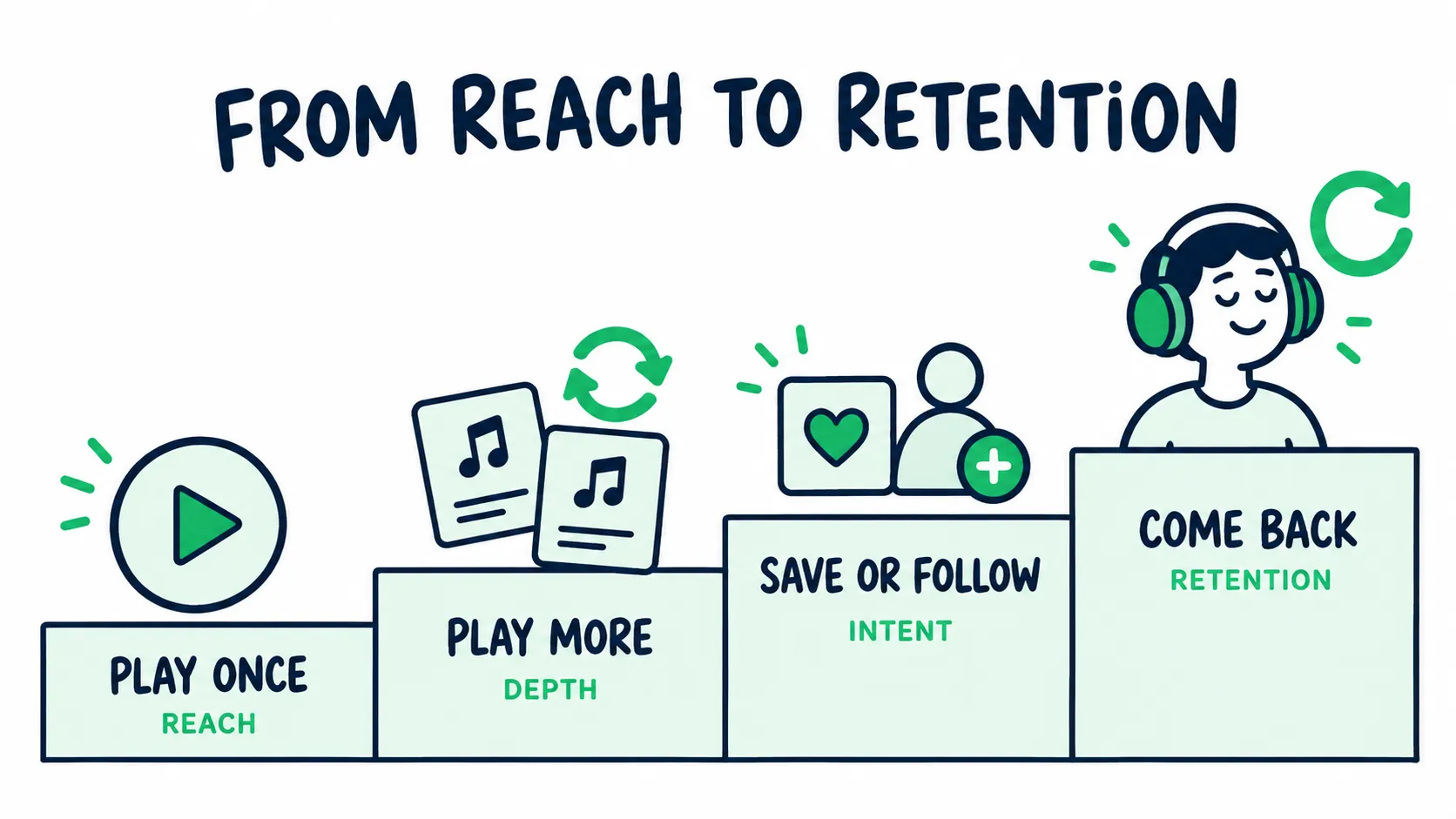
Look for the choices people make after their first play.
Monthly active listeners are people who chose to listen. Spotify’s audience segments guide says they play your music four times more over the next six months, on average, which makes them more useful than a large passive spike.
Career Return
Career return is the proof you can use elsewhere. You learn which songs pull people deeper into the catalog and which cities and countries respond. Your profile can show a manager, collaborator, promoter, or label team that strangers choose the music.
Career return has no clean payout formula, so judge it by whether the campaign changed a real decision.
It may reveal the best entry track for cold listeners. It may show that one country produces deep catalog plays while another produces cheap first clicks. It may give your next release a larger active audience on day one.
If the “learning” never changes your track choice, market, budget, pitch, or release plan, it was not much of a return.
Key takeaway
Promotion is worth more when it leaves you with listeners, proof, and a clearer next move.
Is Spotify Promotion Worth It for Your Goal?
Pick the outcome first, then the channel.
| Your main goal | Worth testing when | Proof to renew | Stop or repair signal |
|---|---|---|---|
| Earn back the campaign cost from streams | Your catalog already has steady income and you know its normal trend | Incremental royalty income moves toward your payback target | You need future fan value to make the math look profitable |
| Find matched new listeners | You know the sound, scenes, or similar artists that define the fit | New active listeners, intent actions, and repeat plays rise together | Listener count rises while depth and intent stay flat |
| Build momentum for a future release | You have another release and follow up plan ready | More followers and active listeners are present when the next song drops | The peak fades without raising the audience floor |
| Find the best entry tracks or markets | Your catalog gives listeners more than one useful path | Certain track and audience pairs keep producing deeper listening | You cannot trace the lift to a track, source, or market |
| Push one exact release | The release has a clear deadline and the offer supports track level control | That track gains active plays, saves, and later catalog use | The system keeps sending budget to songs outside your goal |
| Grow several songs without managing ads | You want catalog learning and can judge the result in Spotify for Artists | The system finds repeatable track and audience matches | You need full control over every bid, creative, and audience choice |
If all you want is a bigger public number, stop there. A temporary monthly listener spike can look impressive while building nothing useful. What counts is whether those listeners saved a song, followed the profile, played another track, or returned later.
A useful campaign answers one hard question. It might be, “Which listener group gives this catalog the best depth?” or “Can this track turn cold listeners into active listeners at a cost I can keep paying?”
If the campaign tries to prove the song, grow every market, lift the full catalog, and pay back the budget at once, the result will be hard to read.
Know What Kind of Spotify Promotion You Are Buying
“Spotify promotion” can mean six different things. Each method buys a different path and answers a different question.
| Method | Mechanism | What it can prove | Main limit |
|---|---|---|---|
| Spotify editorial pitch | Spotify editors consider an eligible unreleased track | Whether an editor sees a programming fit | Free and useful, but placement is not promised or repeatable on demand |
| Marquee or Showcase | Sponsored placement reaches selected listeners on Spotify Home | How Spotify audiences respond to a new or catalog release | Access depends on eligibility, and the campaign stays inside Spotify |
| Discovery Mode | Spotify gives selected tracks more priority in certain programmed sessions for a commission | Which eligible tracks earn response in those recommendation spaces | It does not work like a fixed ad buy with full reach control |
| Independent playlist pitching | Curators review a track for possible placement | Whether the track fits a specific curator or playlist lane | Listener quality depends on the playlist and its real audience |
| Targeted mobile ads | Ads reach people outside Spotify and open the music when they tap | Which audience, creative, market, or track path earns deeper listening | Targeting and the click to play handoff can fail even when ads get clicks |
| Guaranteed stream packages | A seller promises a stream total | Nothing useful about real listener demand | The number can hide artificial activity or low value traffic |
Spotify’s own display campaign guide explains how Marquee and Showcase work. Its Discovery Mode page covers Spotify’s recommendation tool.
Playlist pitching gives a curator a chance to place the song. Targeted ads reach listeners directly. Each person then chooses whether to listen.
Use Spotify’s artificial streaming guidance to understand fake-stream patterns and how artificial activity can affect your music.
To audit a provider before you pay, use the Spotify promotion legitimacy checklist.
When Spotify Promotion Is Worth It
Run the campaign only when four gates are open.
| Gate | What good looks like | If it fails |
|---|---|---|
| Song signal | At least one track already earns saves, repeat plays, shares, or strong response from real listeners | Test the song and message with your current audience before buying more reach |
| Profile path | A new listener can hear a strong entry track, find the next song, and understand the artist fast | Fix the bio, Artist Pick, visuals, and catalog path |
| Test design | You have one main goal, a saved baseline, and a written renewal rule | Do not spend until you know what result will change your next move |
| Budget runway | You can fund the full test without needing the first royalty statement to rescue it | Wait, reduce the test, or put the money into the current bottleneck |
Each gate has to pass on its own. A strong profile cannot make up for a weak song. A good song cannot rescue a test with no success rule.
If all four pass, run a focused test. If one fails, fix that gate first.
Use the Spotify artist profile guide if your profile is the weak link. If the budget is unclear, use the music promotion cost guide and music promotion budget calculator.
When Spotify Promotion Is Not Worth It
Do not spend yet when:
- You need the campaign to pay a bill next month
- You are hoping promotion will fix an unfinished song
- Your profile has no clear bio, Artist Pick, visuals, or catalog path
- You would have to stop the campaign before it gathers useful data
- You plan to judge success from monthly listeners alone
- Your current organic growth is already climbing and you have not found its limit
Promotion fixes a reach problem. It does not fix a song problem, a positioning problem, or a profile with no next step.
Use this bottleneck test:
If 1,000 matched listeners landed on your profile today, what would you want them to play next?
If there is no clear answer, you are buying traffic too early. Build the path first.
If organic content is bringing new listeners every week, keep feeding it. Paid promotion should add reach to something that works.
How to Measure Spotify Promotion Without Fooling Yourself
Use three windows:
- Baseline: The 28 days before the campaign.
- Test: The first 30 days of paid promotion.
- Holdover: The next 28 days after paid reach ends or drops.
The test window shows what you acquired. The holdover window shows what remained.
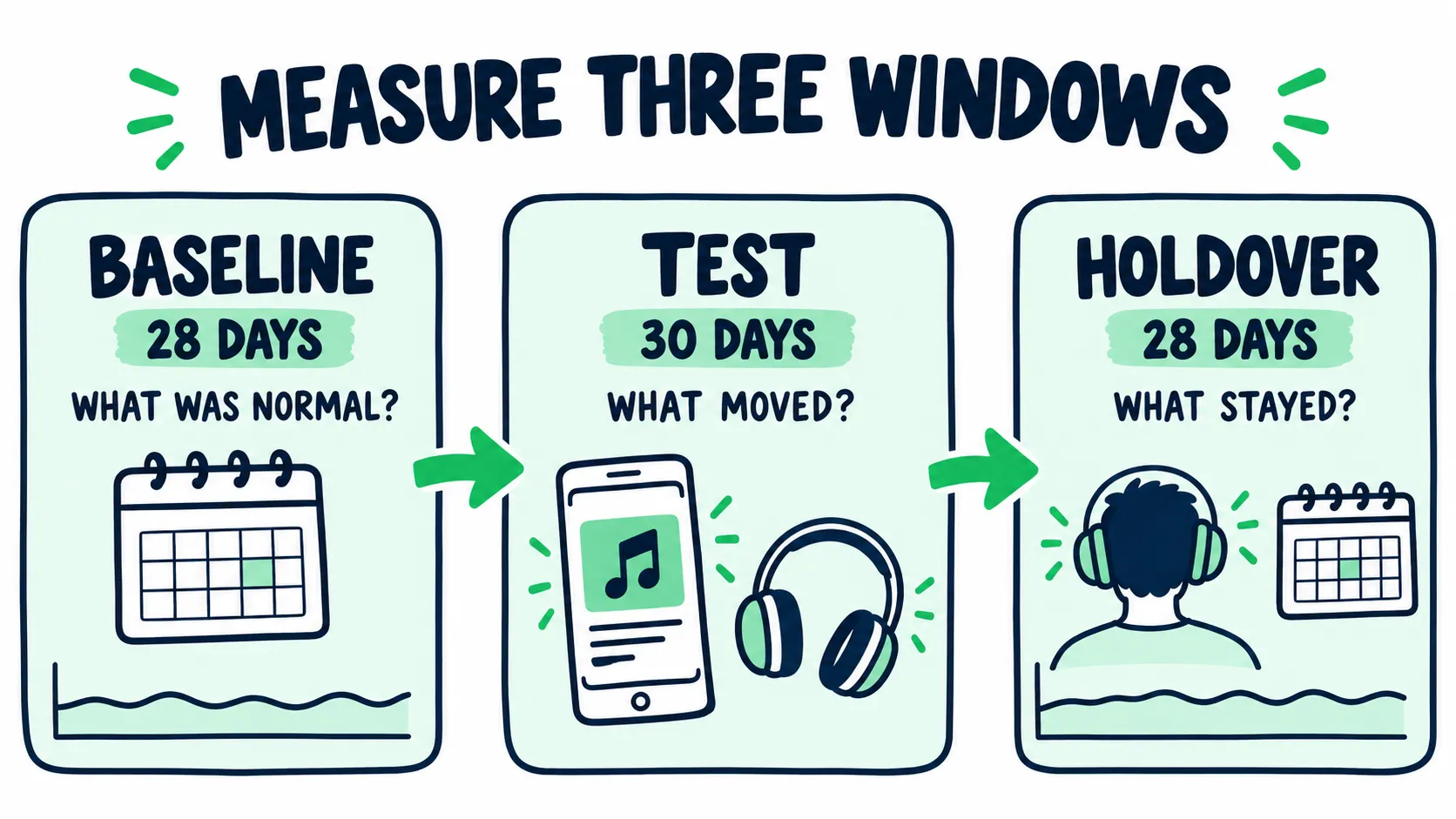
Use the same measures before, during, and after the campaign to see what lasts.
A new release, editorial placement, viral post, tour date, or creator share can move the same numbers. Keep a campaign log with those dates. If another event overlaps the test, mark it instead of giving the ad all the credit.
Before the Campaign
Save a 28 day baseline from Spotify for Artists:
- Streams
- Listeners
- Streams per listener
- Followers
- Saves and playlist adds for the main tracks
- Monthly active listeners
- Source of streams
- Top cities and countries
Spotify’s Source of Streams guide splits streams into active and programmed sources. Active means the person chose your music. Programmed means Spotify or another listener selected it.
Do not rely on memory. Export the numbers or put them in a simple sheet.
If your catalog is already rising or falling fast, one flat baseline can fool you. Save more than one recent window and note the trend. The campaign should beat the path you were already on, not only the last number you saw.
Track a few ratios beside the raw counts:
streams per listener = streams / listeners

active audience share = monthly active listeners / monthly listeners

follower conversion proxy = net new followers / new listeners

catalog spread = streams outside the top track / total streams
Compare these ratios with your own baseline and later campaigns.
Days 1 to 7: Check the Path
Confirm the campaign is live. Then compare its start date with the countries, streams, listeners, and source data in your campaign log.
If the campaign reports clicks but Spotify shows no matching movement after normal reporting time, inspect the handoff. Check the link, landing step, market, device path, and track destination. A paid click is not a Spotify listener.
Do not add budget until you know the path works.
Days 8 to 21: Check Listener Quality
Now compare growth in reach with growth in depth.
- Did streams per listener hold as new listeners arrived?
- Did saves, personal playlist adds, or followers rise with the traffic?
- Did the active audience grow, or did only the monthly listener total move?
- Did people cross into other tracks?
- Did one audience, market, or entry track produce better depth than the rest?
If listener count rises while every depth signal falls, you are buying a broad but weak audience. If a smaller market produces more repeat plays and catalog use, that market may deserve the next test even if its first click costs more.
Spotify’s own display campaign reports focus on converted listeners and active streams per listener. They also track saves and playlist adds. You can see the full model in Spotify’s campaign results guide.
Day 30: Make the Decision
| Pattern | Likely diagnosis | Next move |
|---|---|---|
| Reach, depth, intent, and active audience rose together | The audience fit and profile path both worked | Scale one step and watch whether quality holds |
| Reach rose while streams per listener, saves, and follows weakened | The campaign found attention, not much attachment | Tighten the audience, creative, or entry track before adding budget |
| One track opened the door and other tracks gained plays | You found a strong catalog entry point | Give that track more weight, then test whether the effect repeats |
| One market cost more to reach but produced deeper listening | Cheap reach was not the best reach | Compare cost per active listener, not cost per click alone |
| Spotify moved, but a release or organic spike hit at the same time | The lift has mixed causes | Repeat a cleaner test before making a large budget change |
| Nothing moved in Spotify for Artists | The path, reach, or listener fit failed | Stop and inspect the setup |
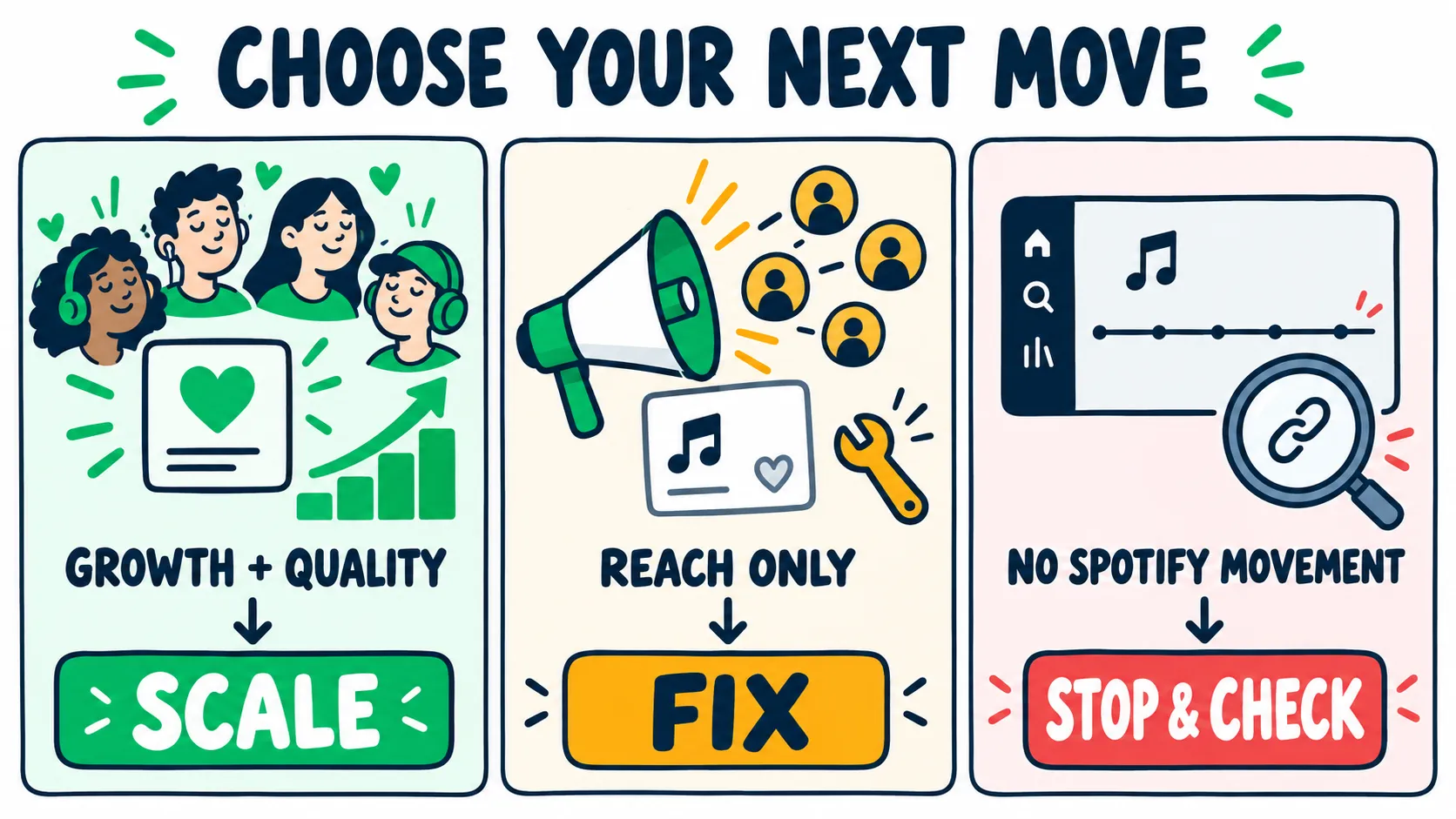
Use listener response and a working delivery path to choose the next budget move.
Do not change the audience, creative, destination, and budget on the same day. You will not know which move helped.
After the Campaign: Check What Stayed
Monthly listeners use a rolling 28 day window, so a drop is normal when paid reach slows. Watch where the new floor lands.
Compare the holdover window with the baseline:
- Are followers still above the old path?
- Is the active audience larger?
- Are saved tracks and personal playlist streams still feeding plays?
- Does the next release start with more active listeners?
If the peak vanishes but the floor rises, the campaign built something. If both return to baseline, it mostly rented attention.
If you keep the campaign running, compare each 28 day window. Scale only while your main result rises and the quality ratio in your renewal rule holds. A cheaper listener is not a bargain if that person never chooses the music again.
For a deeper read on temporary reach, use the Spotify monthly listeners guide. To compare reach with intent, read Spotify followers or listeners.
The Spotify Promotion ROI Math That Matters
Start with the lift above your normal trend. Do not treat every stream during the campaign as a paid result.
Use totals from the 28 day baseline. Project stream and follower rates into the 30 day test, but compare monthly active listeners as trailing 28 day snapshots.
baseline daily streams = baseline streams / 28

expected campaign streams = baseline daily streams x 30

stream lift above baseline = campaign streams - expected campaign streams

baseline daily follower gain = baseline follower gain / 28

expected campaign follower gain = baseline daily follower gain x 30

follower gain above baseline = campaign follower gain - expected campaign follower gain

net monthly active listener change = campaign-end monthly active listeners - baseline monthly active listeners

holdover active audience lift = holdover-end monthly active listeners - baseline monthly active listeners

cost per follower above baseline = campaign cost / follower gain above baseline

cost per net added monthly active listener = campaign cost / net monthly active listener change

cost per net active listener added at holdover = campaign cost / holdover active audience lift

recent Spotify income per stream = recent Spotify income from your distributor / matching recent Spotify streams

estimated income from stream lift = stream lift above baseline x recent Spotify income per stream

direct cash return = estimated income from stream lift - campaign cost

direct cash ROI (%) = (direct cash return / campaign cost) x 100
If the catalog was already climbing or falling, adjust the expected stream and follower projections for that trend. “Net monthly active listener change” is the difference between two snapshots, not Spotify’s “new active listeners” metric.
Use matching Spotify income and stream periods from your own distributor statement. Lift describes a change above baseline; it does not prove the campaign caused every part of that change. Separate logged releases, playlist adds, viral posts, and other overlapping sources before assigning income to paid promotion.
Skip the acquisition cost lines when lift is zero or negative. There is no gain to divide by.
The cash lines measure payback. The acquisition lines measure what it cost to build an audience. Holdover active audience lift shows whether the audience-size floor finished above baseline. Direct cash ROI does not include audience or career return.
Do not turn a follower into imaginary profit. A follow is an audience asset, not cash. Its value becomes clearer when the next release gets more active listeners, repeat plays, and income than your old baseline.
Hypothetical Worked Example
Both campaigns spend $300 and start from the same 28 day baseline: 2,800 streams, 14 followers gained, and a snapshot of 1,000 monthly active listeners. At that daily pace, the 30 day test would be expected to produce 3,000 streams and 15 followers gained without promotion. The campaign-end snapshot on day 30 covers test days 3 to 30. The holdover-end snapshot on day 58 covers days 31 to 58. The numbers below are hypothetical.
| Measure | Campaign A | Campaign B |
|---|---|---|
| Campaign cost | $300 | $300 |
| Campaign streams | 9,000 | 7,000 |
| Stream lift above the 3,000 expected | 6,000 | 4,000 |
| Followers gained during campaign | 35 | 75 |
| Follower gain above the 15 expected | 20 | 60 |
| Cost per follower above baseline | $15.00 | $5.00 |
| Campaign-end monthly active listeners, day 30 | 2,800 | 2,200 |
| Net monthly active listener change | +1,800 | +1,200 |
| Cost per net added monthly active listener | $0.17 | $0.25 |
| Holdover-end monthly active listeners, day 58 | 1,050 | 1,300 |
| Holdover active audience lift | +50 | +300 |
| Cost per net active listener added at holdover | $6.00 | $1.00 |
If the goal is durable audience growth, Campaign B earns the next $300. At the same cost, B finishes with three times the follower lift and six times the holdover audience lift. Campaign A shows more short-term stream lift, but most of its net active audience change is gone by holdover.
Then write down the career return in plain language:
- We found the strongest song in the catalog.
- We found a country worth targeting again.
- We raised the follower base for the next release.
- We learned that this audience did not connect.
That last result can still save money. A clean “stop” decision is more valuable than another month of guessing.
Before you renew, ask what the same budget could buy elsewhere: another strong visual, creator content, live capture, a better release asset, or a different campaign. Spotify promotion is worth it only when its next dollar has a better job than those options.
Use the Spotify royalties calculator for a simple income estimate. The music promotion cost guide covers deeper channel pricing.
The Promotion Mechanism Worth Paying For
A useful promotion system makes the next dollar smarter. Call it the audience intelligence loop. It connects six jobs:
- Start from music evidence: Read the profile, full catalog, similar artists, and listener locations. A broad “people who like music” audience teaches you nothing.
- Separate audience pockets: Test distinct groups built around real listeners of similar artists and scenes, so you learn which fit worked.
- Send real people to Spotify: Targeted mobile ads open the music in Spotify and carry the creative premise that already proved itself. No bots, no stream packages.
- Let the catalog compete: Rotate several fitting tracks to find the best entry song for each listener group. The song you would pick is often not the one a new listener picks.
- Move budget toward chosen behavior: Put more weight behind the track and audience pairs that save, follow, and replay. Cheap taps and raw streams are not the goal.
- Verify and keep the learning: Check every result in your own Spotify for Artists. Carry the winning audiences, tracks, and countries into the next release so it starts warmer.
Profile and catalog data shape the target. Listener behavior changes later track and budget choices. If those parts do not connect, each month starts from the same guess.
Run the loop for a month and it leaves you the answers from the worked example above. You know your strongest entry song, which listener groups and countries respond (useful for touring and ads), and you have a larger follower base waiting for the next release. A fixed stream package pushes one song to everyone, ends with a screenshot report, and starts from zero again next month.
Musicvertising built its Audience Intelligence Engine around this loop. One Spotify artist link gives the system the profile and catalog data it needs. It builds targeted mobile campaigns around separate audience pockets, rotates tracks, and moves budget toward the audiences and songs that earn saves and follows. You check the result in your own Spotify for Artists dashboard. Musicvertising has served over 33,986 artists, bands, and labels.
The model is built for an artist who wants matched listener growth across several songs without managing every ad decision. A campaign that must put every dollar on one track, or repay itself from the first royalty statement, needs a single release push instead.
Judge any Spotify promotion by the same loop. Ask whether it tests the whole catalog, moves budget toward listeners who save and follow, and shows every result in your own Spotify for Artists.
Choose Your Next Move
Profile not ready: Start with the Spotify for Artists guide, then the Spotify Artist Pick guide.
Song has saves but needs reach: Read how Spotify saves work and how algorithmic playlists work, then run a measured test.
Unsure which channel deserves the budget: Start with the music marketing strategy, and make the campaign answer one clear question.
FAQ
Is Paying for Spotify Promotion Worth It if Streams Do Not Cover the Cost?
Yes, if the audience return supports your goal. Keep the two returns separate:
- Cash return: Judge incremental royalty income against campaign cost.
- Audience return: Judge new active listeners, follower growth, catalog depth, and the holdover window.
Do not call a follow “profit.” Test its value on the next release. If streaming income is the only return you care about, do not buy promotion that needs future fan value to make the math work.
Should I Promote One Song or My Whole Spotify Profile?
Promote one song for a release question. Promote the full profile for an artist question.
Choose one song when the deadline is fixed and every part of the campaign supports that release. Choose the full profile when you have several strong songs and want to find the best entry point for each listener group. Musicvertising uses the full catalog approach.
How Long Should I Run Spotify Promotion Before Deciding It Worked?
Use 30 days for direction. Use the next 28 days to see what stayed.
- Week one: Check the traffic path.
- Weeks two and three: Check depth, saves, follows, and catalog use.
- Day 30: Choose whether to scale, fix, or stop.
- Next 28 days: Check whether the audience floor stayed above baseline.
The first month shows what you acquired. The holdover window shows what you kept.
What Happens to My Monthly Listeners When Promotion Stops?
They will often fall. That does not erase what the campaign built.
Monthly listeners use a rolling 28 day window, and people leave that count when they do not return. Followers, saved tracks, and streams already earned remain. Watch the active audience, source mix, and new floor. Judge what stayed, not whether the peak lasted forever.
Should I Pay for Promotion if Organic Social Growth Is Already Working?
Keep the organic engine running. Add paid promotion only when it has a different job.
Paid promotion becomes useful when you want to extend a proven signal, test a new market, or remove daily campaign work.
Log organic spikes beside paid dates. If a piece of content keeps finding active listeners at a lower cost, keep the budget behind it. Do not replace a working source because paid promotion feels faster.