
Artist Bio for Musicians: Get Remembered, Shared, and Booked
A weak artist bio can flatten real momentum into the same story every unsigned artist tells.
Your Problem Is Hierarchy
You have releases, data, live clips, press, credits, and signs of demand. The hard part is choosing what leads.
A large stream count may tell a booker nothing about tickets. A support slot may help with booking but waste space in a Spotify bio. Every fact can be true and still be the wrong one for this reader.
Your Bio Is a Positioning Asset
Positioning means deciding what a reader should remember and why they should believe it. Your bio sets that frame.
It also protects the story. Without one clear version, old facts spread, small links become fake endorsements, and five people describe the same project five ways. That costs trust.
What You’ll Learn
- How to choose and score the lead story
- How to match proof to each reader
- A five part structure for artists with momentum
- How to make claims safe for others to quote
- How to adapt one core bio without conflicts
- How to test the bio after it goes live
This guide is about the bio itself. If you need the full package around it, use our EPK guide for musicians. If you are fixing the page where it lives, use the music website checklist. For everything else on your Spotify page, read the Spotify artist profile guide.
What an Artist Bio Does at Your Stage
At this stage, an artist bio is the approved story your team can use without checking each line with you. It should place the music, frame the current chapter, match proof to the reader, and give others facts they can quote safely.
A writer may quote it, a venue may paste it, a manager may send it, and a fan may read it after one song lands. Each arrives with a different question.
An artist statement explains the work. A press release covers one event. An EPK gathers assets and proof. Your musician bio feeds the same core story into all three.
Key takeaway
Start With the Decision, Not the Platform
Before you write the first line, name the choice the reader is trying to make. A Spotify listener, a promoter, and a writer each read for a different reason.
The platform matters less than that decision. A booker and a fan can both reach your website and still need different proof.
| Reader | Decision they face | Proof that helps | Proof that can mislead |
|---|---|---|---|
| New listener | Should I hear another song or follow? | A clear sound, one human detail, and the current chapter | Industry history and long credit lists |
| Writer | Is there a timely angle I can stand behind? | A clear change, clean facts, quotes, and sources | Old wins with no link to the current release |
| Booker | Can this act fit the room and help the night work? | Live identity, city demand, ticket history, and past bills | Global streams with no local or live link |
| Playlist or radio contact | Does this track fit my audience and format? | Sound, mood, release context, and relevant support | A full life story with no song level detail |
| Partner | Does the artist, audience, and timing fit the deal? | Audience shape, values, growth pattern, and clean rights | Follower totals with no sign of real response |
Write your main version for the reader tied to your next real goal. Then change the opening, proof, and last line for other uses, and keep the facts the same.
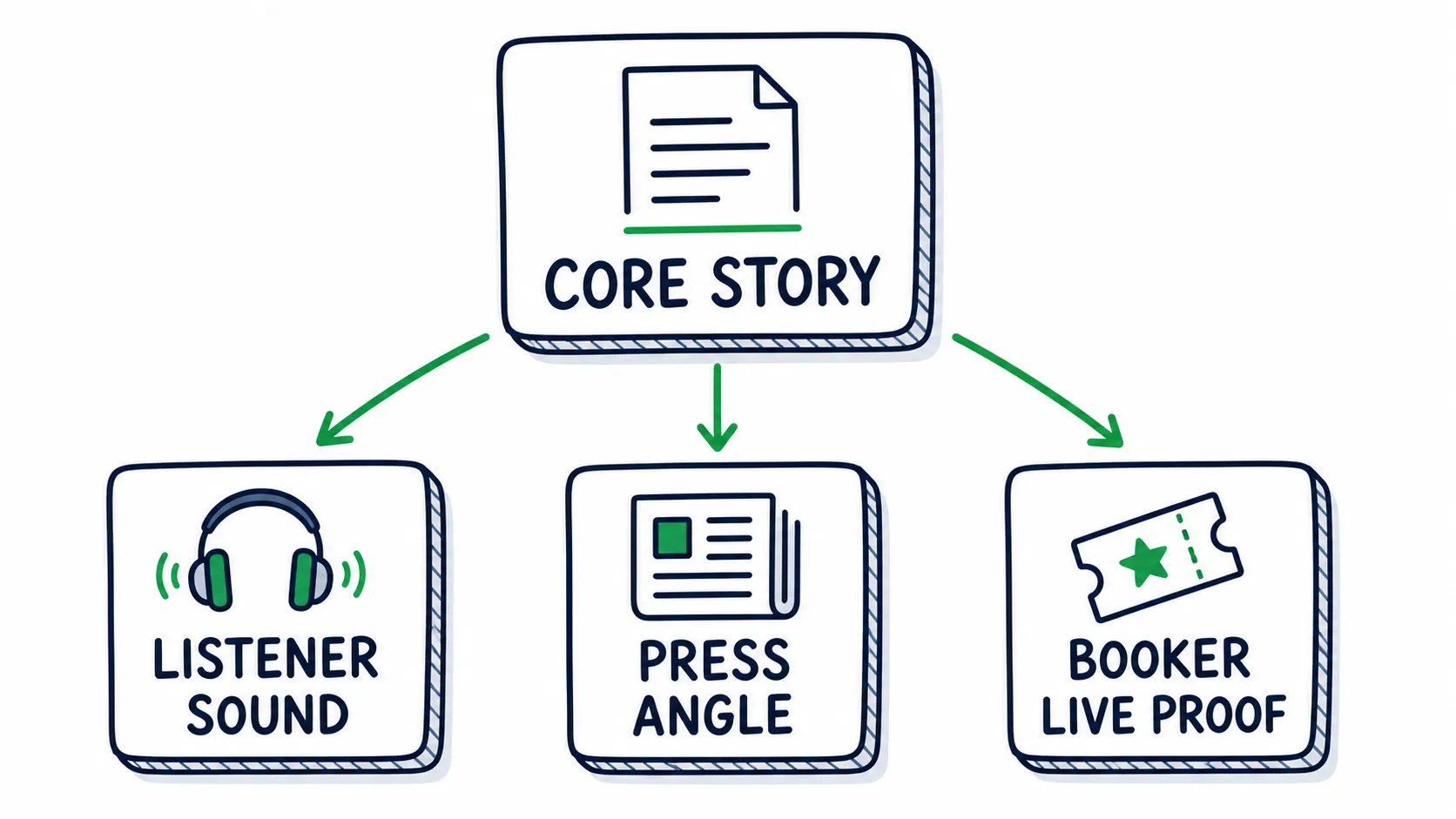
The story stays stable. The proof moves with the reader.
Choose the Lead Story Before You Draft
A bio can hold several good facts, but it needs one lead story. Without a lead, the draft turns into a list. The reader learns that you released music, played shows, got some press, and worked with people. They do not learn what any of it adds up to.
Start by writing three possible angles.
| Possible angle | Use it when | Proof it needs | Main risk |
|---|---|---|---|
| A clear sound shift | The new work marks a real change in writing, sound, or role | Specific music details, a cause for the shift, and the new release | Calling a small style change a full rebirth |
| Live demand | The room, city, or bill is a key part of the case | Ticket counts, room size, repeat bookings, clips, and market data | Using global streams as a stand in for ticket buyers |
| A market taking shape | Real listener action is clustering in a place or group | Active audience, saves, repeat plays, buyers, or local growth | Calling passive playlist reach a fan base |
| A distinct way of making the work | The process changes what people hear or how the project works | Concrete tools, choices, limits, sounds, or collaborators | Explaining gear that has no effect on the story |
| A role or identity shift | The artist has moved into a new role that explains the current music | A clear before and after, plus work that proves the move | Using a personal detail only because it sounds dramatic |
Score each angle from one to five on these points:
- Distinct: Could another artist use the same story?
- Current: Does it explain what is happening now?
- Proven: Do you have facts or work that support it?
- Useful: Does it help the main reader decide?
- Durable: Will it still make sense after one post or playlist fades?
Treat the total as a way to force a choice. An angle that scores high on drama but low on proof should not lead. An angle that scores high on proof but low on reader value may belong deeper in the EPK.
Build One Master Artist Bio File
Most bio mess starts when three people have three files. Keep one private master file that your team can check.
Start with these notes:
ARTIST IDENTITY
Artist name:
Home base:
Role or lineup:
Pronouns:

MUSIC
Primary sound:
Three concrete sound cues:
Current release or project:
One useful influence or reference:

STORY
Reason this project exists:
Key turning point:
What changed in the current chapter:

PROOF
Verified shows:
Verified press:
Verified radio or playlist support:
Useful audience numbers with source and date:
Credits and collaborations:

NOW
Current focus:
Next confirmed release or show:
Best approved link:
Last checked:
Owner:
These notes can be ugly. Nobody outside your team needs to see them. Under the notes, add a claim log so your team can use the bio safely.
| Public claim | What proves it | Context to keep | Review trigger |
|---|---|---|---|
| Sold out a 220 capacity room | Final ticket report from the venue | Paid tickets, comps, date, and city | A larger or more recent headline show |
| Brazil is the strongest active market | Spotify for Artists audience data | Active audience, date range, and top cities | Campaign or audience mix changes |
| Played by a named radio host | Playlist log, clip, or station page | Show name, station, track, and date | The claim stops helping the current story |
“Strong ticket sales in Chicago” tells a booker more than “growing fast.” A strong active audience in Brazil may matter more than a huge global stream count when the show is in São Paulo.
Also separate a true fact from a safe public claim. A famous artist may follow you without supporting the project. A song may touch a large playlist without creating fans. The claim log stops those jumps before they reach a pitch.
If your team is planning a release, update this fact bank as part of the music release checklist, not after the campaign is over.
Use This Five Part Artist Bio Structure
Now turn those notes into a draft. You need five moves, though not necessarily five paragraphs.
1. Position
The first line should place the project. Give the name, home base when it matters, setup, musical lane, and one point of difference. If one sentence feels crammed, use two.
Weak:
Nova Vale is a unique and passionate artist who has loved music since childhood.
Better:
São Paulo singer and producer Nova Vale makes tense electronic pop built on close vocals, heavy low end, and restless club drums.
The better version tells us what the project is, where it comes from, and what we might hear. The weak one gives us nothing we could play.
2. Sound
Write what a person can hear: voice, rhythm, instruments, energy, space, mood, and where the song feels at home.
“Dreamy” is weak alone. “Soft vocals over blown out drums and wide synths” gives the mind somewhere to go. One artist reference can give a listener a quick door into the sound. Three famous names usually blur it.
3. Tension
Tension turns a list of facts into a story.
Look for a useful contrast:
- Studio control against a loose live show
- Local roots against demand in a new country
- Years behind other artists before moving to the front
Pick the tension that explains the music or the current chapter. You do not need to turn pain into content. A breakup, loss, or identity story belongs only when the artist wants it there and the work carries it.
Skip music school, your first guitar, and old stage names unless the reader needs them to understand this project now.
4. Proof
Add two or three facts that show the project is moving in the real world.
Good proof is specific. Name the room and paid ticket count. Name the radio show. Give listener growth a market, time window, and source.
Be exact with names. If a DJ played your track once, say they played it. Do not turn one spin into “supported by.”
5. Now
End on what you are releasing, touring, or building right now, not somewhere in your past.
Your pre release strategy should decide when the next release becomes the main story. The bio should support that plan, not start a second one.
Pick Proof That Means Something
You do not need a Grammy, a giant playlist, or a famous quote. You need the strongest true fact for this reader.
When you have several facts, favor real behavior first. Fans returning, buying, saving, or showing up means more than your own claim.
Next comes action from someone else, such as press, radio, a repeat booking, or a useful credit. Numbers help when they answer a reader’s question. Praise from the artist comes last.
A small fact with context often beats a big number with none.
For example:
The band’s first headline in Recife drew 180 people, with more than half of advance buyers coming from outside its existing email list.
Now the reader can see the place, the crowd size, and where the buyers came from.
Compare it with:
The band is quickly taking the world by storm.
The first line can be checked. The second is fog.
Match the Proof to the Claim
Proof only works when it supports the exact claim beside it.
| What you want to prove | Signals that help | What does not prove it alone |
|---|---|---|
| People will show up live | Paid tickets, repeat bookings, local buyers, room history | Global streams or followers |
| Listeners care beyond one play | Saves, repeat plays, follows, direct signups, and purchases | Monthly listeners or one playlist spike |
| A market is forming | Active listeners, repeat buyers, city growth, direct fan response | Reach from a passive playlist in that country |
| The project has momentum | Growth across several periods, channels, or actions | One peak with no follow through |
| The story has outside weight | Original press, radio action, strong credits, repeat support | Paid reposts, copied blurbs, or a social follow |
If you are using profile data, check the traffic before you turn it into a claim. Our Spotify monthly listeners guide explains how a large surface number can hide weak fan action.
Use this proof line:
ACTION + SCALE + PLACE + TIME + SOURCEYou may not publish every part, but you should know every part.
For example:
Active listeners in Brazil grew 38 percent during the last two release cycles, led by São Paulo and Rio de Janeiro.
That line tells us what grew, where it grew, and over what period. The claim log should hold the source, exact dates, and starting size.
A percentage without a starting size can fool the reader. Growth from 20 to 60 is 200 percent, but it is still 40 new people. Use the percent and raw count when both matter.
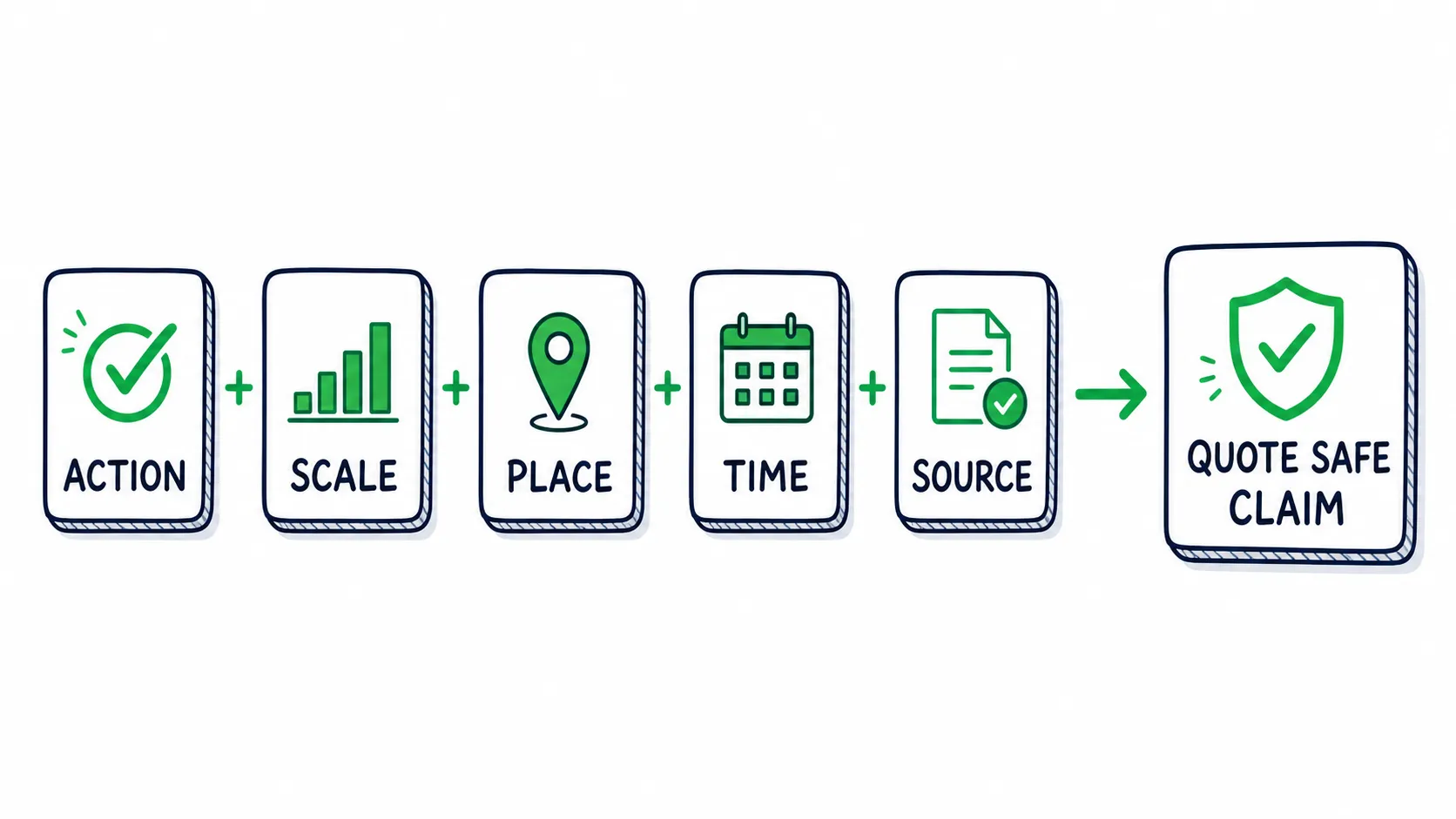
A claim is safer when its action, scale, place, time, and source are known.
Make Every Claim Safe to Quote
Assume a writer will copy your sentence as written, so the wording cannot lean on a private explanation.
| Risky wording | Safer wording | Why |
|---|---|---|
| “Supported by DJ Name” | “Played by DJ Name on Show Name” | A play is not always an endorsement |
| “Sold out Venue Name” | “Sold 210 paid tickets in a 220 capacity room” | It separates sales from guest list and comps |
| “Built an international fan base” | “Active listeners now cluster in Brazil, Mexico, and Portugal” | It names the signal and the markets |
| “Earned major playlist support” | “Added to Playlist Name by Spotify editors” | Editorial, user, and paid playlists are not the same |
Exact wording may look less dramatic, but it carries more weight because the reader does not have to guess what happened.
Artist Bio Examples for Musicians
These artists are made up. Look at how each bio works, but do not borrow the wording. Your odd little details are the part worth keeping.
Band Bio Example
North Arcade came together after late shifts in borrowed rehearsal rooms. The Leeds band turns post punk tension into direct songs, with bass and drums doing the heavy work while two guitars leave space. Repeat support slots across northern England led to sold out shows in Leeds and Sheffield. Fan clips from those nights brought new listeners into the older songs. The next EP keeps the sweat and pressure of the stage in each take.
The late shifts and borrowed room make the opening feel lived in. Then the bio gets to the shows, the listener response, and what comes next.
Producer Artist Bio Example
Lisbon producer and DJ Mara Lu slides from broken beat into bright house without cleaning up every rough edge. She records ferry brakes and bits of half heard talk, then tucks them under loose drums. Local radio play led to opening slots for touring acts. She now runs a monthly night for new Portuguese producers. Her next three tracks use sounds from the ferry route where she wrote them.
The ferry is the detail nobody else can steal. Bookers still get the lane, the radio path, and a real event to check.
One Artist, Three Readers
Here are the same artist facts shaped for three jobs.
For a listener profile
Nova Vale makes electronic pop for the point in the night when the party feels too honest. Close vocals sit over clipped drums and synths that never settle. New single “Glass House” starts a sharper chapter for the São Paulo singer and producer.
The sound and new song lead. The room size can wait.
For press
After years producing other singers, São Paulo artist Nova Vale stepped up to the mic. Her electronic pop holds close vocals against clipped drums and uneasy synths. The live show now runs on voice, sampler, and hand percussion. Recent songs found their strongest repeat listeners in Brazil and Mexico, while Vale’s first local headline sold all 220 tickets. New single “Glass House” begins the next run.
The role change creates the angle. The facts give a writer clean lines to check and reuse.
For booking
Nova Vale is a São Paulo electronic pop act built around live voice, sampler, and hand percussion. Her first local headline sold all 220 tickets, while recent releases have built repeat listener pockets in Brazil and Mexico. With new single “Glass House” out now, Vale is taking the live set into new rooms.
The live setup and paid demand move up. The deeper origin story moves out.
Nothing here conflicts. The artist, release, sound, and proof stay the same, and only the order changes.
Create the Right Artist Bio Length
Keep several approved versions. Do not squeeze one long bio into every field.
| Version | Useful length | Best use | Must keep |
|---|---|---|---|
| One line | 15 to 25 words | Introductions, event grids, social notes | Position, sound, one point of difference |
| Short artist bio | 40 to 70 words | Show listings, pitches, compact profiles | Position, sound, current chapter, one proof point |
| Standard bio | 100 to 160 words | Website, EPK, Spotify, partner notes | All five parts |
| Full bio | 220 to 300 words | Press background and deep context | More story and proof, not more adjectives |
Write the standard version first. It is long enough to hold the full argument and short enough to expose weak choices. Once that version works, cut it down and build it out.
When you make the short version, do not trim random words from every sentence. Remove whole jobs in this order:
- Old background that does not explain the current work
- Extra proof that does not fit this reader
- A second sound reference
- Detail already shown by a nearby image, clip, or headline
Keep the position, one sound cue, the best proof, and what matters now.
When you make the full version, add cause and context, not more praise.
Your first 150 characters should also work alone. Put them into a blank note and ask:
- Can I tell which artist this is?
- Can I hear a rough shape of the music?
- Is there a reason to keep reading?
The platform limit always wins. YouTube’s official artist profile guidance allows up to 1,500 characters. YouTube Music may cut the text after about 150 characters. Put the good part first.
SoundCloud’s profile guide gives you far more room and separate links. You still do not need to fill every character.
Spotify’s artist profile guidance calls the profile your home on Spotify. Write that bio for the person who just heard one song and wants to know if the rest is for them.
Apple Music for Artists recommends long and short versions for an EPK. Keep both ready even when a platform gives you plenty of room.
Use the YouTube channel customization guide when adapting the same story to your channel profile and links.
Make Your Artist Bio Sound Like a Person
Read the draft out loud and stop at any line that sounds like a stranger wrote it for an award show. Cut:
- Empty praise or claims that fit any artist
- Three adjectives where one real detail would work
- Backstory or numbers that do not help the reader
- Famous names used for status and promises about what you are “poised” to do
Then run three checks.
The Swap Test
Replace your artist name with another artist’s name. If the bio still works, you have written a type of artist, not this artist.
The Proof Test
Underline every claim. Can a source, action, sound, or fact support it? If not, rewrite it.
The Voice Test
Ask one close collaborator, “Does this sound like us?” Do not ask if it sounds impressive. That question brings out the big empty words.
Keep one detail that only your project could own. It may be the ferry brakes, the borrowed room, the voice note that became the hook, or the town where the first real crowd showed up. That detail does more work than five claims about being unique.
A human voice comes from details only you own and phrases you would say out loud. Slang and extra adjectives do not supply it.
If a team member writes the bio, record ten minutes with the artist first and ask:
- What changed in the music this time?
- What should someone notice on the second listen?
- Which recent moment made the project feel real?
Pull two or three phrases that work in print. Then make a short voice note:
WORDS WE USE
Direct, physical, specific:

WORDS WE NEVER USE
Visionary, fearless, genre defying:

SENTENCE FEEL
Short, dry, little hype:

DETAILS ONLY WE OWN
Places, objects, habits, sounds:
Now anyone on the team has a real voice to work from.
If you use AI, use it to sort facts, find repeats, or cut a long version. Give it your own notes. Tell it not to add claims. Then rewrite anything you would never say.
Your wider content strategy for musicians should use the same voice. If your posts sound direct but the bio sounds formal, people will feel the gap.
Keep Every Version Current
If your manager, publicist, and drummer each have a copy, the oldest one will come back at the worst time.
Name one owner. Keep the approved one line, short, standard, and full versions in the same file. Add the date you checked them and links to the proof.
Update the bio when:
- A new release becomes the main story
- A tour, show, or stronger proof point changes the case
- The lineup, location, sound, or role changes
- A number, link, quote, or future claim goes stale
Read it before every campaign. Give it a full check every few months.
Your website and EPK should use this file. Change the size and focus for each platform, but do not write the whole story again.
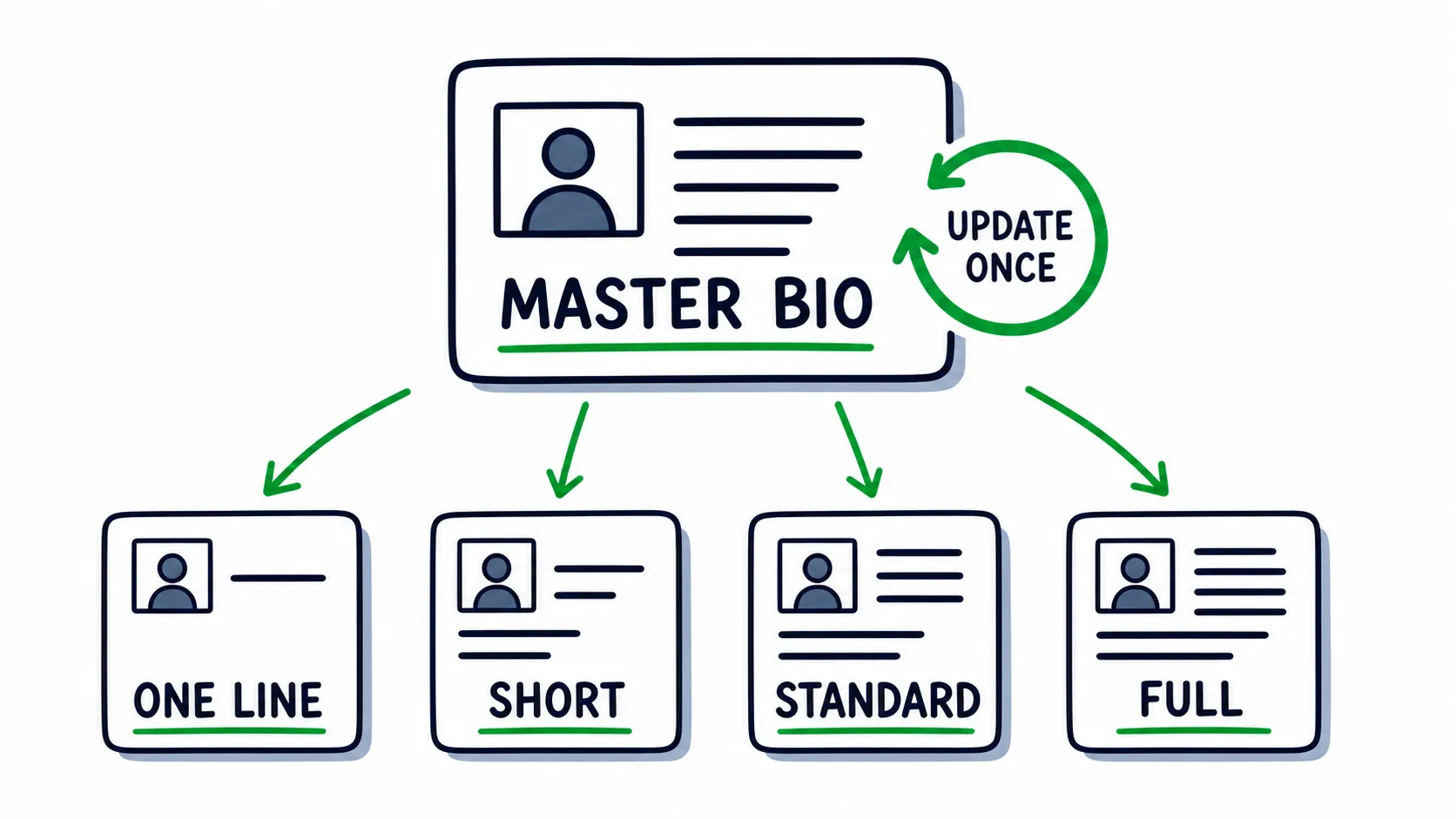
Update the master once, then publish the approved length each channel needs.
Test the Bio Like a Working Asset
Before you approve the bio, test whether it does its job. Everyone liking the prose is not a pass.
| Test | How to run it | A pass looks like |
|---|---|---|
| Twenty second recall | Let someone skim once, then hide the bio | They can state the sound, current chapter, and one proof point |
| Quote test | Pull any fact out of the paragraph with no extra context | The line stays true and does not imply more than happened |
| Handoff test | Give it to a manager, venue, or writer with no notes | They can paste it into the right place without a rewrite |
| Match test | Compare the opening with the first song, image, clip, and link nearby | Every asset supports the same promise |
| Freshness test | Check every number, role, release, quote, and future claim | Nothing is stale, vague, or still called upcoming after release |
Track the wrong facts that show up in listings, press, and partner emails. A repeated error means the master bio or claim log is unclear.
Track good replies too. A line that writers keep pulling may be your strongest angle. If bookers skip the stream count and ask for city data, move the city proof up.
Use the Bio as an Audience Hypothesis
Your bio bets that this sound, story, and current chapter will matter to a certain kind of listener. Next, test whether the right people behave the way the story predicts.
Run the Story to Signal Loop
| Step | Question | What to do |
|---|---|---|
| Map | Who should care about this sound and story? | Define likely listeners through sound, mood, similar artists, use case, and market |
| Match | Can you reach people already close to that lane? | Start with a small, clean audience rather than broad traffic |
| Route | Which song best proves the promise? | Send each audience to the track or profile path that fits the angle |
| Read | What did those listeners do after arrival? | Watch saves, follows, repeat plays, second songs, cities, and source quality |
| Shift | Where is deeper response forming? | Move attention and budget toward the audiences, songs, and markets that keep responding |
Take a baseline read before sending traffic. The Spotify audit helps separate profile setup, listener momentum, and placement quality before a new test changes the numbers. Then test one clear entry point.
Your bio already names the audiences to test. The similar artist in your sound line, the scene tied to your home base, and the lane in your first sentence each point to a different group of real listeners. Build a separate listener group around each reference instead of blending them into one broad audience. When the groups stay apart, the results tell you which part of the story found its people.
Set the test budget before launch so the spend answers one question instead of drifting. The music promotion budget calculator can help set that ceiling.
The same test applies to a creator post or a paid campaign. Judge any paid option by whether it keeps those listener groups separate, moves budget toward the groups that save and follow, and shows results in your own Spotify for Artists. For playlists, pick the exact playlist before you pay for placement.
Let Behavior Diagnose the Gap
| Pattern | What it may mean | What to test next |
|---|---|---|
| Clicks, then fast exits | The promise, listener, and entry song do not match | Change the audience or route before changing the bio |
| Streams, but few saves | The track earned a play but not a place in the listener’s life | Test a stronger song or a tighter listener group |
| Saves, but few follows | The song connects, but the artist story or catalog path does not | Strengthen the profile promise and next song route |
| Follows and second song plays | The listener sees value beyond one track | Test nearby audiences and more of the catalog |
| Response clusters in one city | A market may be forming | Check repeat behavior, direct fan action, and live potential |
Do not rewrite the bio after one noisy test. Look for the same pattern across more than one audience, song, or release.
If one group keeps saving, following, and moving into the catalog, you have found a stronger link between listener, story, song, and market.
The output is audience intelligence: a live map of which listeners stay, which songs pull them deeper, and which markets show repeat demand.
When the same pattern survives several tests, move it into the claim log. The next bio can describe observed demand instead of the demand the team hopes to create.
Demand the same from any growth process: it should learn from real behavior, show the result in your own dashboard, and move resources toward the people who stay. Use this loop to check whether the promise in the bio maps to real listener fit before you plan a full campaign.
Once the pattern is clear, scale it slowly. The Spotify algorithm launch playbook explains the release signals around that test. The music marketing strategy guide shows how to connect the audience, channel, budget, and next move.
Artist Bio Checklist
Before you publish, confirm:
- Identity: The exact artist name appears in the first sentence
- Sound: The opening describes something a reader can hear
- Tension: One story detail explains the current project
- Accuracy: Every public claim can be checked
- Reader fit: The proof supports the reader’s decision
- Timing: The current release or focus is clear
- Compression: The first 150 characters still work alone
- Scan: The bio reads well on a phone
- Consistency: Short and full versions agree on the facts
- Ownership: One person owns the next update
If all ten are true, send it.
Artist Bio FAQ
How long should an artist bio be?
Keep four versions: a one line bio, a 40 to 70 word short bio, a 100 to 160 word standard bio, and a full bio. Use the shortest one that still fits the reader’s decision. A firm platform limit always comes first.
Should an artist bio be in first person or third person?
Use third person for press, booking, your EPK, and most profiles because others can paste it. First person works on a personal About page or fan note. Keep the facts the same.
What if I have no major press, awards, or big numbers?
Use the strongest real action you have: repeat bookings, paid tickets, return listeners, radio play, sales, or a useful credit. Add context and leave out hype.
Can I use AI to write my artist bio without sounding fake?
Use it to sort, shorten, or flag vague lines. Give it checked facts and real voice samples. Check each claim and rewrite anything you would not say.
Do I need different bios for Spotify, my EPK, my website, and booking?
Yes, but build them from one master file. Keep the core facts stable. Change the opening, proof, length, and last line to fit each reader.