
Spotify Release Engagement: The 28 Day Signal That Shows If Your Release Is Working
Spotify release engagement shows whether your real audience came back for the new song.
That sounds simple, and it still makes a lot of artists nervous. You can get streams and feel like nothing happened. You can have followers and wonder why nobody showed up on release day. You can see one song get a little Release Radar push, then watch the next one fall flat even though you did the same steps.
This metric cuts through that noise by asking whether the people already close to your music cared enough to play the new release.
The Short Answer
Spotify release engagement is the percentage of your monthly active listeners who streamed a new release during its first 28 days.
Spotify uses your monthly active listeners from the day before release as the baseline. Then it checks how many of those listeners streamed the release during the first 28 days.
You can read Spotify’s official definition in its guide to release engagement.
Key takeaway
Why This Gets Confusing
Artists usually compare the number to the wrong thing: followers, monthly listeners, or first week streams. Then the number feels broken.
The better comparison is your active audience before release day versus the active listeners who played the new release after it came out.
Example:
180 active listeners streamed the release
divided by
1,000 monthly active listeners before release
equals
18 percent release engagement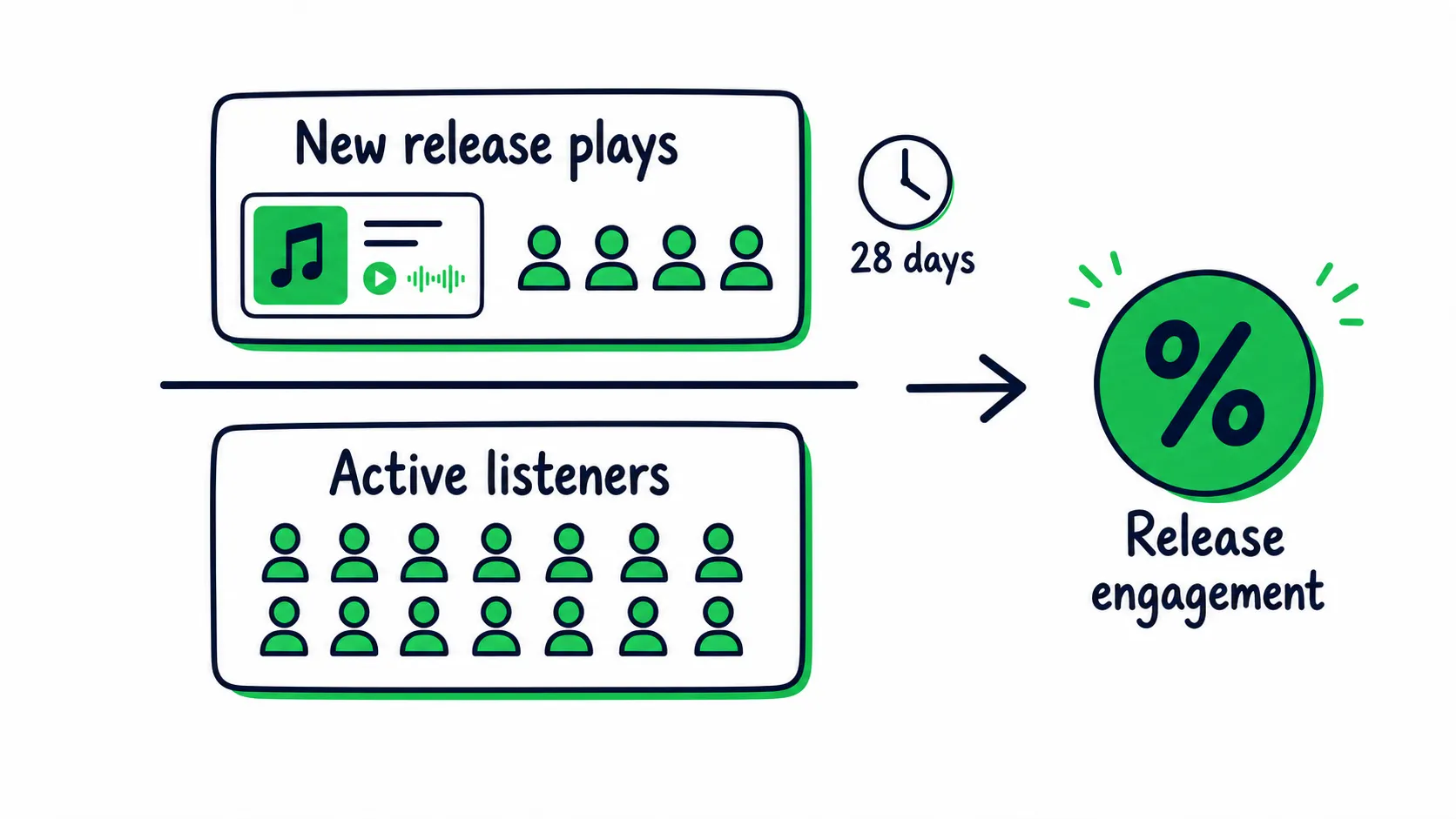
Release engagement is easier to read when you treat it like a simple percentage of active listeners who came back.
What You’ll Learn
- What Spotify release engagement means in Spotify for Artists
- How the first 28 days are measured
- Why followers do not always become release listeners
- What low release engagement can mean
- How to improve the signal before and after release day
- Which numbers to check before spending more money
What Spotify Release Engagement Actually Measures
Release engagement looks only at people who were already active around your artist profile, then counts how many of them played the new release.
Spotify explains in its audience segments docs that monthly active listeners are people who streamed your music from active sources in the last 28 days. Active sources usually show more intent.
Spotify’s source of streams guide separates listener chosen activity from programmed activity. Active streams can come from places like your artist profile, a listener’s library, their own playlist, or search.
So release engagement ignores these questions:
- How many total followers do you have?
- How many monthly listeners do you have?
- How many streams did the song get?
- Did one playlist make the graph jump?
It asks whether people who already had a real link to your music came back for the new release. That is why the number can feel rough:
- You might have 5,000 monthly listeners, but if most came from passive playlist traffic, the new release can still feel quiet.
- You might have followers who followed years ago and have not listened since.
- You might have run a campaign that brought streams, but almost no saves, follows, or repeat plays.
None of that means you are doomed. It means you should read the release as an audience test, not a popularity contest. Are people coming back because they care, or is the release only borrowing attention for a few days?
Spotify Release Engagement Vs Other Metrics
Spotify for Artists gives you a lot of numbers. Some are useful, and some can fool you if you stare at them alone. Use this table to keep them straight.
| Metric | What it tells you | What it does not prove |
|---|---|---|
| Release engagement | How much of your monthly active audience streamed the new release in 28 days | That every stream came from a fan |
| Monthly listeners | How many unique people streamed you in a rolling 28 day window | That those listeners are loyal |
| Followers | How many people chose to follow your artist profile | That they will all hear every release |
| Saves | How many people kept the song in their library | That the whole campaign was healthy by itself |
| Playlist adds | How many listeners added the song to their own playlists | That big playlist traffic is high quality |
| Release Radar streams | How much traffic came from Spotify’s new release recommendation surface | That your full audience engaged with the release |
For the full rolling window breakdown, read the Spotify monthly listeners guide. For saves, read Spotify saves. This page covers the question in between: did your active audience react to this release?
Where Release Radar Fits In
Release engagement and Release Radar are connected, but they measure different things.
Release Radar is Spotify’s personalized playlist for new music. Spotify says your followers get songs from your new release in their Release Radar, and if you pitch a song at least 7 days early, that is the song they get. You can read Spotify’s page on getting music on Release Radar.
Release engagement is wider. It counts active listeners who streamed the release during the first 28 days, whether they came from Release Radar, your profile, their library, search, your social links, email, playlists, or another path.
So artists can see strange mixes:
- Good Release Radar streams, but weak saves
- Strong playlist traffic, but poor release engagement
- A big follower count, but very few release listeners
- A small audience, but strong release engagement
If you want the full Release Radar breakdown, use the Spotify Release Radar guide. This article is for the wider release health check.
What A Good Spotify Release Engagement Rate Means
Spotify does not publish a universal “good” release engagement rate. That is annoying, but it is honest.
One artist might have a tiny audience and a strong core fan group. Another might have a much bigger audience built from passive playlists. The bigger artist can look better at first glance while having a weaker release response.
Instead of chasing one number, read streams and release engagement together.
| Pattern | What it can mean | What to check next |
|---|---|---|
| Low streams and low release engagement | The release did not reach enough warm listeners | Pitch timing, profile setup, email, socials, direct fan asks |
| High streams and low release engagement | Traffic may be cold, passive, or playlist heavy | Source of streams, saves, playlist adds, repeat plays |
| Low streams and high release engagement | Your core audience liked it, but reach was small | Promotion budget, content reach, playlist outreach, retargeting |
| High streams and high release engagement | The song likely found the right listeners early | Scale carefully and protect source quality |
A song with fewer total streams can be the better release if the right people saved it, replayed it, and followed you after hearing it. Random attention gives you a spike. Real listener fit gives you something to build the next move on.
Why Your Spotify Release Engagement Is Low
Low release engagement does not always mean the song is bad.
It usually means something broke between the song, the audience, the timing, the message, or the traffic source.
Your Followers Are Not Active Fans
This is one of the most common complaints artists bring up in music marketing forums:
“I have followers. Why did almost none of them stream the new song?”
Because a follow is useful, but it is not a promise. Some followers found you through one song or an old playlist. Some followed years ago. Some like your music but rarely open Release Radar. Some missed it.
So your release plan cannot depend only on Spotify followers. You need direct paths too: email, social posts, your website, text list, Discord, live shows, and retargeting.
For the full follower comparison, read Spotify followers or listeners.
The Release Was Pitched Too Late
Spotify’s playlist pitching guide says unreleased music can be pitched through Spotify for Artists.
The safe move is to deliver music early, wait for it to show up in Spotify for Artists, then pitch it with real breathing room before release day instead of at the 7 day minimum.
If the song appears too close to release day, you lose time for boring fixes: artist profile, credits, Canvas, Artist Pick, pitch details, smart link, and release day email. Each one affects whether people can find the song and understand why they should care.
If your release setup feels rushed, use the music release checklist before your next drop.
The First Listeners Were The Wrong Listeners
Spotify learns from the people who hear your music, which can help you or hurt you. If your first traffic comes from broad targeting, random playlist swaps, low intent ads, or sketchy playlists, the data can get messy fast.
A poorly matched listener might play once and leave. A matched listener is more likely to save, replay, follow, add the song to a personal playlist, or check another track. That behavior is what makes the first 28 days useful, so promotion needs discipline.
Good promotion is a listener fit test, measured by what listeners do after the first stream. Run it like this:
- Start with listeners who already like similar artists
- Send them to the song in a way you can track
- Watch what they do after they land
- Keep the sources that bring saves, follows, repeat plays, and playlist adds
- Stop the sources that only bring one time streams
That is the difference between traffic and useful signal. Traffic makes the dashboard move. Useful signal shows you who the song is for.
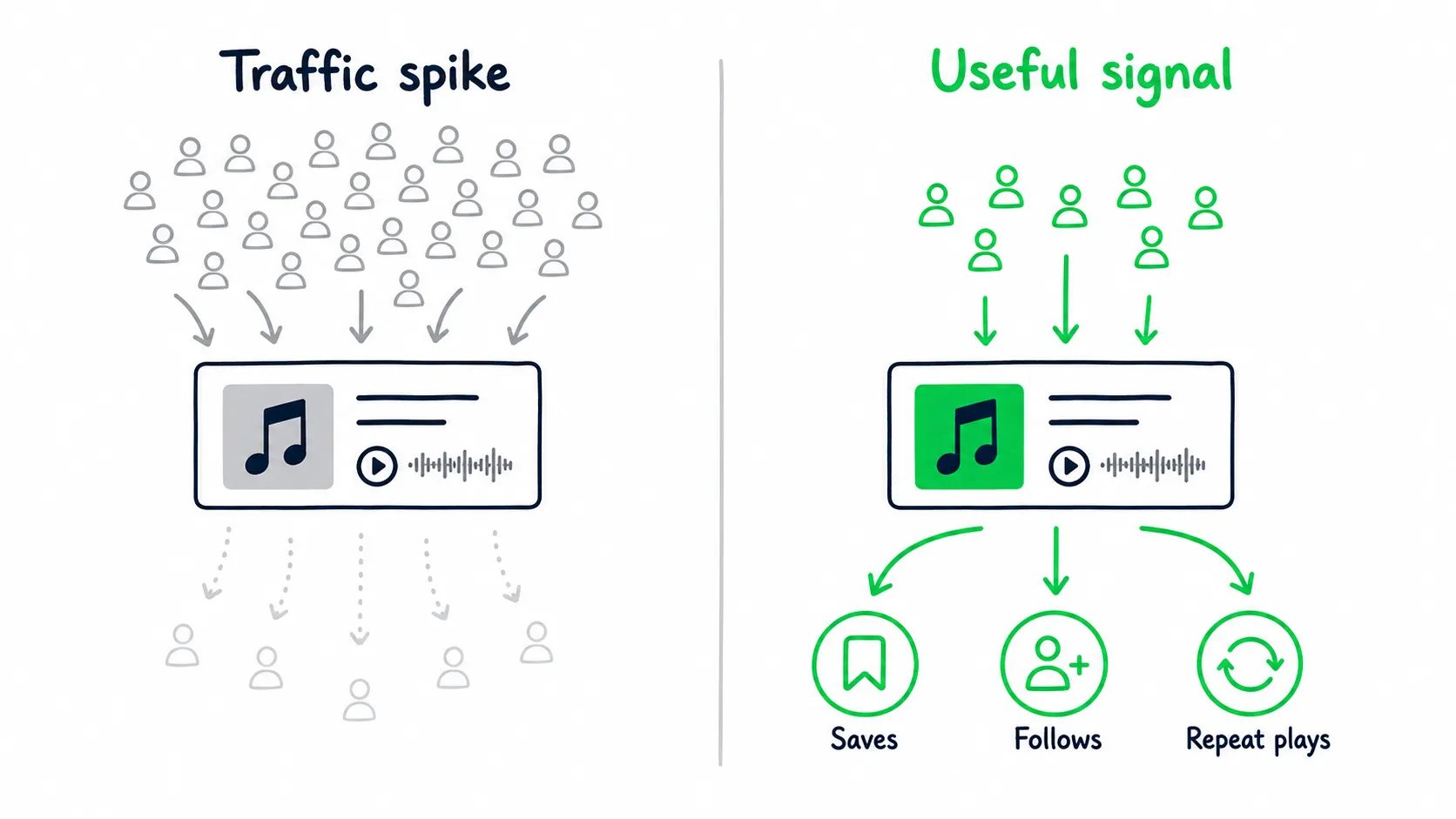
A smaller group of matched listeners can be worth more than a bigger spike that leaves no saves, follows, or repeat plays.
The Song Got Streams But Not Much Intent
Streams are easy to see. Intent takes more digging. After release day, look at:
- Saves
- Playlist adds
- Followers gained
- Repeat streams
- Active sources
- Listener location
- Streams per listener
Spotify’s page on types of Spotify playlists explains that personal playlists are shaped by listener behavior. Spotify also warns artists about third party services that guarantee streams.
Low quality traffic can make a song look busy while making the audience signal worse. If a song gets streams but almost no saves, personal playlist adds, follows, or repeat plays, do not scale the campaign yet. You may be buying exposure without demand.
The Release Story Was Too Vague
“New song out now” is an update, not a release story. Before release day, write one clear listener sentence:
This song is for [specific listener] who wants [specific feeling, scene, or identity].Example:
This song is for indie pop listeners who need a late night drive song after a breakup they are pretending not to care about.That one sentence helps with almost everything. Your Spotify pitch gets clearer, your captions get easier, your ad targeting gets less random, and your playlist research gets tighter. Your fans also know what kind of friend to send the song to.
If the song has no clear listener story, the campaign usually turns into a link dump.
For a deeper launch system, read pre release strategy for musicians and music marketing strategy.
How To Improve Spotify Release Engagement Before Release Day
Better release engagement starts before the song is live. The goal is to give the song a fair test with the right listeners, not to hack Spotify.
Clean The Release Path
Before you promote, check the boring stuff. It is boring until it costs you the launch.
- The artist profile is claimed in Spotify for Artists
- Artist image, bio, links, and Artist Pick are current
- The upcoming release appears under the right artist profile
- Song title, credits, version label, and featured artist roles are correct
- The Spotify for Artists pitch is submitted early
- The smart link works on mobile
- Release day post, email, and short clips are ready
Spotify’s new releases guide points artists toward release tools, profile updates, merch, clips, and measuring engagement.
Do the setup before you send people to the song. It prevents leaks you cannot always recover from later.
Warm The Right People
Do not ask cold strangers to pre save a song they have not heard. Use the pre release window to find the best angle instead:
- Post clips with the strongest moment
- Send the hook to people who already like your lane
- Ask trusted listeners which line they remember
- Watch comments, shares, saves, replies, and profile visits
A pre save can help existing fans remember the drop, but it does not replace real listening after release day. Aim to have a small group of people who already know why the song matters before it goes live.
Pick One Main Action
Do not ask fans to do five things at once.
For release engagement, the first ask is “Listen and save it if it hits.” It feels better because it is honest. If the song lands, ask them to add it to a personal playlist. If they are already into your music, ask them to follow your profile.
Use this order:
- Listen
- Save
- Add to a personal playlist
- Follow
- Share with one person who would actually like it
What To Do During The First 28 Days
Release engagement is measured across the first 28 days, so do not vanish after release day. A lot of artists lose momentum here: they put everything into Friday, post the link twice, then wait for Spotify to do the rest.
Days 1 To 3: Check For Setup Problems
Do not panic over the first few hours, but do check for obvious problems:
- Wrong artist page
- Broken smart link
- Missing Canvas
- Weak Artist Pick
- Missing pitch
- Wrong version label
- No release day email
- No clear path from your profile to the song
If something is broken, fix the path before you spend more money.
Days 4 To 7: Read Source Quality
Now check where the streams came from. If most streams are passive and very few listeners saved or followed, slow down. If a smaller source brings stronger saves and playlist adds, that source may be more valuable than the bigger one.
This is your first budget gate. Do not scale just because streams moved. Compare saves, follows, and streams per listener for each audience and each track you are pushing, then move next week’s budget toward the combinations that produce them. A cheap tap that ends in one stream looks efficient on the ad report and teaches you nothing.
A useful Spotify audit should tell you whether this profile is turning attention into listeners who stay.
Days 8 To 21: Feed The Best Angle
By now you should know which clip worked, which caption got replies, which audience saved the song, and which source brought listeners who did more than stream once. Put more effort there.
Instead of random reminders, show the lyric people mention, the story behind the hook, or the moment the song fits. Send traffic to the strongest path, not a messy link maze.
If playlist outreach is part of the plan, match the playlist to the song. Use free playlist submission to test curator response, or playlist placement to choose the exact playlist whose audience fits.
Days 22 To 28: Decide What The Song Earned
At the end of the window, make a call. Do not keep pushing every song the same way. Let the response decide the next move.
| Result | Decision | Next move |
|---|---|---|
| Strong engagement and strong saves | Keep pushing | Scale the best source carefully |
| Strong engagement but low reach | Expand reach | Test paid traffic, playlist outreach, and content angles |
| Weak engagement but good stream volume | Audit source quality | Pause weak sources and protect future targeting |
| Weak engagement and weak reach | Learn and reset | Improve song choice, story, profile, and launch plan |
Weak results are still useful if they change your next release. Besides “Did this song work?”, ask “What did this song teach us?”
The Listener Fit Loop To Aim For
A one time push starts from zero every month. You want a loop that gets smarter with each release.
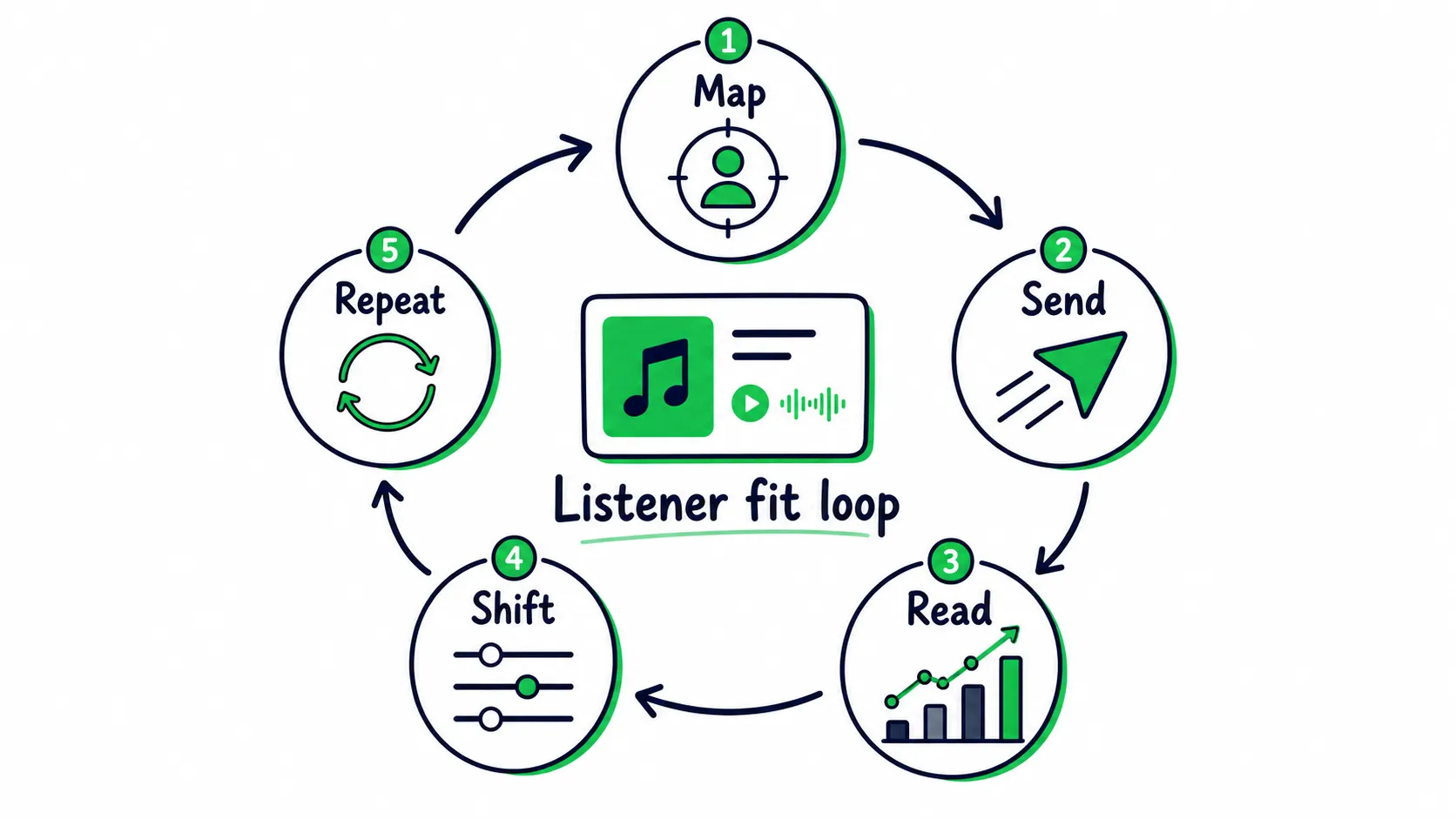
The best release systems get sharper over time because each campaign teaches the next one where real listener fit lives.
| Step | What you do | What you learn |
|---|---|---|
| Map | Define the listeners most likely to care based on genre, similar artists, mood, and catalog fit | Who should hear the song first |
| Send | Drive a controlled amount of trackable traffic instead of blasting every audience at once | Which sources create real listening behavior |
| Read | Check saves, follows, repeat plays, playlist adds, source quality, and release engagement | Whether listeners actually wanted the song again |
| Shift | Move more effort toward the audiences that stay and away from the ones that bounce | Where the next push should go |
| Repeat | Use what you learned on the next release instead of starting over | How your audience gets clearer over time |
That loop is why cheap streams are such a bad deal. They teach you nothing about your audience and give you no basis for the next decision.
A better release system should leave you with more than plays. Write down which audiences saved, which track pulled new listeners into the catalog, and which countries followed. Start the next campaign from that list instead of from scratch.
The listeners who saved and followed this time are part of your monthly active base when the next song drops. That base is the baseline release engagement measures, so the next release starts with an active audience that shows up.
The Simple Release Engagement Scorecard
Use this scorecard after every release.
| Question | Good sign | Warning sign |
|---|---|---|
| Did active listeners come back? | Release engagement improved compared with your last similar release | The percentage dropped while traffic looked bigger |
| Did listeners want the song again? | Saves and personal playlist adds were healthy | Streams rose but saves stayed flat |
| Did the audience match the song? | Top cities, countries, and sources make sense for your lane | Traffic came from odd sources or random locations |
| Did the profile convert? | Followers and catalog streams increased | People streamed once and left |
| Did the release create a next step? | You know which audience or angle to scale | You only know that the song got plays |
The goal of promotion is to put the song in front of listeners who are more likely to act like future fans, rather than make a dashboard jump for a few days. That means better targeting, cleaner source quality, smarter campaign timing, and numbers you can verify inside Spotify for Artists.
When you compare any Spotify promotion approach, judge it by the audience intelligence loop. Does it start from your music and similar artists? Does it test more than one track? Does it move budget toward listeners who save, follow, and replay? Does every result show in your own Spotify for Artists, and does the learning carry into your next release? Or does it only rent you a temporary spike?
FAQ
Why did none of my Spotify followers listen to my new release?
Short answer: followers are not the same as active fans.
Some followers may:
- Skip Release Radar
- Miss the release
- Follow you from one old song
- No longer listen to your music often
Build direct paths too: email, social, shows, your website, retargeting, and real fan reminders.
Does pitching to Spotify guarantee Release Radar?
For your followers, yes, with a few exceptions, if you pitch and deliver at least 7 days early. For wider reach, no. Spotify says a song pitched at least 7 days before release goes into your followers’ Release Radar. Deliver it at least 7 days early too, or it can miss the first week. Spotify skips listeners who have already heard the song, and it leaves out re-releases and some alternate versions, like acoustic or live takes. Pitching does not guarantee a wider algorithmic push.
Pitching can help Spotify:
- Understand the song
- Pick the right unreleased track for follower Release Radar
- Read the genre, mood, instruments, and release context
The better release setup is still simple:
- Pitch early
- Keep metadata clean
- Give the song a real listener fit test after release day
Why did one song get Release Radar but the next song did not?
Because each release is a new test. The process may look the same from your side, but the signal can change fast. Check the differences:
- Did one song get more saves?
- Did one have better source quality?
- Did one bring more repeat plays?
- Did one reach better matched listeners?
- Did one have stronger playlist adds?
Compare listener intent between the two songs, not only their streams.
Do pre saves improve Spotify release engagement?
Pre saves can help, but mostly as a reminder tool. What happens after the song is live matters more:
- Real streams after release day
- Saves from listeners who heard the song
- Personal playlist adds
- Repeat plays
- Follows from people who want more music
What matters more for release engagement, saves, follows, or playlist adds?
They answer different questions, so read them together.
| Signal | What it usually means |
|---|---|
| Saves | The listener wants the song again |
| Playlist adds | The song fits a real listening moment |
| Follows | The listener may want future music from you |
| Repeat plays | The song had enough pull to bring someone back |
For release engagement, the best read combines source quality, listener intent, and repeat behavior.