
Best Music Affiliate Programs: Real Rates and Who They Fit
The best music affiliate program is the one your audience already buys from, not the one with the biggest percentage.
A 60% commission on something nobody in your audience wants pays less than 3% on the guitar they were going to buy anyway. Pick the store or tool that fits your viewers first, and the rate second.
The short answer
The best music affiliate programs, by the kind of creator you are:
- Gear channels and teachers: Amazon for US beginners, Thomann for Europe, and Reverb for used and vintage gear in the US.
- Producers: Plugin Boutique, Loopmasters, Splice, and Native Instruments.
- Video creators: Soundstripe and Epidemic Sound, if you already use their music.
- Course and lesson creators: Skillshare and Pianoforall.
- Artists who sell merch: Printful.
- People who advise artists on promotion: our own Musicvertising affiliate program.
Why this list is different
Affiliate terms change often, so we checked every rate, cookie window, and payout rule below against each program’s official page when we wrote this. When a program doesn’t publish its rate, we say so.
We also left out every program that sells music promotion, playlist pitching, or ads for artists. Those compete with us, so we’re not the right people to rank them.
What You’ll Learn
- How music affiliate programs pay, and the math behind one link
- A side-by-side of the programs worth joining
- Which program fits your audience, including YouTube Shopping
- Recurring vs one-time commissions
- What it takes to get approved and paid, and Amazon’s link rules
- How to disclose your links the way the FTC expects
How do music affiliate programs pay?
You earn a share of what people buy through your link, as long as they buy inside the program’s cookie window. What a link earns depends on four numbers, and the commission rate is only one of them.
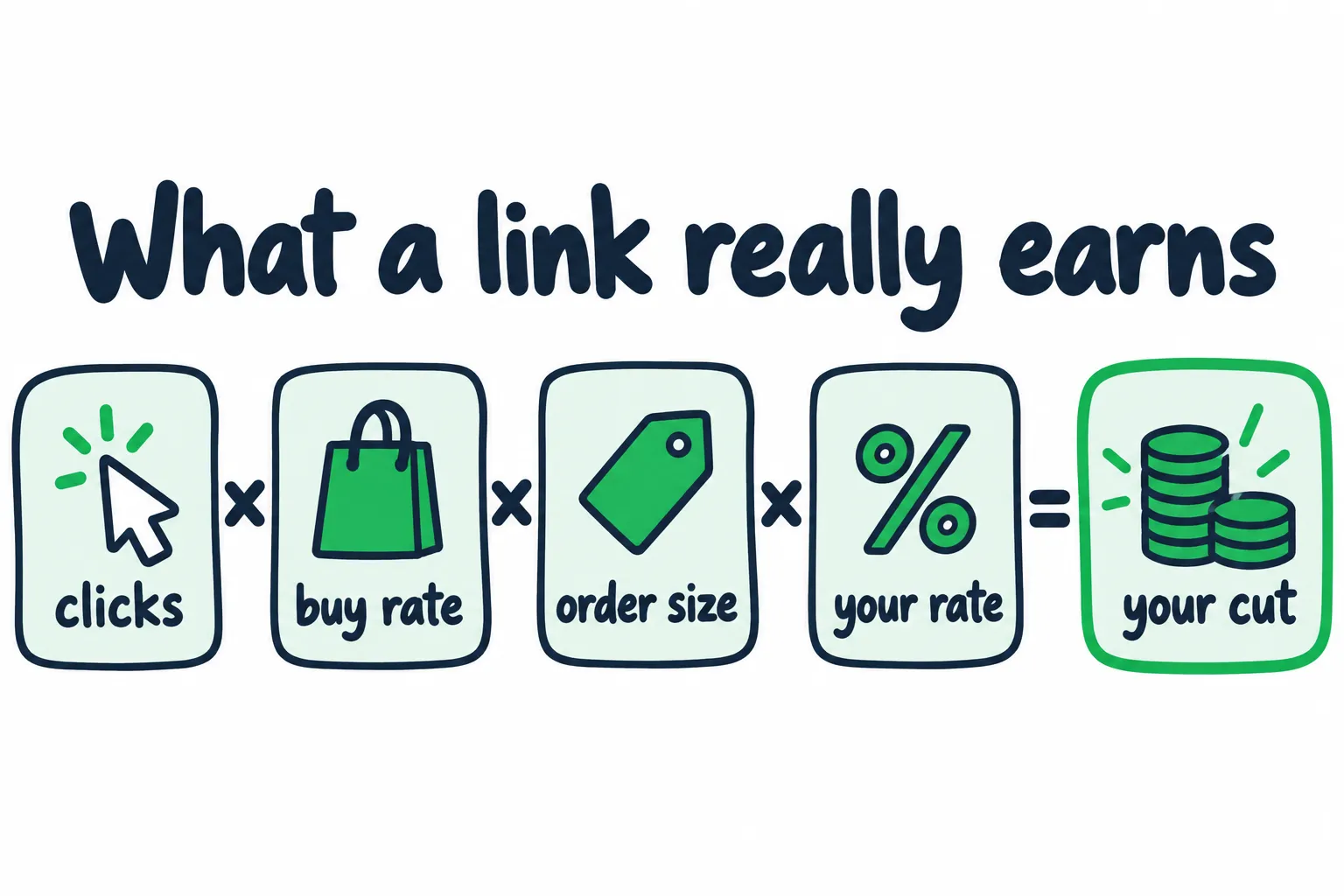
Raise any one of the four numbers and your cut goes up.
Here’s an example with made-up but realistic numbers. Say a gear video sends 1,000 clicks, 2% of them buy, and the average order is $400. That’s $8,000 in sales:
- At Amazon’s 3% on musical instruments, you earn $240.
- At Reverb’s 5%, you earn $400, plus $5 for each first-time buyer.
That assumes both stores convert at 2%. If Amazon converts twice as well for your viewers, it wins, even at the lower rate.
Four other terms decide whether, how, and when you get paid:
- Cookie window: how long after the click a purchase still counts. Amazon’s is 24 hours. Pianoforall’s is up to 90 days.
- One-time or recurring: whether you earn once, or every time a subscription renews.
- Cash or credit: some programs pay in store credit until you reach a higher tier.
- Payout minimum: the balance you need before they pay you.
Price beats percentage. One affiliate in r/Affiliatemarketing sent about 450 clicks to their main partner for a single sale. They added a store with lower prices, and it made two sales right away. The niche was home batteries, but gear buyers shop around the same way.
The best music affiliate programs compared
These are the programs worth joining, with the terms each one publishes. “Not stated” means the official page doesn’t give that detail, so ask before you build content around it.
| Program | What it pays | Cookie window | Recurring? | Best for |
|---|---|---|---|---|
| Amazon Associates | 3% on musical instruments, 5% on digital and physical music, $3 per Amazon Music Unlimited trial or subscription | 24 hours (cart items count for about 90 days) | No | US gear roundups and beginner setups |
| Thomann | 4.5% for creators, 3.5% for websites, 2% for forums | 14 days | No | European audiences |
| Reverb (US) | 5%, plus $5 per new buyer | 30 days | No | Used and vintage gear, pedals |
| Plugin Boutique | 15% | Not stated | No | Plugin tutorials and deal roundups |
| Loopmasters | 20% | Not stated | No | Sample pack reviews |
| Splice | Rate not published. Pays on trials, subscriptions, and rent-to-own plugins | Not stated | Yes, on eligible renewals | Producers and sample tutorials |
| Native Instruments | Rate not published. Covers Native Instruments, iZotope, and Plugin Alliance | Not stated | Not stated | Producers and mixing teachers |
| Soundstripe | 40% of the first transaction | 45 days | No | Video creators who use stock music |
| Epidemic Sound | Credit at first. Cash as an Ambassador: 50% of a referral’s first 12 paid months | Not stated | For 12 months | YouTubers who already use its music |
| Skillshare | 20% of a new member’s payment, up to $34 | 30 days | No | Course and tutorial creators |
| Pianoforall | 60%, about $27 on a $49 sale | Up to 90 days | No | Piano teachers |
| Printful | 10% of the product price after discounts, for 12 months on stores created through your link, plus $25 per first Growth plan. Taxes and sample orders don’t count | 30 days | For 12 months | Artists and merch tutorials |
| Apple Music | A one-time payment per new membership. The amount isn’t published | 30 days | No | Large music audiences |
| Musicvertising | 20%, including eligible recurring payments | 90 days | Yes, while the subscription stays active | Music creators, consultants, educators, and communities |
Which music affiliate program fits your audience?
Match the program to what your viewers already buy, and where they live. A store that doesn’t ship to your audience, or a tool they’ll never use, earns nothing at any rate.
Gear channels and teachers
Use Amazon for US beginners who want one-click buying, Thomann if most of your audience is in Europe, and Reverb for used gear, pedals, and vintage instruments in the US.
Amazon’s cookie lasts 24 hours, so it rewards people who buy right after watching. Thomann pays creators 4.5%, but it requires 5,000 social followers or 500 daily website visits.
High prices help. One YouTuber who used to cover camera gear earned $25 to $90 per sale, so one to four buyers made $100. By their math, that’s what 10,000 ad views pay most creators. Pricier instruments and interfaces work the same way.
Producers
Plugin Boutique and Loopmasters pay 15% and 20%, and both sign up on the same affiliate page. Splice pays on trials and new subscriptions, plus eligible renewals. Native Instruments has no channel size requirement, which helps if you’re small.
Recommend the best tool for the job, even when it isn’t in your program. When one deals subreddit set out to build a free plugin bundle from Plugin Boutique’s catalog, a popular pick wasn’t sold there.
Video creators
Soundstripe pays 40%, but only on the first payment, so annual plans earn far more than monthly ones. Epidemic Sound pays in credit at first. Once you refer 12 paying users, you can apply to become an Ambassador and earn cash: 50% of each new referral’s first 12 paid months.
Only promote the library you use in your own videos. Your viewers can hear it.
YouTube Shopping, and why artist channels can’t use it
YouTube Shopping’s affiliate program lets you tag products in your videos, but music channels aren’t eligible. YouTube excludes any channel that is a music channel, an Official Artist Channel, or tied to music partners like labels, distributors, or publishers (YouTube).
A gear review or tutorial channel can qualify, as long as it’s in the YouTube Partner Program and based in a supported country. Your artist channel can’t. If you want to tag gear, do it from a separate creator channel.
Amazon products can be tagged too, if you’re enrolled in one of the countries YouTube lists for it and link your Amazon account. Those earnings are paid through AdSense about two months after they lock (YouTube). Our YouTube monetization guide covers the other ways a channel earns.
Course and lesson creators
Skillshare pays 20% of a new member’s payment, capped at $34. Pianoforall pays 60%, about $27 on a $49 sale, with a cookie of up to 90 days. It’s one of the highest rates in music, but it only fits piano audiences.
If you run a newsletter, affiliate links fit there too, with the same disclosure. Our email marketing guide covers building the list.
Artists who sell merch
Printful pays 10% of the product price, after discounts and without taxes, on orders from stores created through your link, for 12 months. Sample orders don’t count. It fits if you make videos about your own merch setup, or teach other artists how to sell. Merch is one of the income streams in our guide to making money with your music.
People who advise artists
If you publish for musicians, consult for artists and labels, or run a course, newsletter, podcast, or community about music business growth, our own program pays 20% on qualified sales, including eligible recurring payments while a subscription stays active, with a 90-day cookie.
It fits if your audience is artists who are ready to put budget behind a release. Details are on our affiliate program page, and the rules are in our affiliate agreement. For fixed-fee paid posts instead of commission, see our content creator partnerships.
Recurring or one-time: which commission pays more?
Recurring pays more over time when the product is a subscription people keep. One-time pays more up front. Compare what one referral is worth over a year, not the headline percentage.
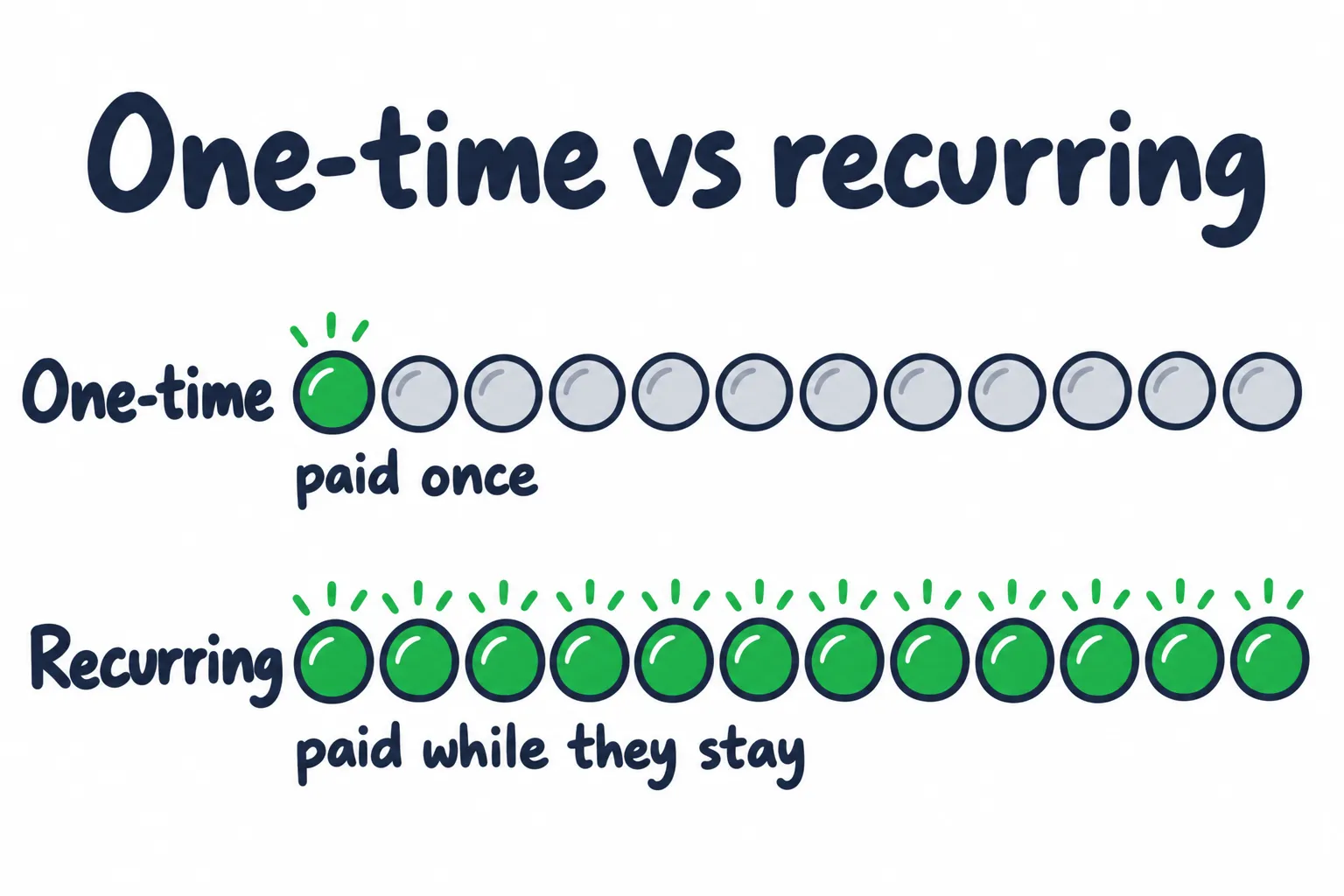
A recurring commission keeps paying as long as your referral stays.
| Program | How long it pays | What one referral is worth |
|---|---|---|
| Soundstripe | First payment only | 40% of one month on a monthly plan, or 40% of the year on an annual plan |
| Skillshare | First payment only | 20% of the first payment, up to $34 |
| Epidemic Sound (Ambassador) | 12 paid months | Half of a year’s subscription |
| Printful | 12 months of orders from stores created through your link | 10% of eligible product orders that year, after discounts |
| Splice | Eligible renewals | Keeps paying on renewals the program counts |
| Musicvertising | While the subscription stays active | 20% of every eligible payment |
Recurring only pays off if people stay. A cheap subscription that most people cancel after a month earns less than a one-time sale on a $400 interface.
How do you get approved and actually get paid?
Read the entry rules and payout terms before you build content around a program. Some programs won’t review you until you’ve made sales, and some hold your money until you hit a minimum.
| Program | To get in | To get paid |
|---|---|---|
| Amazon Associates | Amazon reviews your account after you refer 3 qualified sales within 180 days. Your own orders don’t count | $10 minimum by direct deposit or gift card. $100 by check, minus a $15 fee (Amazon) |
| Thomann | 5,000 social followers or 500 daily website visits | Automatic once you reach €50 |
| Loopmasters and Plugin Boutique | Referrals from your own site or social pages. No paid search ads | Quarterly, in January, April, July, and October, once you reach £25 |
| Splice | Open to music creators worldwide. Reviews take 1 to 3 business days | Monthly |
| Native Instruments | No channel size requirement | Monthly, once you reach a minimum you set |
| Skillshare | Apply through its affiliate network | 30 days after the month’s commissions lock |
| Printful | Apply on its affiliate page | Once you reach $25 |
| Apple Music | Apply through Apple’s partner program | Once you reach $30 |
| Musicvertising | Apply, and most applicants hear back within 5 business days | On a consistent schedule, after refund and fraud review windows clear |
Keep your own records. Programs change and sometimes close. The moderators of r/AudioProductionDeals said a sample company stopped answering about their unpaid earnings and removed its affiliate dashboard. Save screenshots of your clicks and sales each month.
Amazon’s link rules trip up music creators
Amazon is strict about where its links go (Amazon):
- Emails and DMs are fine if the people receiving them opted in.
- Printed material and ebooks are not. Amazon bans offline promotion.
- No link shorteners that hide the destination, and purchases through “redirecting links” are disqualified. That means links that pass through another site without the visitor clicking anything there. A page where fans tap an Amazon link themselves is a different case. Check this before you route Amazon links through a smart link or link-in-bio page.
- Don’t type prices by hand. Prices can only appear through Amazon’s own links or its API.
Got viewers outside the US? US Associates can turn on OneLink, which sends international shoppers to their local Amazon. Those sales count in the matching country’s Associates program (Amazon).
How do you disclose affiliate links?
Say it where people see it, in plain words, right next to the link.
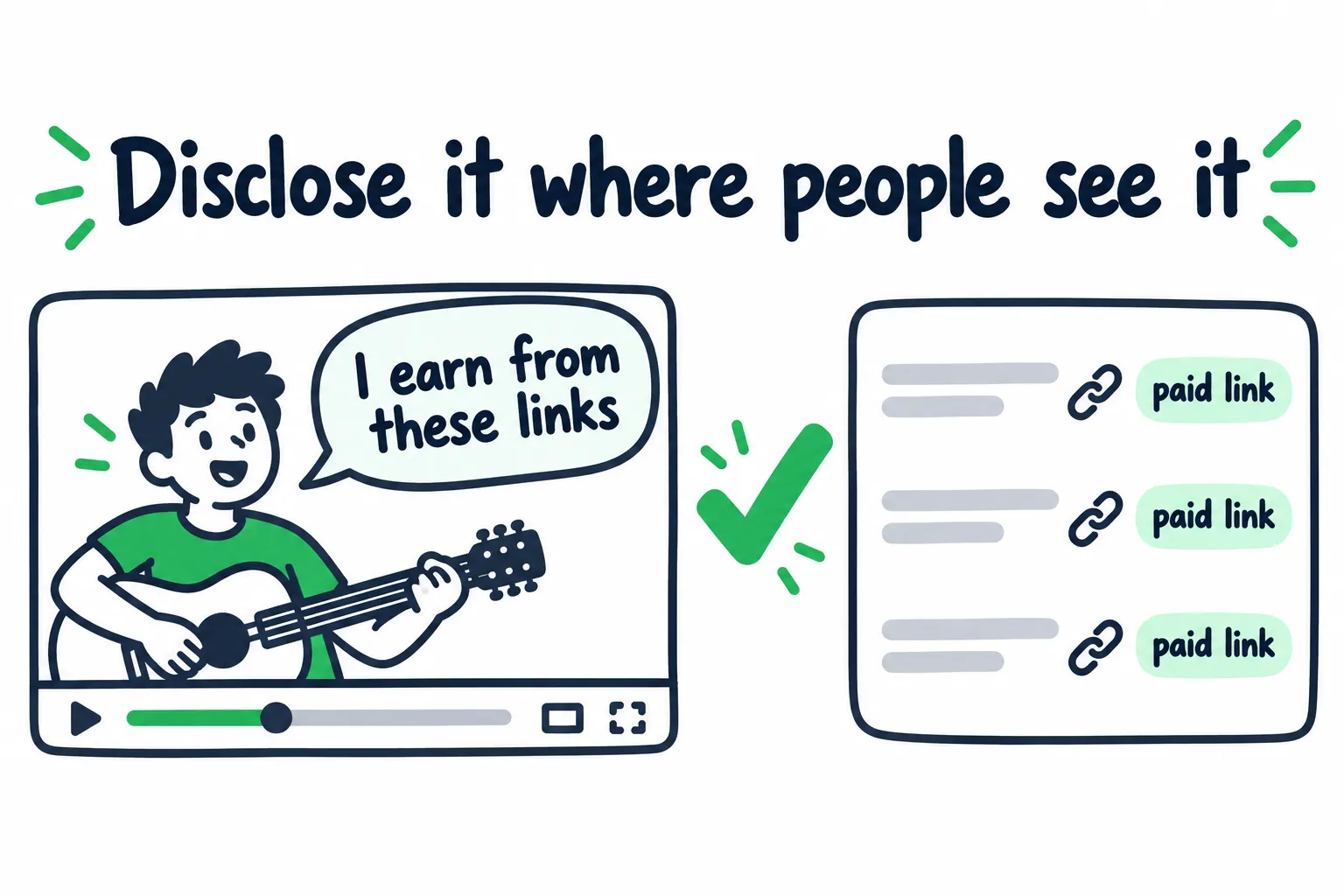
Say it in the video, and label each link where it appears.
From the FTC’s endorsement FAQ:
- “Paid link” right next to the link should be an adequate disclosure.
- “Affiliate link” on its own may not be enough. Viewers might not understand that it means you get paid.
- On YouTube, disclose in the video and in the description near the links. A description alone is easy to miss.
Amazon also requires its own line wherever you use its links: “As an Amazon Associate I earn from qualifying purchases” (Amazon).
One habit worth copying comes from r/AudioProductionDeals. Its deal posts list stores where they earn nothing next to their affiliate links, so readers can pick the best price. Pair that with a plain line like “I earn from these links” next to the links, not at the bottom of the post.
FAQ: Music Affiliate Programs
What is the highest paying music affiliate program?
By percentage, Pianoforall’s 60% and Soundstripe’s 40% are among the highest. By money, it depends on your audience. A gear channel can earn more from 3% on expensive instruments than from 60% on a course nobody in its audience wants.
Do I need a big audience to join a music affiliate program?
Not always. Native Instruments has no channel size requirement. Thomann wants 5,000 followers or 500 daily site visits, and Amazon reviews you only after your first 3 sales.
Can I put affiliate links in my YouTube descriptions?
Yes, but disclose them in the video too. The FTC says a disclosure only in the description is easy to miss.
Label each link “paid link” and say it out loud when you recommend the product.
Is Amazon still worth it for music gear?
It can be, if your viewers buy soon after watching. Amazon pays 3% on musical instruments, and its 24-hour window only covers items added to the cart in that time.
If your audience researches for weeks before buying, a program with a 30-day cookie, like Reverb’s in the US, may earn more from the same video.
Do music affiliate programs work outside the US?
Many do. Thomann is built for Europe, and Splice accepts affiliates worldwide. Amazon pays per country store, but US members can turn on OneLink to earn when foreign viewers buy on their local Amazon.
Reverb’s program is for the US, so check where most of your audience lives before you pick.